Introduction
Can an experience be designed to remove the societal and personal pressure attributed to diet track whilst keeping the positive health effect?
This case study explores a speculative diet tracking app that decenters the number of calories a person consumes and instead focuses on the effects of diet and exercise on the user’s physical and mental state.
The goal is to create an embodied experience in logging meals that forces users to evaluate the way they actually feel rather than allowing numbers to project feelings onto them.
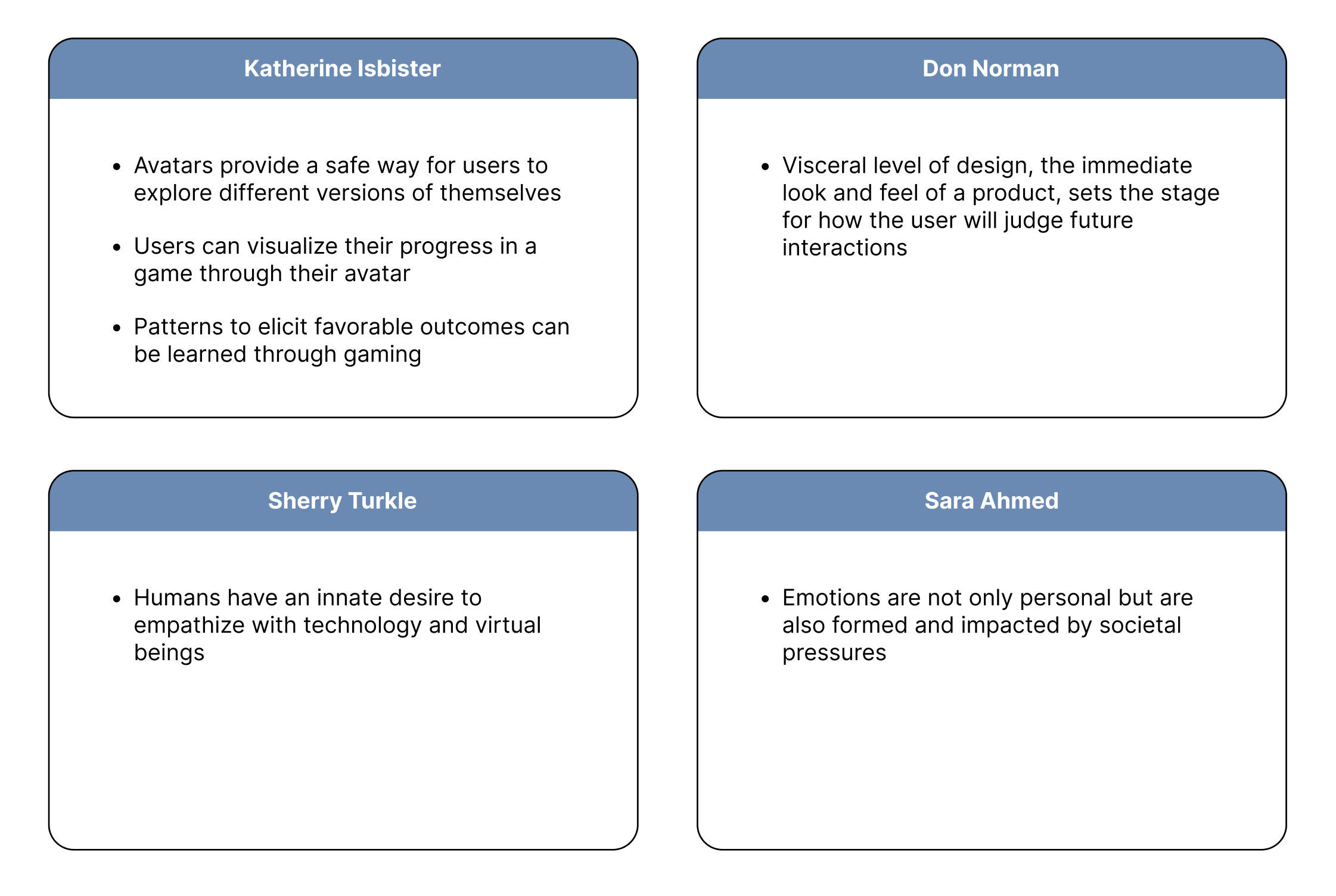
Theorists Behind the Design
Initial User Interviews
“I feel like I’m in an video game and I’m automatically losing”, noted one user on the feeling of opening traditional diet tracking apps
User interviews were conducted to get a sense of users’ personal emotional journeys using diet tracking apps and to better understand how the tracking process caused or exacerbated negative emotions.
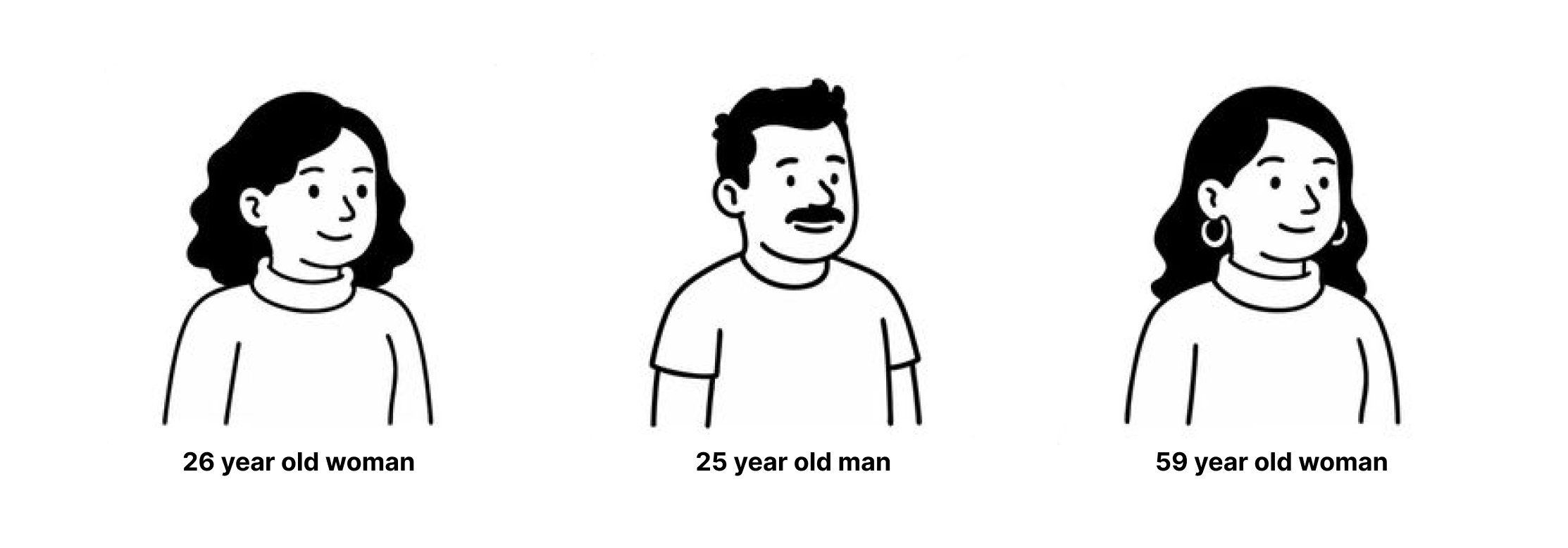
Users displayed feelings of anticipation and vulnerability while opening tracking apps from the fear of seeing missed goals and feeling judged when looking at the breakdown of their calories. They noted that while they know that even if they were consciously tracking for their overall health, they still subconsciously tied their goals to their weight and felt like they were not on track if they weren’t seeing quantifiable changes in their numbers.
The tracking turns into an exam and the numbers start to feel like they are being graded.
One user gave their partner control of their tracking app and scale to monitor progress for them, taking the pressure off of the user by introducing a mediator who could shield them from any unwanted effects from seeing the numbers themselves. This reveals a gap in what is available to consumers right now in diet tracking and what is actually desired. This also demonstrates the lack of a. dependency that users have on seeing numbers to be able to continue to progress towards their goal.
Prototyping
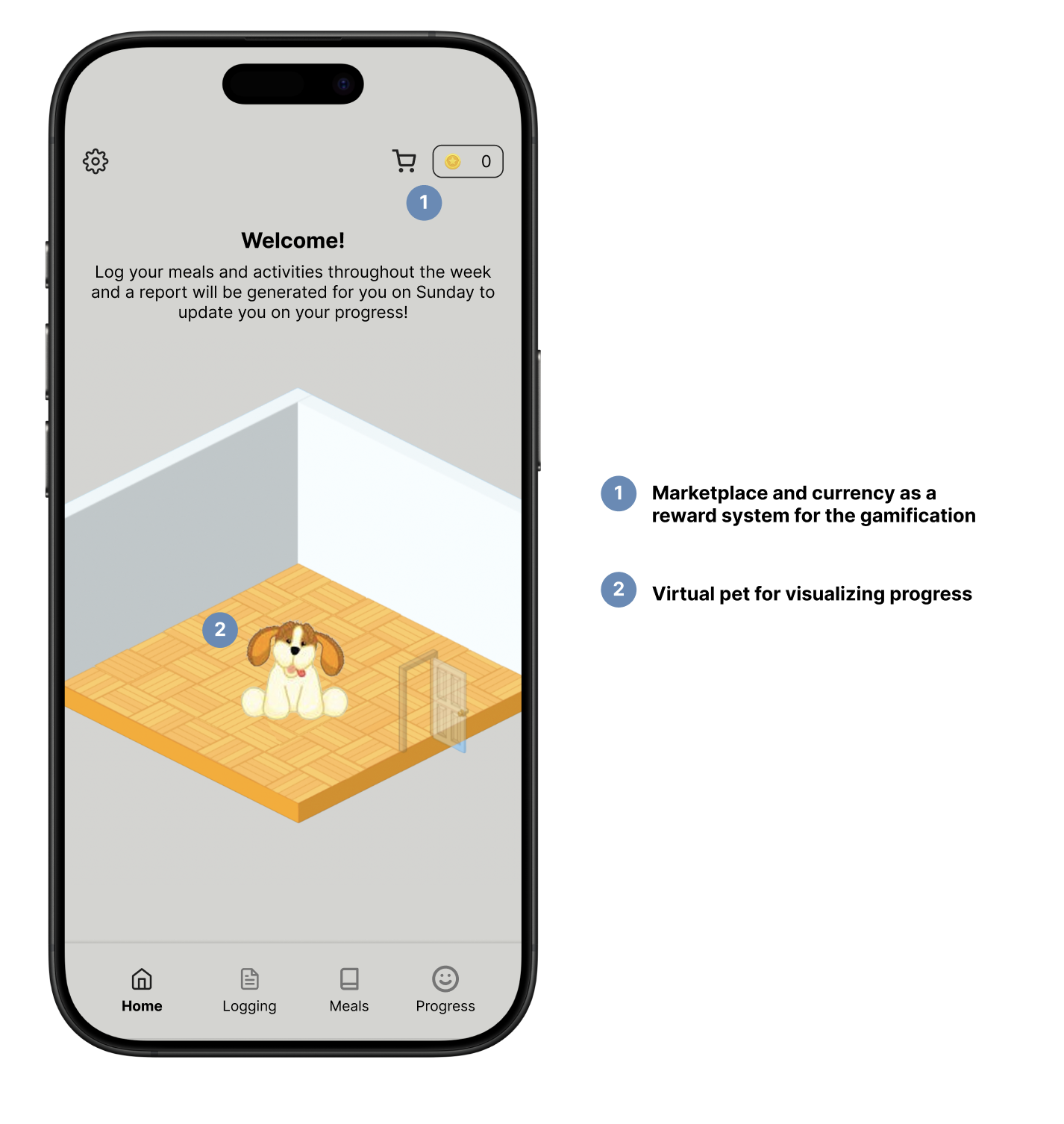
The prototype shows a simple, minimalist design to promote a calm environment. The isometric game, complete with the user’s virtual pet situated in its home, sparks nostalgia in the user, feeling reminiscent of earlier simulation games like Nintendogz or Tamagotchi. The nostalgia contributes to the immediate visceral reaction of familiarity and comfort.
The marketplace and currency serve as a tangible reward system within the game. This design is familiar and understandable for users to recognize there is worth attached to the coins and an ability to progress in the game.
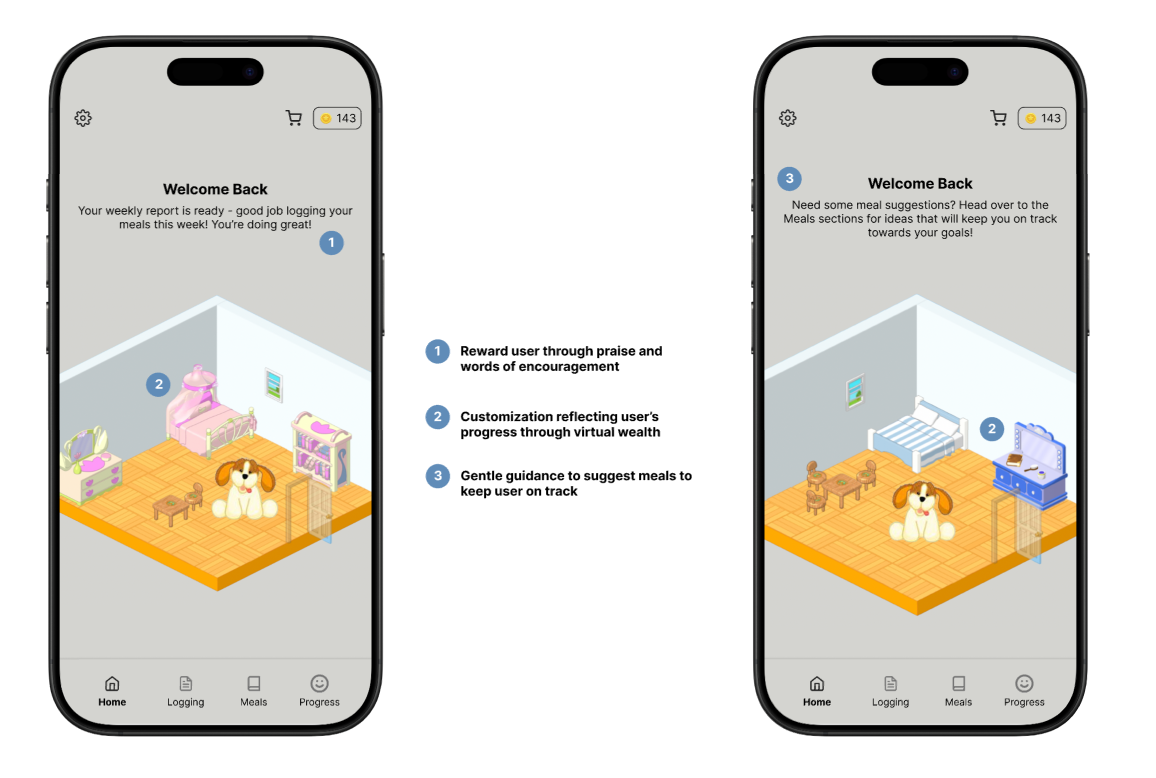
The user is able to customize their virtual pet’s home to provide a visual representation of their progress in the game. The customization allows the user to actively engage with the game, creating an attachment through creative expression. Every room can look different making it easier for the user to project themselves on their pet and develop empathy towards the being.
Introducing Friction
Intentional friction is introduced before accessing the user’s raw data by prompting the user to confirm that they would rather see their numbers rather than their weekly progress report.
This seeks to create discomfort in the user, who is forced to think about what is motivating them and must reflect on whether they want to use them as supplemental information or if they want to create a story around them.
The moment of friction gives pause to sever the tie between the number seen on the scale and the way a person feels about themselves. The discomfort is aimed to confront the user with the fact that they do put importance on something that doesn’t tell the whole story. In actively choosing not to read their progress report, the user has to sit (even if briefly) with the notion that they prioritized a number over qualitative feedback on the state of their health.
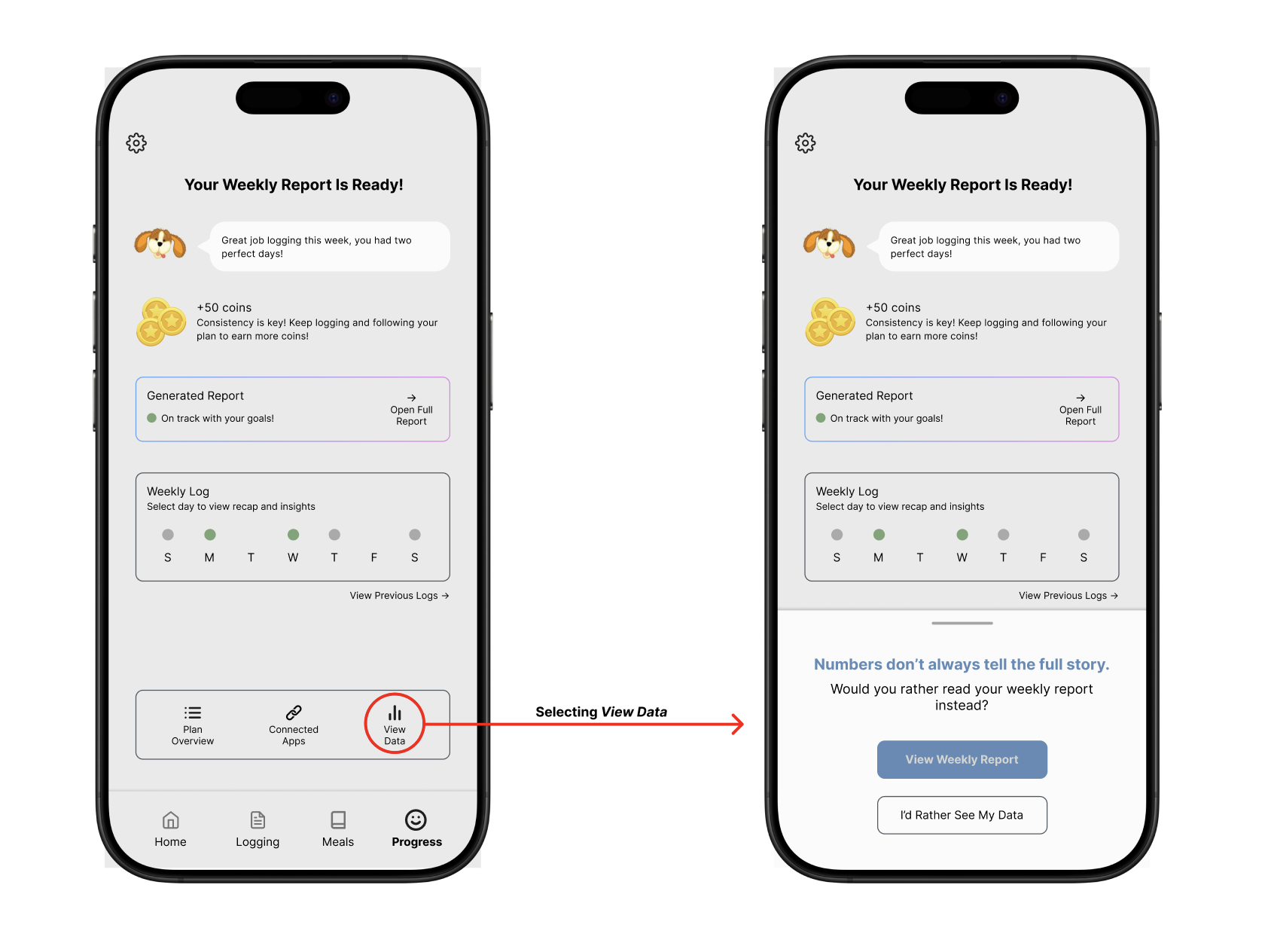
Testing with users revealed a mixed reaction, with the majority of users feeling “confronted in a health way” with introspective thoughts on what their intention is with requesting the data. One user reported feeling frustrated with the friction entirely, upset by the allusion that the app knew what was better for them. This may have been a problem with the additional friction regardless of the context as the user complained “I know what I want, so why won’t it just give it to me”, a common complaint with friction in any setting.
Conclusion
There is a gap in what is currently offered in diet tracking apps and what would provide an emotionally-sensitive experience. This case study shows that it is possible to maintain control over ones diet while removing the negative pressure attributed to numbers.
This project invites users to imagine a future where their health is truly prioritized and there is no external negative pressure from societal pressures making its way into their tracking process. They can imagine engaging in a positive reward loop as a replacement for the negative reinforcement that is currently used.
Citations
Isbister, Katherine. How Games Move Us: Emotion By Design. MIT Press, 2016.
Norman, Donald A. Emotional Design: Why We Love (or Hate) Everyday Things. Basic Books, 2004.
Turkle, Sherry. Alone Together: Why We Expect More From Technology and Less From Each Other. Basic Books, 2012.
Ahmed, Sara. The Cultural Politics of Emotion. 2nd ed., Edinburgh University Press, 2014.