If You Answered Yes, NYC We Have Something for You!
The Department of Consumer and Worker Protection’s core function is twofold: it enforces consumer protection and licensing laws to shield New Yorkers from predatory business practices, while also enforcing critical worker protection standards like paid safe and sick leave, fair workweek laws for certain sectors, and minimum pay rules for delivery workers. Our task at hand when working with this organization was to optimize the complaint process. In doing so, we uncovered notable usability issues that potentially hinder the experience of filing a complaint online.
Complainer’s Struggles: Identified
- Within the “Worker Rights” webpage, workers often struggled to navigate through to the “File Complaint” subpage.
- Within that “File Complaint” subpage, workers are largely confused by the list of laws displayed within the “File Complaint Online” section.
- Workers do not feel confident that their workplace issues would be remedied by the NYC DCWP.
Methodology Used to Carefully Address Usability Issues
Step 1: Client-Meeting Kickoff
Addressing key discussion points, such as:
- Confirmation of data supporting the claim of user confusion and erroneous submissions.
- Whether to focus on investigating the confusion in the current setup or focusing on designing the new combined experience.
- Flexibility on adopting design-forward solutions that might not necessitate complex, automatic detection programming.
- Clarification on the target audience and constraints for participant recruitment.
- Logistics for submitting test reports within the live portal.
Step 2: Finding Eager to Participate “Fake” Complainers
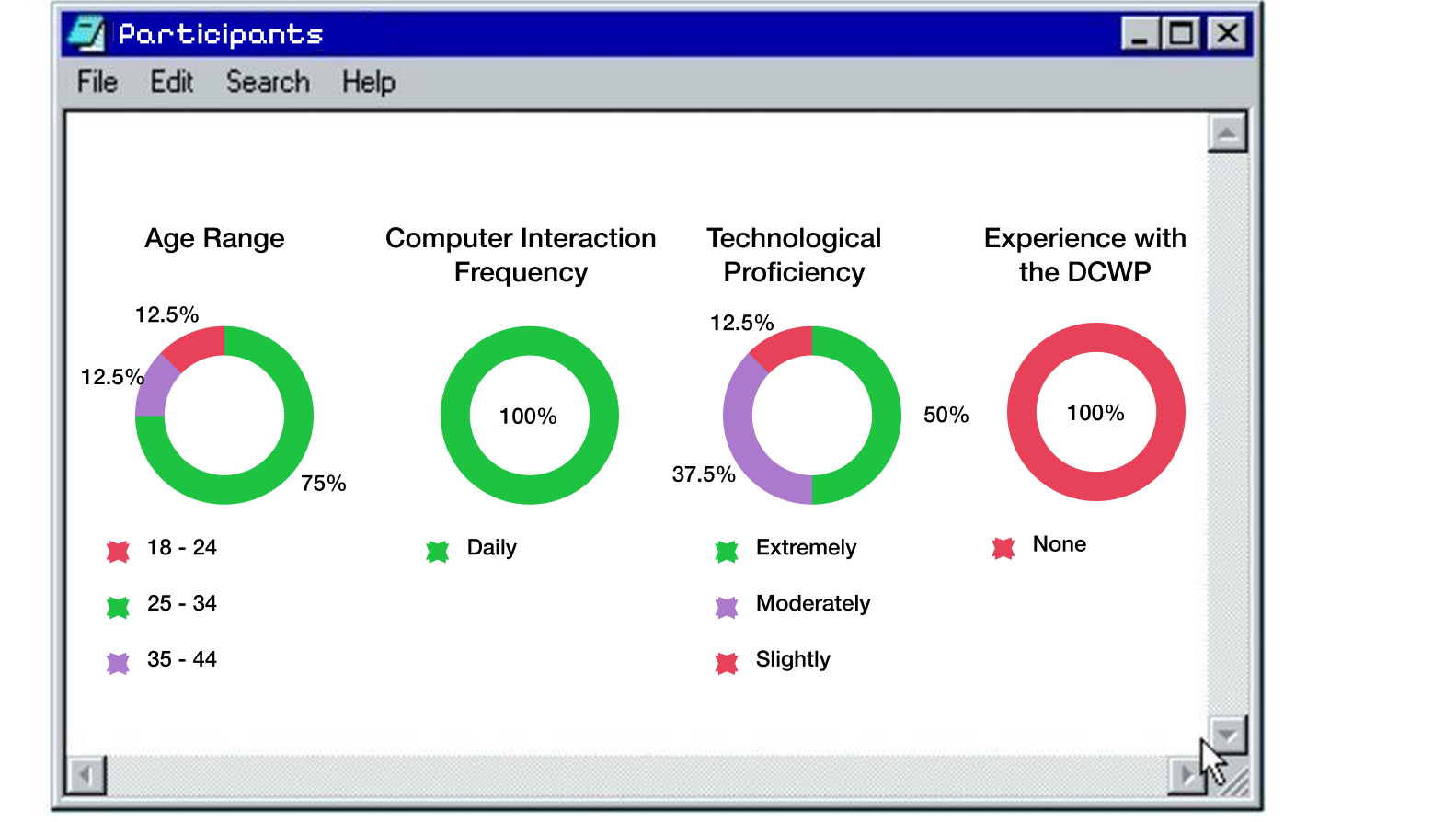
We wanted to ensure we had the proper participant pool so that there was little no room for error, with restrictions being must be 18+ and located in NYC. Below is a graphic of our participants and some information about them. We used private panels to find randomly selected users who fit the criteria and prepared to do moderated testing.
Step 3: Lets Get Moderated (Testing)
All four of us conducted eight moderated user tests in order to see for ourselves in real time the pain points of the website (in regard to complaint pathway). We were able to ask questions and hear user feedback immediately, overall making our project “come to life”.
Personal Contribution of Design/Research Responsibilities
My personal contribution for this report as a whole was conducted 2/8 moderated user testing sessions, creating Recommendation 3 (Improving visibility of Complaint Next Steps), and creating the executive summary. Based on looking at all of our usability testing notes, I was able to configure a method that would be most helpful for those finding “Complaint Next Steps” by putting it within a more visible place on the website.
Defining Usability Tasks for DCWP Stakeholders (Workers and Consumers)
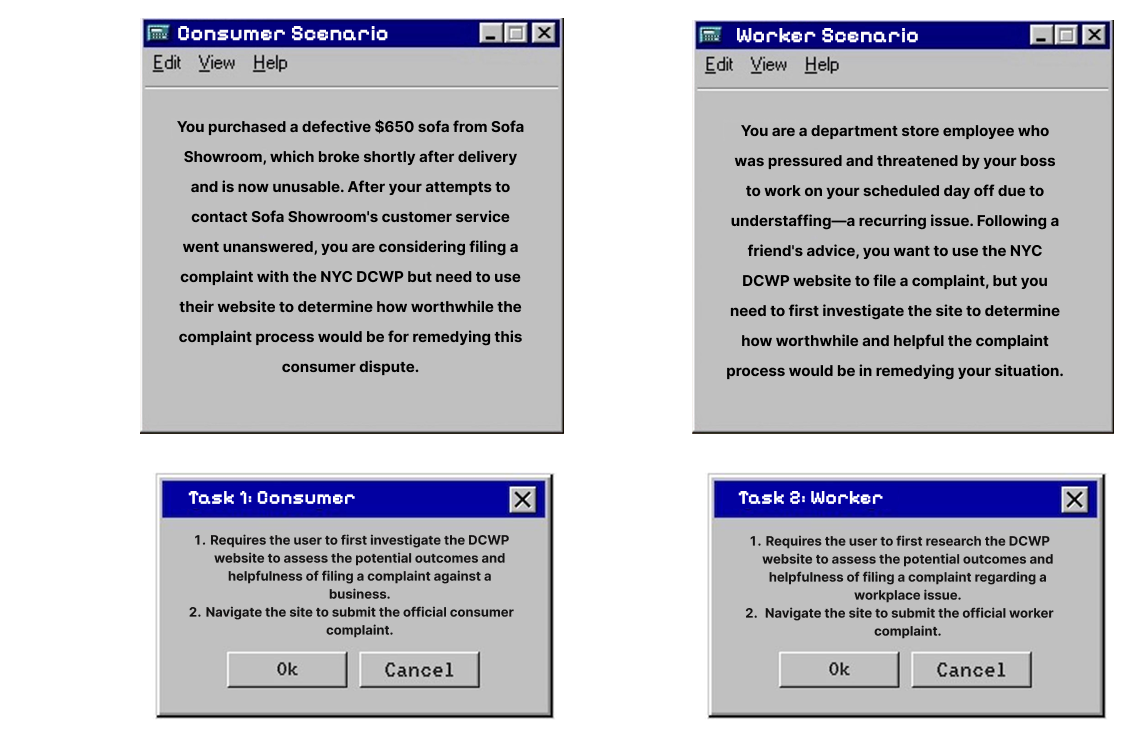
Users were separated into two distinct groups: Consumers and Workers. Both users were given different scenarios in regards to their role, and asked to fill out two questions each.
Findings from the Complainers
What we discovered from moderated/unmoderated user testing.
- Primary navigation was the first step for 75% of participants, however 0% of the workplace users located the complaint link in the tertiary navigation. 100% workplace users hesitated when presented with a decision point.
- Participants expressed confusion when tasked with finding and filling a worker’s complaint form
- When people looked for the next steps all users struggled to find the exact location.
Fake-Complaint-Driven Recommendations
Recommendation 1:
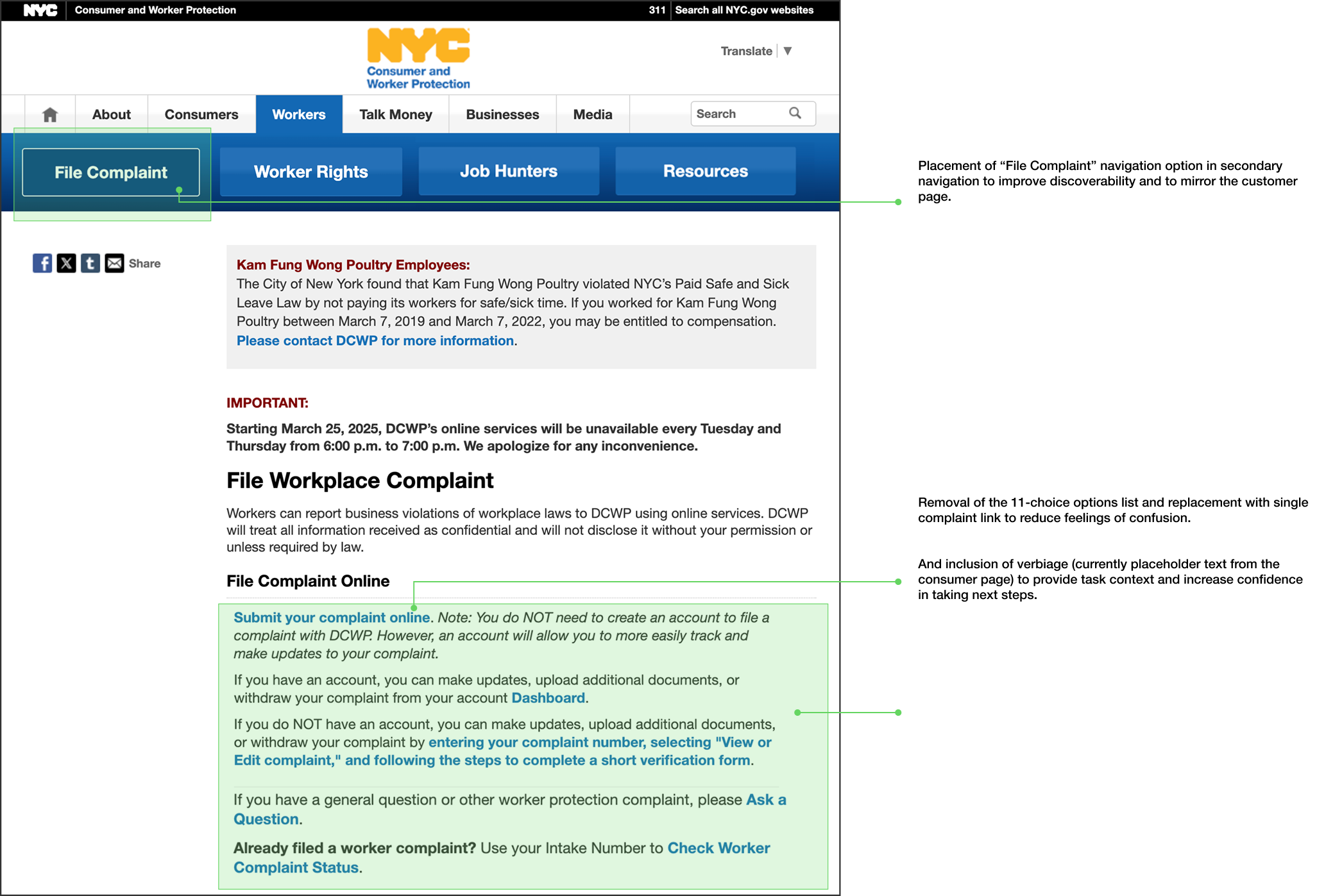
Improving discoverability of the Workplace Complaint Form through addition of a secondary navigation link and a single inline text link.
While 75% of users successfully used the global navigation to search for both complaint types, the existing structure led to a 60-second longer, more error-prone journey for workers. Consumers easily found the dedicated “File Complaint” tab, resulting in a 90% ease rating and a consistent four-click flow. Conversely, workers were routed to a general “Workers Rights” page and struggled to locate the submission link within the sidebar, leading to a 55% ease rating and unique, error-filled paths. We recommend improving the discoverability of the workplace portal by adding a prominent “File Complaint” tab to the “Workers” page secondary navigation and replacing the ambiguous business violation links with a single, clear “Submit your complaint online” link, mirroring the efficient consumer flow.
Recommendation 2:
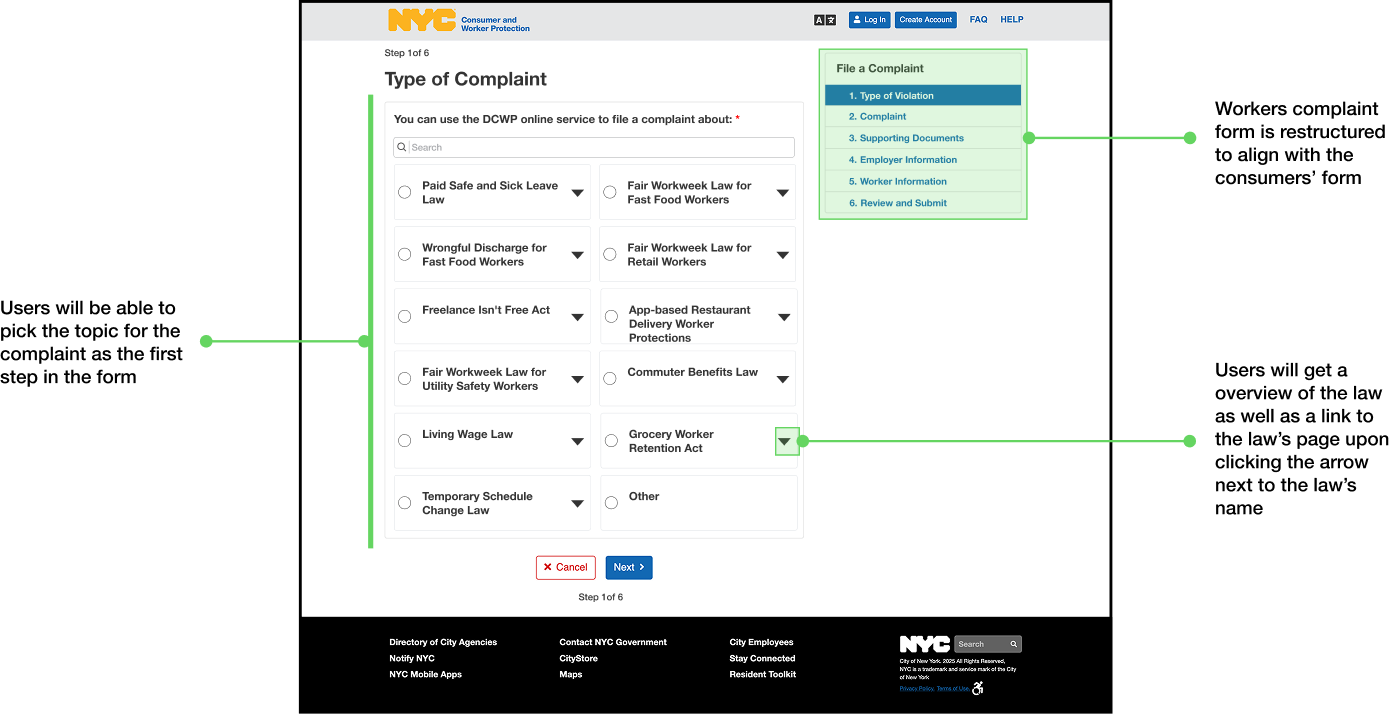
Merging all workers’ forms into one simple, easy-to-access “Workers’ Complaint Form.”
A proposition merging all specific business violation portals into a single, unified workplace complaint portal, similar to the highly successful consumer portal structure. This consolidated portal would reduce the barrier to entry and increase user confidence by immediately bringing users into the form. Within this portal, users would select the violation from a list, each supported by an expandable, descriptive dropdown offering brief context and a link to the detailed “Worker Rights” subpage (opening in a new tab), thus simplifying the selection process while still enabling the DCWP system to properly sort and process complaints by violation type.
Recommendation 3:
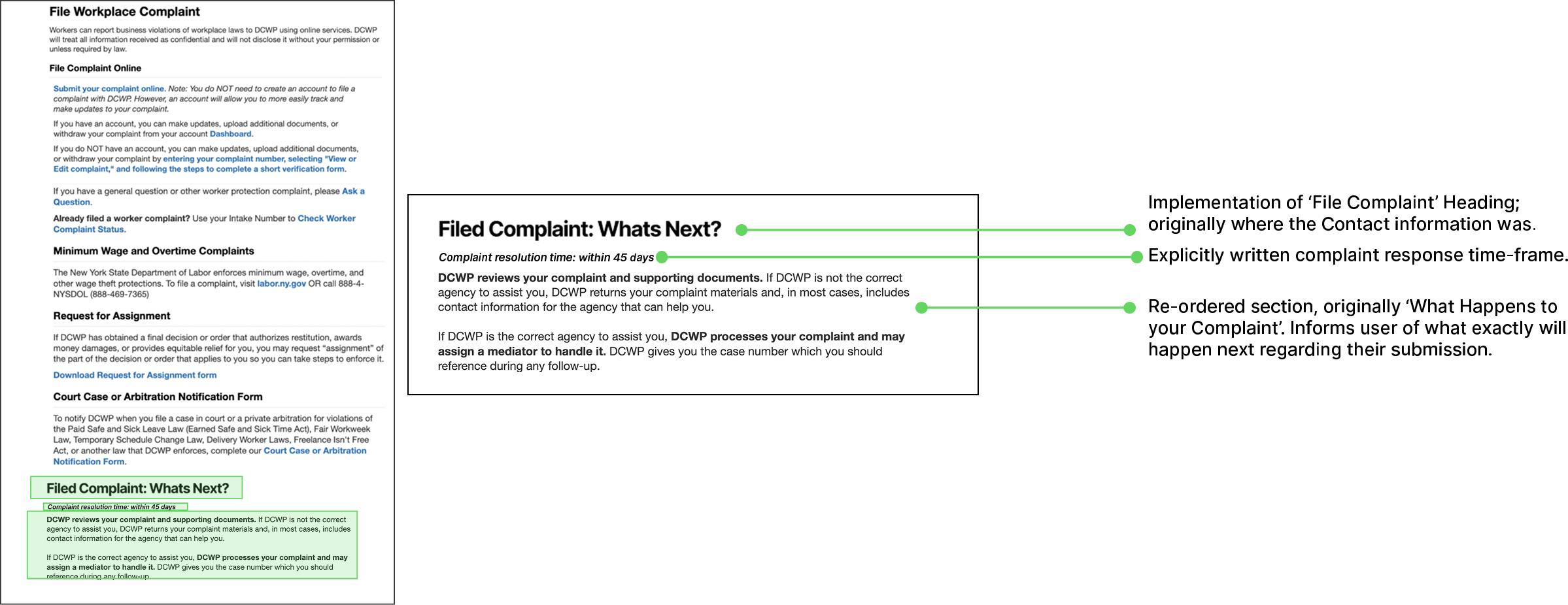
Improving visibility of Next Steps post complaint submission.
A proposition to add a dedicated “Filed Complaint: What’s Next?” section to the “Worker Rights”: “File Complaint” subpage. This section should clearly and concisely outline the next steps in the workplace complaint process, including an explicit time-frame (e.g., referencing the existing 45-day guideline mentioned in the consumer section). This change is intended to bolster worker confidence and provide efficient access to critical information, mirroring the success consumers had in locating outcome details.
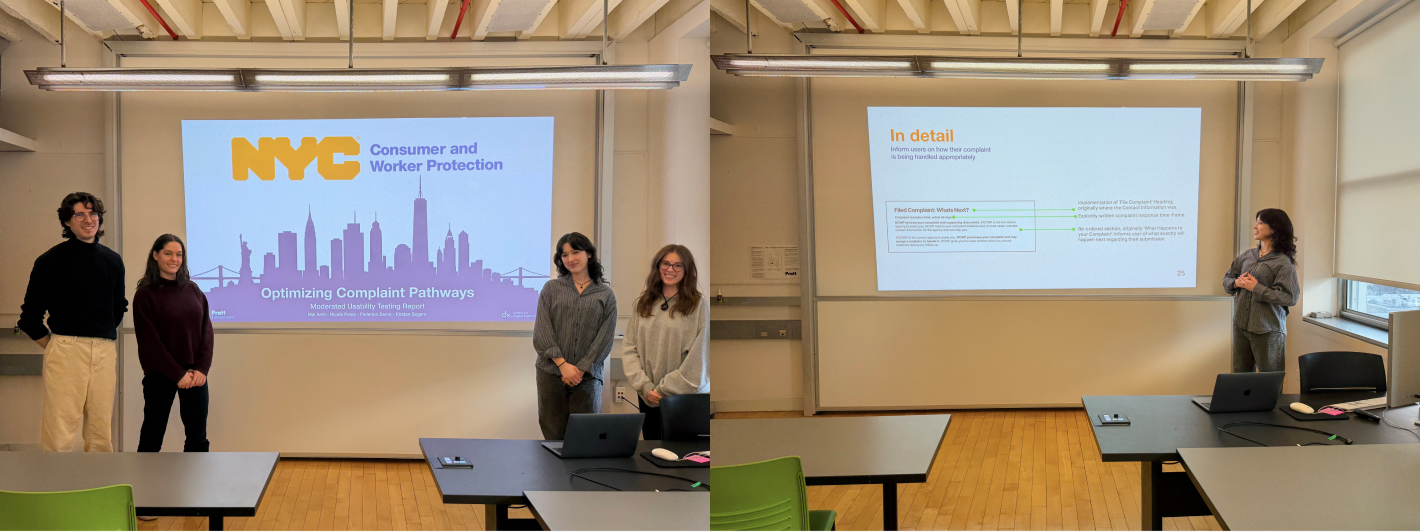
The Faces Behind the Magic:
Want the Full Scope?
Report Link:
https://www.figma.com/design/lT5KGyVKWhTdqddIgl07JX/DCWP-Report?node-id=340-57&t=bNXQSQnJeFKjlRpH-1