INTRODUCTION
Existing digital wellbeing tools tend to reduce stress to something measurable and optimizable, overlooking its embodied, emotional, and temporal nature. Research on rituals also shows how repeated, intentional practices shape attention, create meaning, and confer a perception of continuity in everyday life.
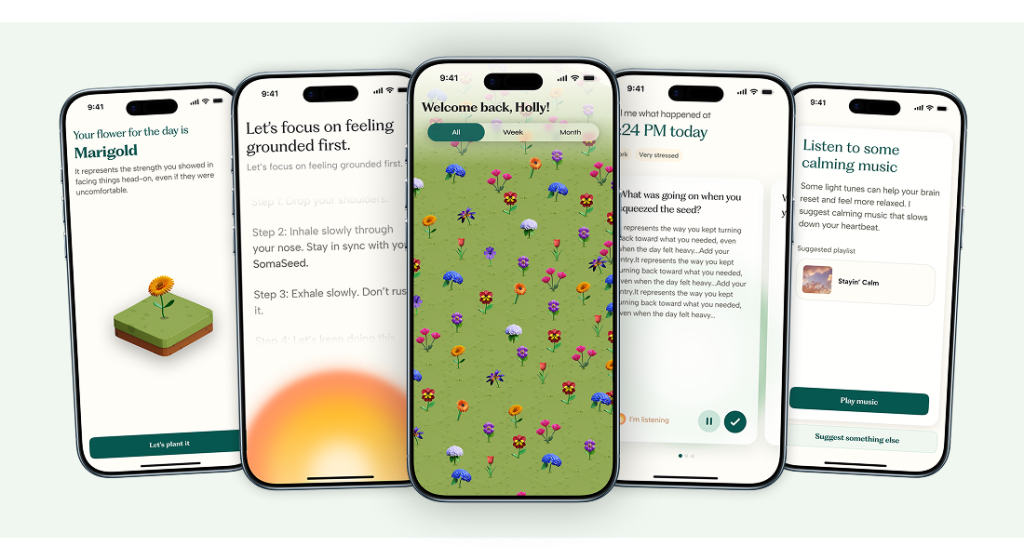
As part of the UX Design for AI class at Pratt, we proposed Soma, a tangible interaction that encourages users to reflect on how they cope with stress, favoring preparation over suppression for overwhelming moments. Soma is a connected system of a physical ball-like object and a mobile app that helps users through moments of overwhelm and encourages them to understand how they can better cope with such moments in the future.
PROBLEM STATEMENT
Over 75% Americans reported experiencing physical or emotional symptoms of stress, but existing digital tools metricize it, making it more overwhelming.
Most people aren’t short on data about their stress; rather, they’re short on support that actually lands in the moment. Existing literature suggests people reach for something grounding, sensory, and simple when they’re overwhelmed.
That gap between how stress is experienced and how it’s currently designed for became the starting point for this project. So the question we asked ourselves was:
How might we utilize AI to create sensory experiences that help people manage stress in moments of overwhelm?
INTRODUCING…
Soma: A connected wellness ecosystem that helps people grow through their stress
PRIMARY RESEARCH
We conducted a WHO5 / PANAS mapping survey to understand how well people cope with their stress.
This helped us find prospective interviewees who could tell us about their stress triggers, coping mechanisms, and what kind of sensory experiences help them most.

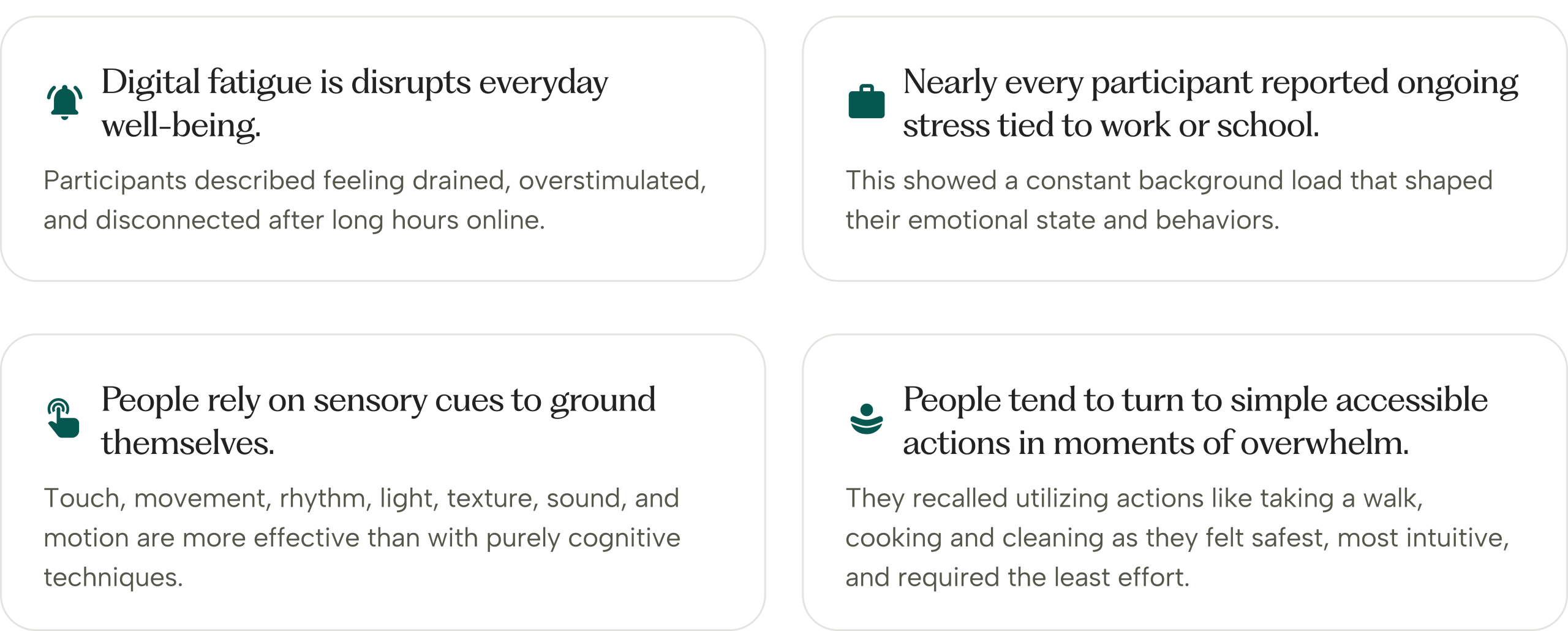
Through our 7 interviews, we found 4 key insights:
INTERACTIVE PERSONA
We distilled our research into an interactive persona, called Holly.
Holly is a custom GPT trained on our research findings and interview transcripts. Creating an interactive prototype instilled a feeling of user-first design as it became our source of truth when thinking of design directions and validating potential solutions.
You can also interact with her here: https://chatgpt.com/g/g-68ec4e6d69b881919dd2883c5fc3f2cb-holly-the-intuitive-reactor

DESIGNING PHYSICAL SOLUTIONS
We chose to work with physical objects in conjunction with digital products to create a more holistic grounding experience in moments of stress.
People usually look for sensory, physical ways to feel immediate grounding. The need to make these emotionally simple led to a lightweight object users can reach for when stress spikes.
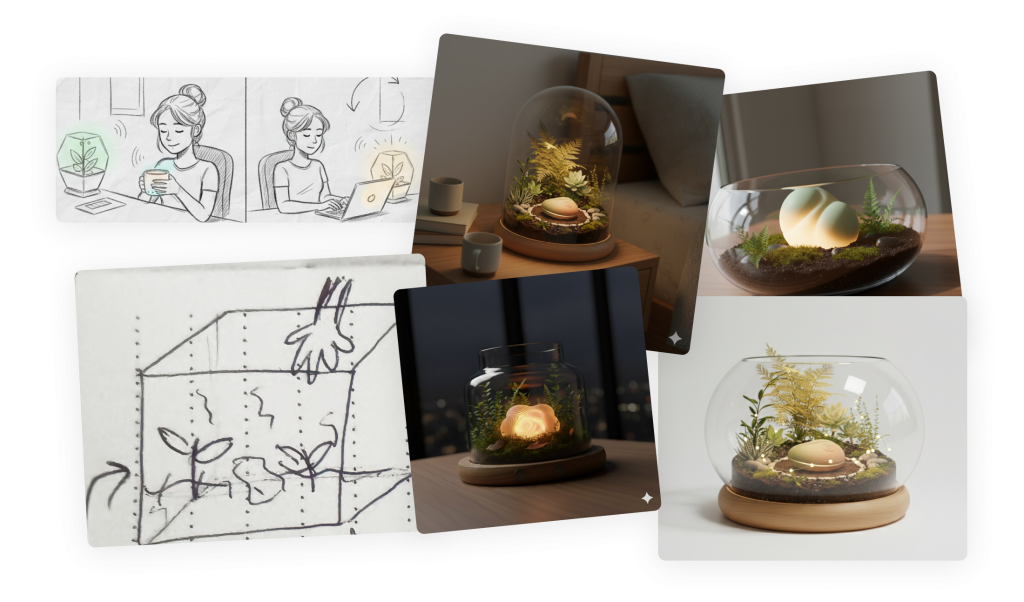
We used GenAI (Gemini) to come up with early concepts of all the physical elements of the solution. This lets us quickly iterate on various materials, shapes and behaviors.

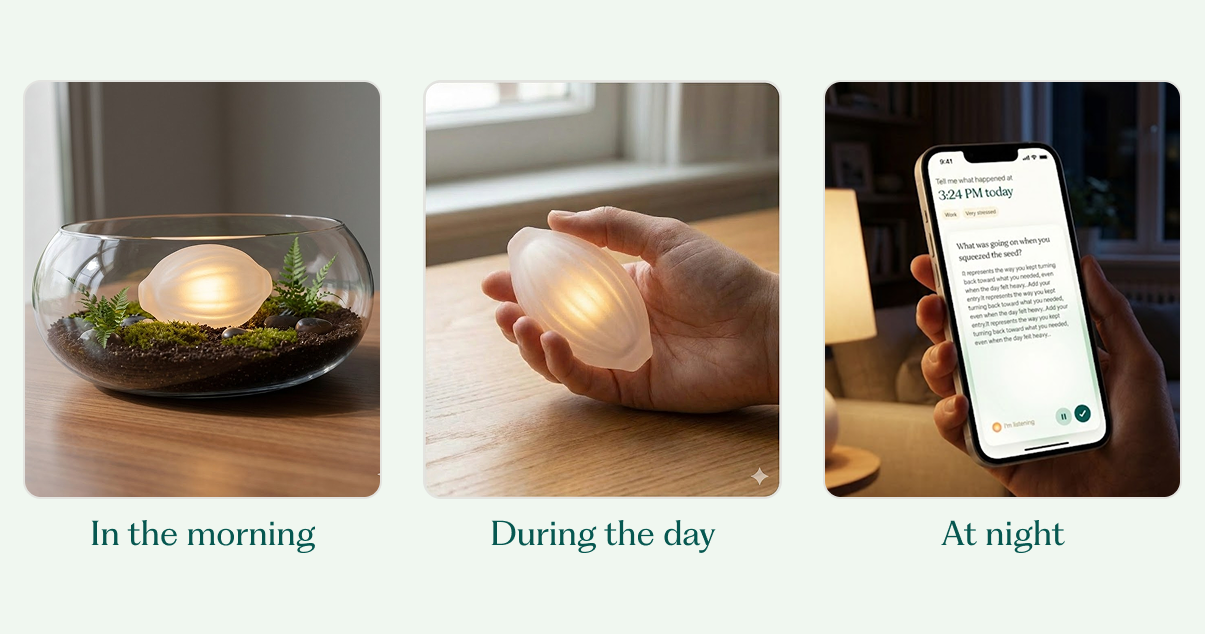
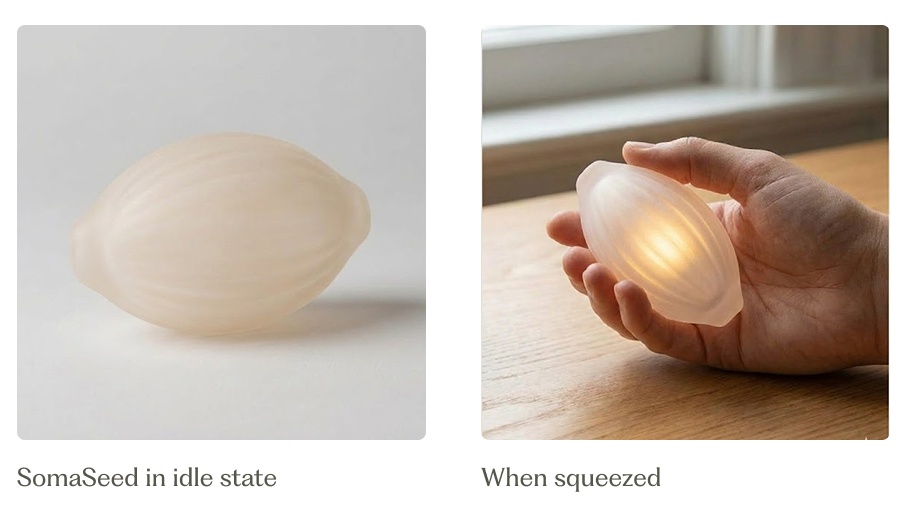
This culminated as the SomaSeed: a tactile, squeezable object that people can interact with for instant relief of physical stress.
- On squeezing, the SomaSeed is activated and emits calming glows.
- It is designed to be equipped with sensors that understand your body’s signals of stress (breathing rate, heart rate, grip pressure).
- AI translates these signals into pulsating glows that guide the user through breathing exercises for immediate sensory grounding.
We came up with the idea of a resting place for the physical object to build on the ritual of returning home at the end of the day. The Terarrium acts as that place where you “plant” your stressful moments at the end of a tough day.
CREATING THE SOMA APP
Based on our research, we built an app that provides suggestions to cope with moments of stress and identify patterns without judgment.
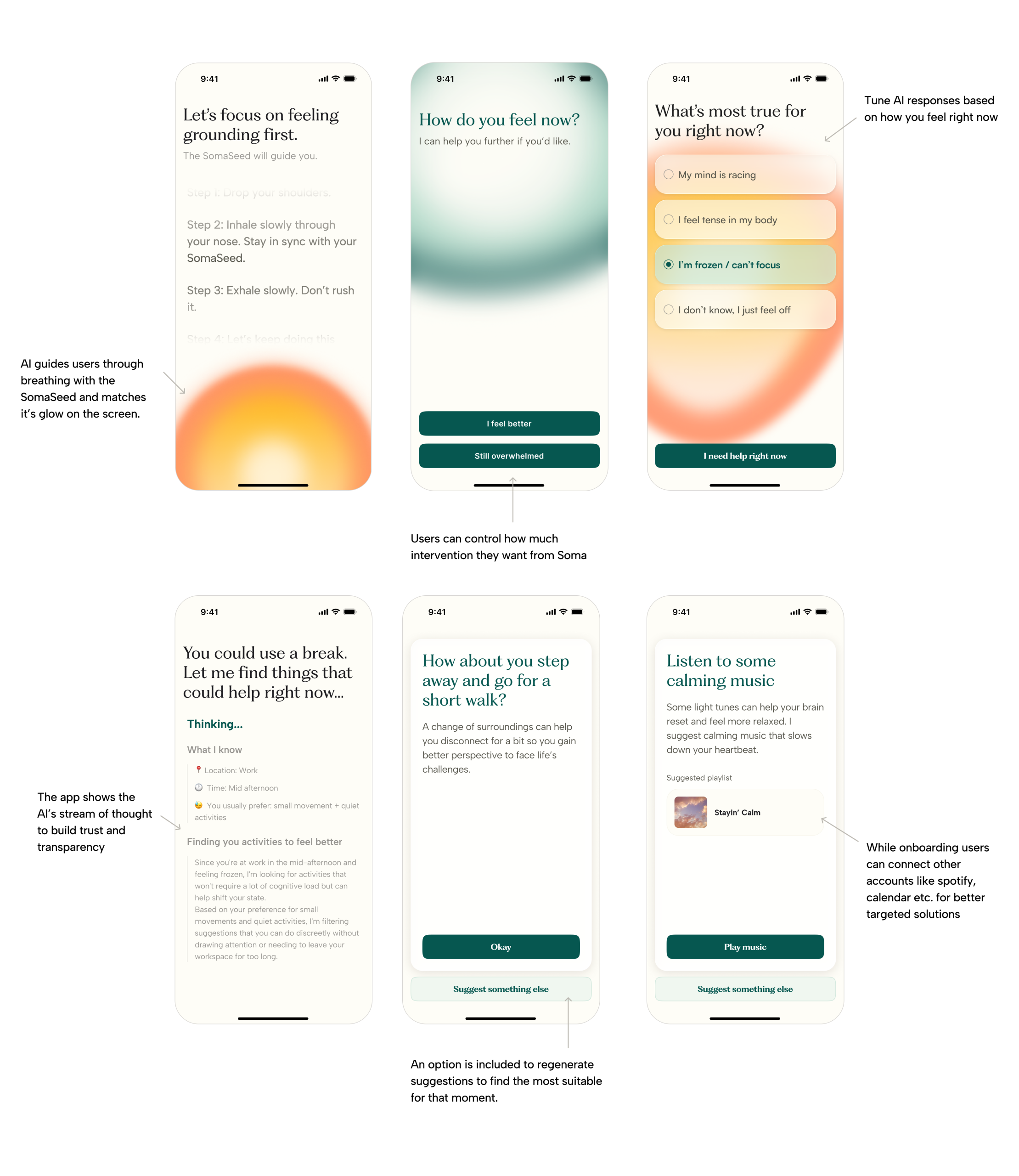
PART 1: When stress arises during the day, and the user squeezes the SomaSeed
The app should surface only what’s needed: a short calming sequence and suggested actions to find peace in the moment of stress, while logging each squeeze to build patterns over time.
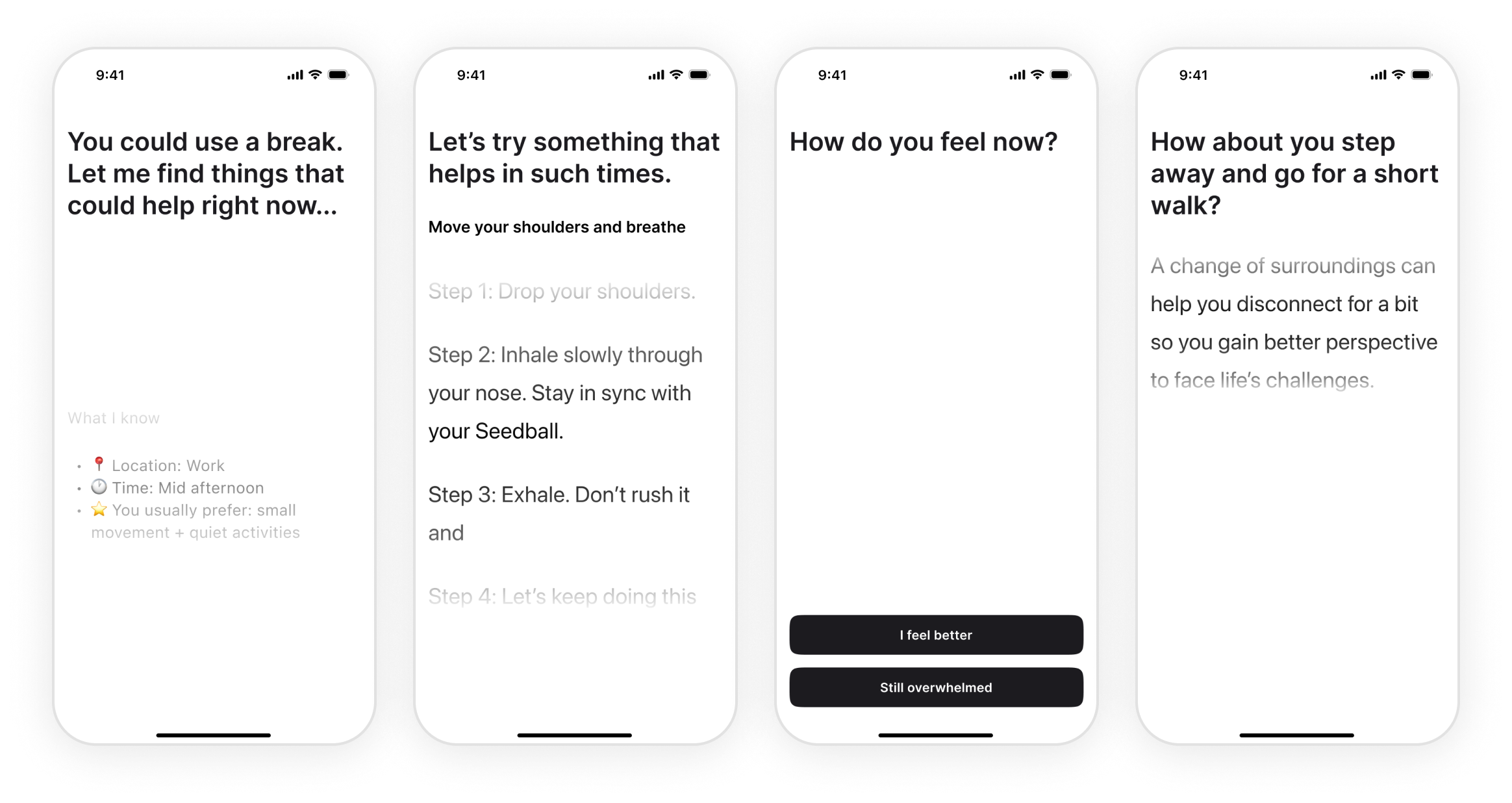
Let’s see how this flow finally works when the user squeezes the SomaSeed in a moment of stress.
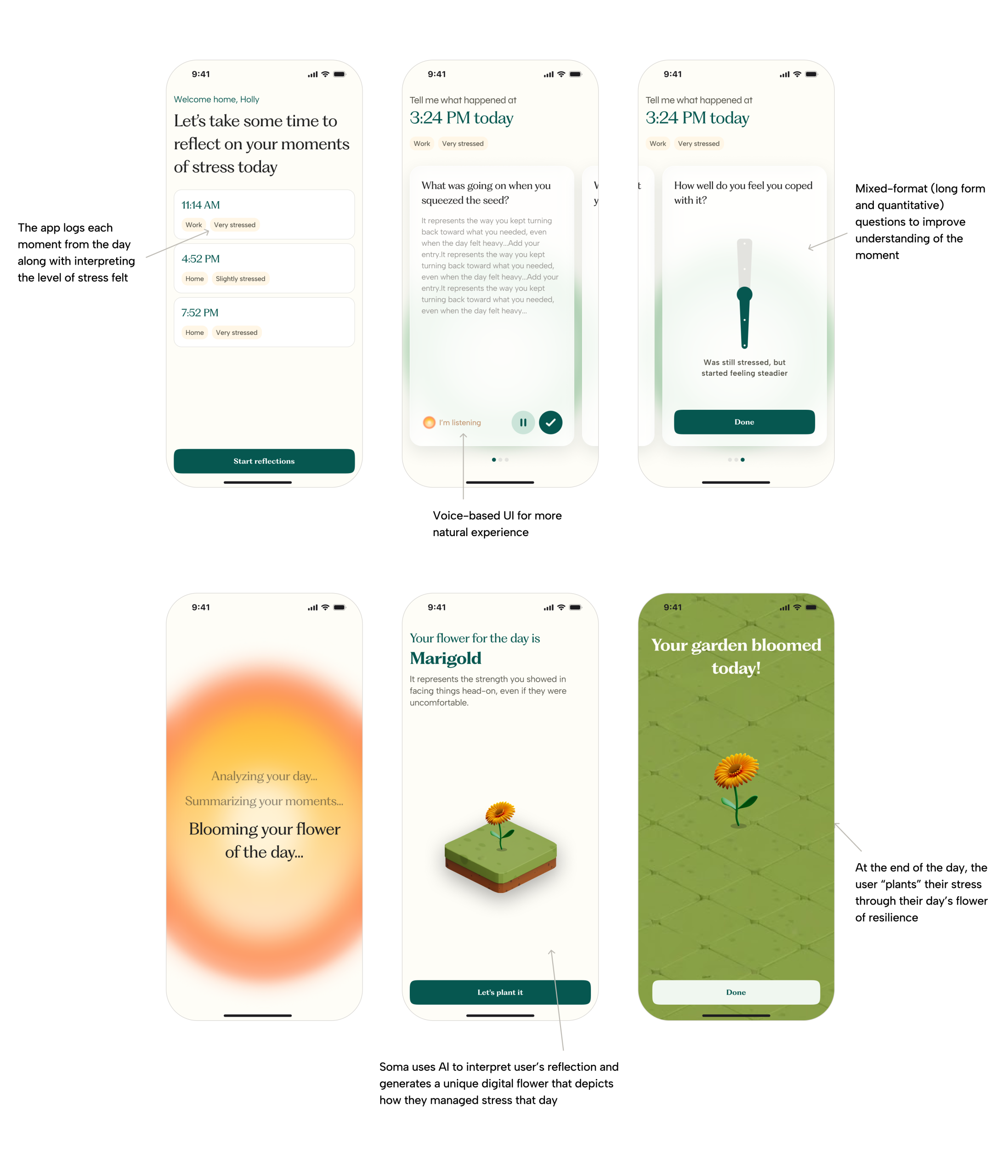
PART 2: At the end of the day, when the SomaSeed is returned to the terrarium
The app should gently nudge users to reflect on their day and think about how they coped with its stresses.
This is aimed at creating a daily ritual of staying in touch with emotions and facing them head-on rather than sweeping them under the rug

Let’s see how this flow guides mindful reflection on moments of stress and coping throughout the day.
PART 3: Bringing all moments of coping together to uncover stronger patterns
To further build on the emotional language of the system, we introduced a garden view of all the moments you conquer day-to-day.
Different flowers to reflect different stress patterns in a way that feels intuitive rather than clinical.
We built a Lo-Fi version of the garden using Figma Make as a way to demonstrate how it functions as a free canvas. This helped the team find alignment faster as there was a visual example of the concept in front of them.

Let’s see how the Garden manifested as a visualization of coping and reflection.

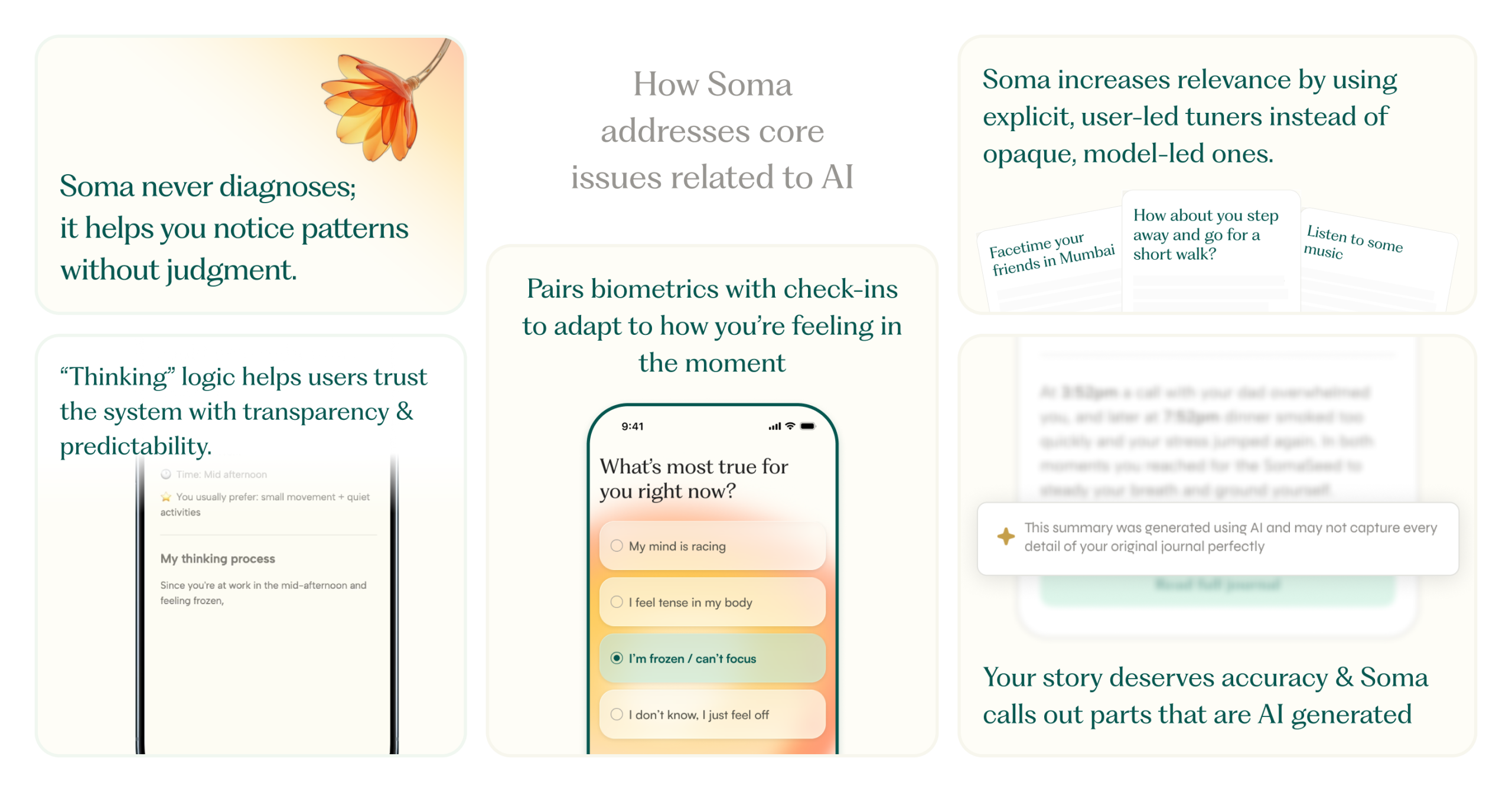
Bringing AI into Soma came with a responsibility to use it thoughtfully. We made transparency a core part of the experience and carefully identified the ethical challenges users might face—so we could solve for them upfront.
Soma was built because well-being isn’t a problem to solve. It’s a practice to cultivate.
One day, one breath, one ritual at a time