Introduction
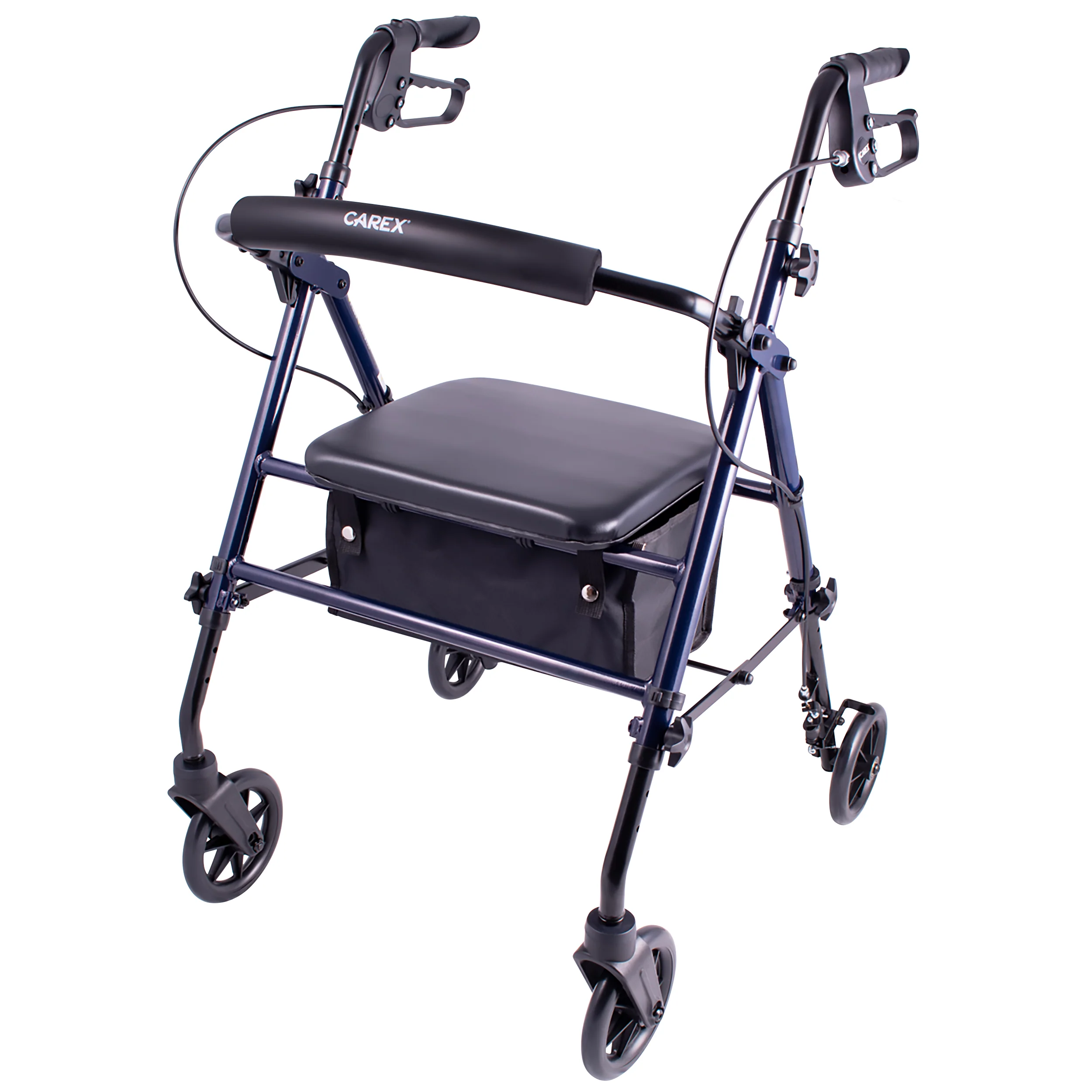
The assistive technology (AT) in the featured image is a mobility walker, specifically the Carex Step ‘n Rest® Rolling Walker. A mobility walker is a functional aid used to increase stability, improve balance, and reduce pressure on the legs, allowing individuals with both temporary and permanent conditions to walk safely and independently.
Overview
Mobility walkers are often framed as just medical devices, but the Carex Step ‘n Rest® Rolling Walker demonstrates how its design can support autonomy, personal confidence, and the removal of social and technical barriers that typically limit disabled individuals’ access. Designed primarily for older adults and people with mobility disabilities, this rolling walker integrates multiple features that address both social and technical barriers. Examining its handle mechanisms, seating affordance, and four-wheel movement through different disability models shows both its effectiveness and limitations as an accessible technology.
Handle Mechanisms
This particular model of walker was selected for analysis because of its standout features compared to other walkers and assistive technologies, with one of those features being the height-adjustable handles that double as brakes. From a medical model of understanding disability, these handles accommodate people with reduced grip strength, arthritis, or limited upper-body endurance by allowing them to distribute weight more evenly when walking. The hand brakes provide additional protection when it comes to speed control and stopping, reducing fall risk.
From a social model of disability, it’s admirable that the adjustable handles respond to human variation rather than expecting users to conform to a single body type. By allowing customization, the product reduces the limiting effects of environments that require longer walking without support. However, the press mechanism of the brake levers may still be a challenge for people with limited hand dexterity or tremors, suggesting that medical accessibility is not universal even within assistive products.
Using person-first language, this rolling walker’s design really supports the idea that a person is not defined by their medical and social barriers, by offering stability without requiring assistance from others, reinforcing independence and agency.
Seating Affordance
The “rest” part of Step ‘n Rest® is primarily shown through the built-in seat, which allows users to rest at any point in their movement. From both a medical and social perspective, the seat supports both physical endurance and emotional well-being. People who experience fatigue, chronic pain, or balance issues can participate longer in activities such as walking through a park or running errands.
The seat also reflects principles of universal design, benefiting not only people with injuries and mobility conditions but also pregnant people, older adults, or anyone who needs intermittent rest (situational disability). However, the seat’s height and firmness may not accommodate all bodies equally, particularly people with larger bodies or limited ability to transition between sitting and standing. This highlights how even universally designed products can still unintentionally exclude certain users, but discussions and critiques like this can inspire the creation of products and interfaces that can reach a closer definition of universal design.
Four Wheel Movement
Lastly, the Carex walker’s four-wheel design improves maneuverability and reduces the need to lift the device while walking. From the social model of disability, this feature addresses environmental barriers such as uneven sidewalks, long corridors, or crowded public spaces that can be physically difficult or unsafe for people with mobility disabilities.
At the same time, it’s important to mention that four-wheel movement introduces some trade-offs. Though four-wheel navigation increases speed and fluidity, the smooth movement may feel less stable for some users compared to two-wheel walkers, especially when walking indoors or on slopes. Mentioning the handles, seat, and wheels of the Carex walker are relevant to the designers of assistive technologies, because they have to carefully consider the points at which a product can fit “universal” needs and when different models should be produced to accommodate different needs.