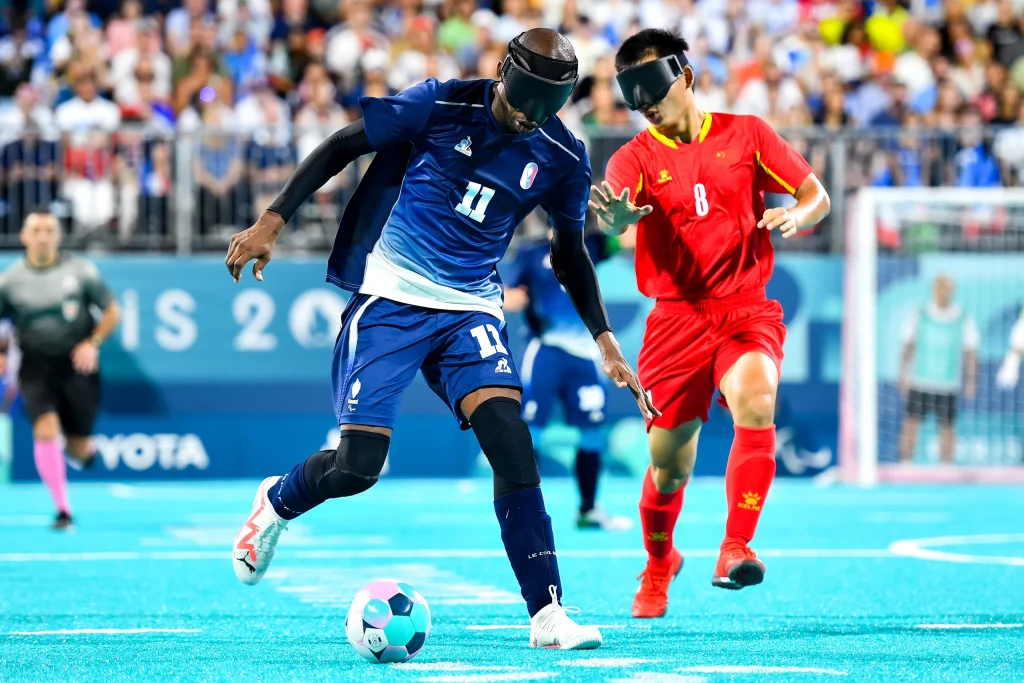

Figure 1. Blind soccer players using a sound-emitting ball in a match, wearing eyeshades for fairness.
A sound-emitting soccer balls is an assistive technology designed to support soccer players who are blind or have low vision. Every time the product comes into contact with a player or a wall, it features audible cues that allow players to locate and track it in the game. Through sound, the ball gives the opportunity to people who are visually impaired to participate in the world’s beautiful game, soccer.
Product Overview and Context
Sound-emitting soccer balls are mainly used in blind soccer, a Paralympic sport governed by the International Blind Sports Federation (IBSA) and has been part of the Paralympic Games since the Athens 2004 Paralympics . This is a different version of regular soccer that features two 5-a-side teams composed of visually impaired athletes. These balls contain internal sound bell-like sound mechanisms that allow players to perceive its location through hearing.
A commercial example of the product is Goalfix Flyte Sound Soccer ball produced by American company Goalfix Sports USA.

Figure 2. Audible blind soccer ball (size 4) from Goalfix Sports Ltd.
Feature 1: Internal Sound Mechanism
The main feature of the sound-emitting soccer ball, like the name says, is its internal sound mechanism that produces continuous audio cues when the ball is touched or when the ball moves. From the accessibility perspective, this is an example of sensory substitution, where information (in this case, where the ball is) received through vision is made available through hearing. This is a great feature because it enables visually impaired athletes to pass, dribble, and shoot the ball without relying on sighted assistance.
While this product is a good example of assistive technology, it still falls short in different areas of accessibility. First, this feature assumes all users can rely primarily on hearing, leaving athletes who are both visually impaired and deaf facing still additional barriers. Furthermore, the location where the product is used plays a huge part in how effective it can be. Imagine playing with the ball in a noisy environment; players wouldn’t be able to have the auditory feedback needed to locate the ball. This shows that the accessibility of the product is still dependent on the context of how it’s used.
Feature 2: Physical Design
This product is designed to resemble a regular soccer ball in both size and overall shape, allowing anyone that uses the ball to experience a version of soccer that feels authentic. From the perspective of the functional model of disability, the product, by design, is durable and features a layer of cloth that protects the internal sound system that doesn’t hinder the feel of the ball for athletes. This feature supports accessibility through functional usability by its ease of use and intuitiveness because it follows the same design as a regular soccer ball. This feature is not perfect, and similar to feature 1, it falls short in certain aspects. Because of its internal sound system, sound-emitting soccer balls are heavier and behave differently than a regular soccer ball, affecting bounce, speed, and kicking dynamics. This doesn’t prevent participation, but it does require visually impaired athletes to change their playing technique.
Medical and Social Model of Disability
Under the medical model of disability, this product addresses blindness or low vision by trading visual information with auditory feedback. This is really important because it gives the opportunity to a huge set of people to play soccer and engage in physical activity. While effective, the medical model focuses only on the player’s impairment rather than questioning how the sport was designed. Traditional soccer was designed around the expectation that all players can visually track the ball, relying on sight and hearing to navigate the field and communicate with teammates. This framework, while still important, narrows the game to a “default user”, in this case people without disabilities.
Under the social model of disability, the product changes the sport itself rather than the people who play it, enabling participation without requiring athletes to conform to society’s sight-based norms. However, as I mentioned in previous paragraphs, the balls works in combination with other spatial adaptations, such as quiet playing fields, boundary markings, and communication rules.

Figure 3. Blind soccer math featured in the Paris 2024 Paralympic Games
Sound-emitting soccer balls are a good example of how assistive technology, focusing on inclusive design, expands who is able to participate in sports. At the same time, with its limitations, the product shows that accessibility is still dependent on its context.