How research, visual storytelling and user empathy lead our team on a journey to design a sensory access tool for Positive Exposure Gallery and what I learned in the process.
Course: Info 606- Digital Accessibility
BY: Anika Majumder
Team: Liz, Allison, Alaa, Anika
My Role: Visual Design. Storyboard illustration. Sensory kit. Solution concept & ideation
Gallery environment is the barrier
When we think about art galleries, we picture an open space for visitors to wander around, explore the art on display, and connect with it. This might be how we experience galleries as neurotypical visitors, but for a neurodivergent visitor, every detail is important. Bright overhead light, the chit chats, unpredictable crowds, everything combined can create something the brain simply cannot handle all at once. This results in sensory overload. Sensory overload happens when all five senses are getting more input than the brain can process at once (Dynamics 365 Lady, 2024). This can trigger anxiety and panic, causing the visitor to opt for leaving the environment immediately. Neurodivergent people with Autism, ADHD, anxiety, and panic disorder often experience sensory overload more than others (Choi et al., 2025). This is a genuine accessibility issue that is often overlooked.
Our project focused on Positive Exposure, a gallery in Lower Manhattan whose mission is to celebrate human difference and diversity through art and culture. And yet when we visited, we found that neurodivergent visitors were mostly left to navigate it without support. No sensory information on the website to prepare ahead. Lack of wayfinding for visitors with sensory needs and staff guidance for recognizing distress. A quiet room existed, but was not distinctly marked and filled with boxes.
The gap between the gallery’s values and its physical and digital environment was our design opportunity. Our team created Visit Ready: a sensory access system made up of a social narrative, a sensory map, a sensory kit, and staff reference cards, all in one kit, and proposed a website page where visitors could access everything before they arrived. This case study tells the story of our journey to our idea, focusing especially on the research and visual storytelling work that I contributed most to, and how that work shaped the solutions we built together so that Neurodivergent visitors can enjoy what matters, the art, and a smooth visit to the gallery.
Understanding the experience before designing for it.
Before making any decisions, we needed to understand what sensory overload is and what it means for a neurodivergent person. We wanted to understand this not only from an academic and clinical perspective but also from the lived experiences of someone who deals with sensory overload as a neurodivergent person. Our reasearch unfolded in three layers: academic research, Lived experience media (first hand accounts) and field trip observation of the gallery itself.
Academic and secondary research
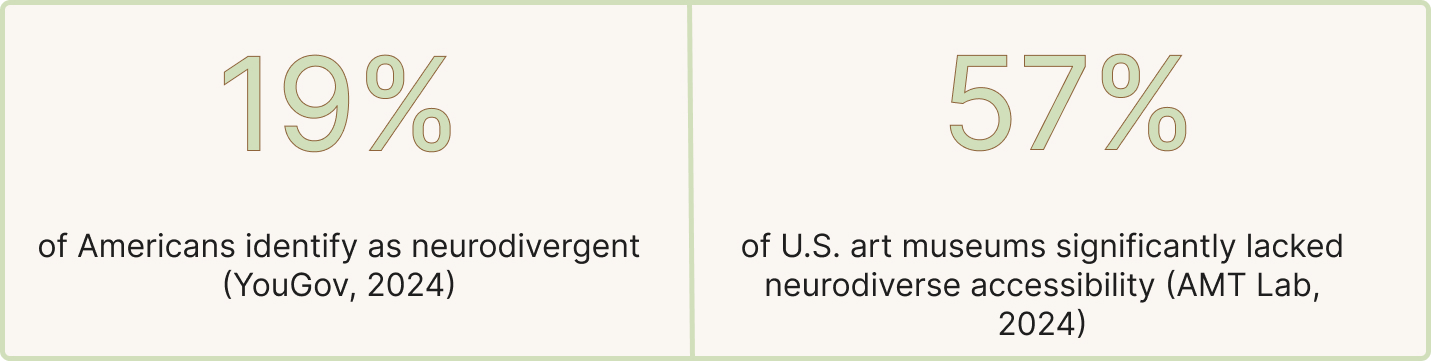
For Academic research, we reviewed papers on neurodivergent sensory processing, medical resources on sensory overload, and published studies on accessibility in cultural institutions. One interesting finding came from a 2024 review of 30 U.S. art museums where 57% scored negatively on neurodiverse accessibility (AMT Lab, 2024). A YouGov survey from the same year found that 19% of Americans identify as neurodivergent (YouGov, 2024). These figures helped us understand that this was not a niche concern and should be taken more seriously.
The academic literature also helped us map the full range of sensory triggers: not just sound and light, but unpredictable layouts and the overall weight of multiple inputs happening simultaneously (Wada et al., 2023). Participants in one study described that this caused difficulty concentrating and feeling overwhelmed (Wade et. al., 2023)
Lived Experience Research
Alongside academic sources, we wanted to understand the first hand experiences. So watched videos from TikToks, YouTube vlogs, and read personal accounts by neurodivergent people describing sensory overload in their own words. One person described needing to stop mid-drive to take medication because the sensory environment in the car had become unmanageable (owlibee, 2025). Another said:
“When everything is happening at once…noise, people, lights…it feels like my brain can’t process it all.” – emhahee, 2023(TikTok)
From these accounts, we found an understanding of the emotional factors of experiencing sensory overload that academic papers could not provide us. We were also introduced to the concept of Social Narratives through a video by Orion Kelly, an autistic creator, who explained how step-by-step illustrated guides help prepare people for unfamiliar environments by making the unknown known (Kelly, 2025). This became foundational to our final design.
The insight that changed my thinking
Before this project or research, I always assumed sensory overload only happened due to the intensity of too much noise or too much light. This research revealed something else: unpredictability is a trigger. In an unfamiliar environment or even at a familiar one, when things shift, and you don’t know where you are and where you should go next, it becomes overwhelming. This reframed our design direction and it became more than wanting to reduce stimuli; we wanted to reduce uncertainty. This meant preparing the visitors before they even set foot through the gallery door.
Field research: Positive Exposure
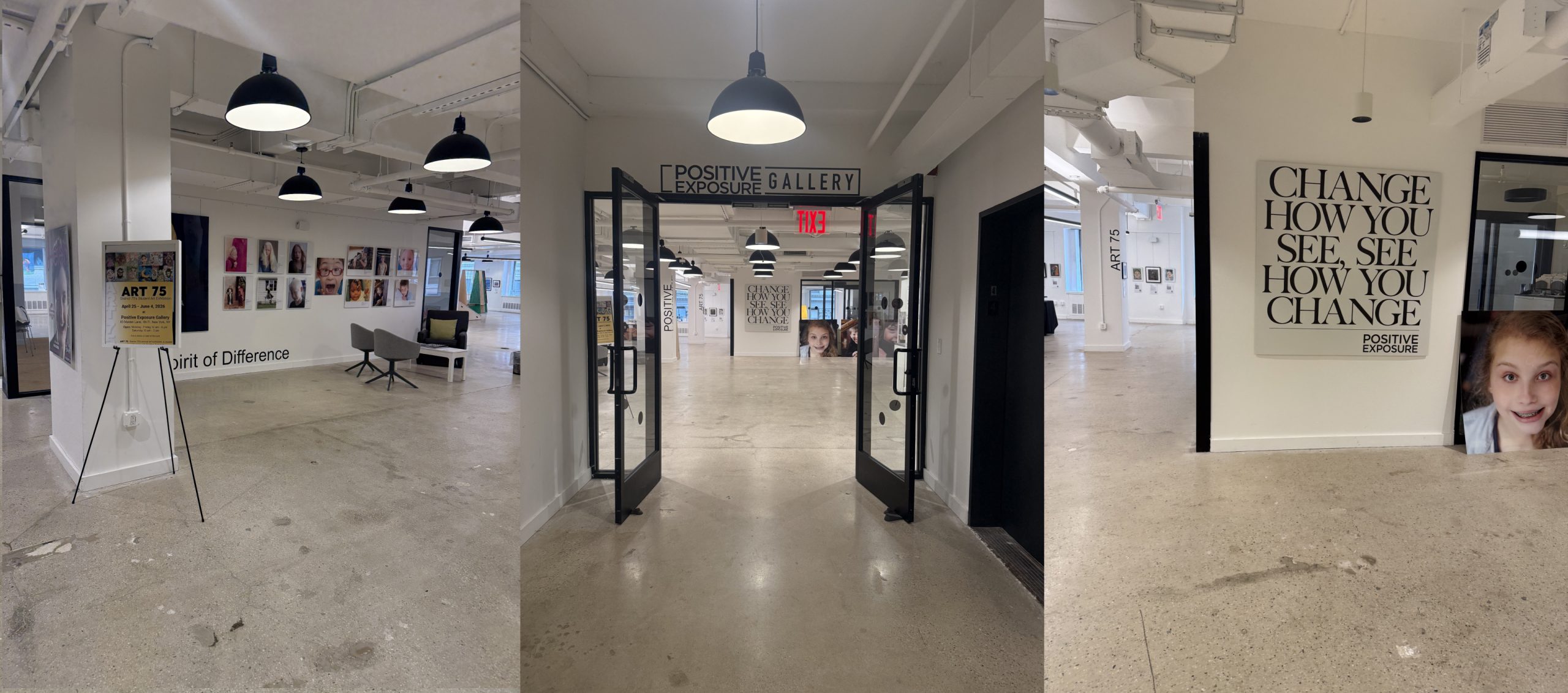
After our kickoff meeting with Amanda McFee, who is the Director of Arts at District 75, a NYC public school program that serves students with disabilities, including neurodivergent kids, we decided we want to visit Positive Exposure in person. There we met Ian Burton, the gallery’s Director of Operations. This visit confirmed what the data had suggested. We saw the space as a visitor would, with an open floor plan, pendant lighting, multiple gallery rooms, and an active exhibition (ART 75: NYC’s District 75 Student Art Exhibition). What we found was four significant gaps from our visit:
Finding 1: The quiet room was invisible
A room existed that staff informally used as a calm space. It had two stools and cardboard boxes, a printed out signage, no sensory tools, no way for a visitor to know for sure it is the quiet room they could enter in the time of need
Finding 2: No Sensory tool available on sight
No noise-canceling headphones, tinted glasses, or fidget tools for visitors to borrow. Anyone with these needs had to bring their own, with no guidance that they should.
Finding 3: No pre-visit guide
The Director mentioned he had once emailed a rough text-only description to a teacher before a class visit. It was informal, never repeated, and nothing existed for individual visitors to seek out before visiting. The website also did not provide any information.
Finding 4: Lack of arrival orientation
Visitors entered without being oriented to the space ahead of them. No one to point them to the quiet room, offer a map, or recognize the signs of sensory distress.
Drawing the visit to understand it
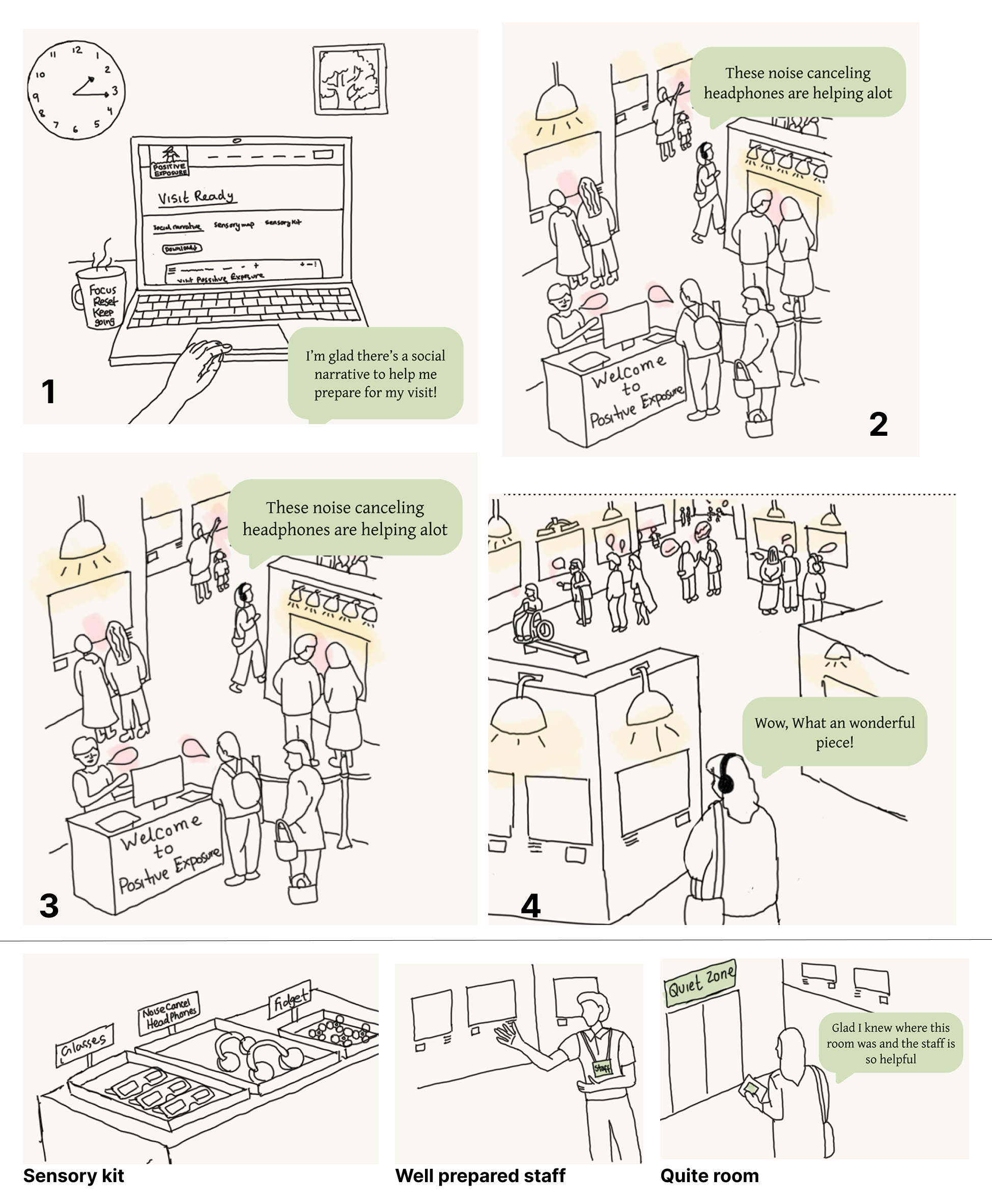
After completing our secondary research and field visit, I took on the task of translating what we had learned into a visual narrative, a hand-drawn storyboard following a fictional neurodivergent visitor named Jessie through a gallery visit at Positive Exposure. This was not just a decorative choice but one to deepen understanding. I used illustration as a research method: a way to test whether we had truly understood the emotional gravity of the experience before we started designing solutions.
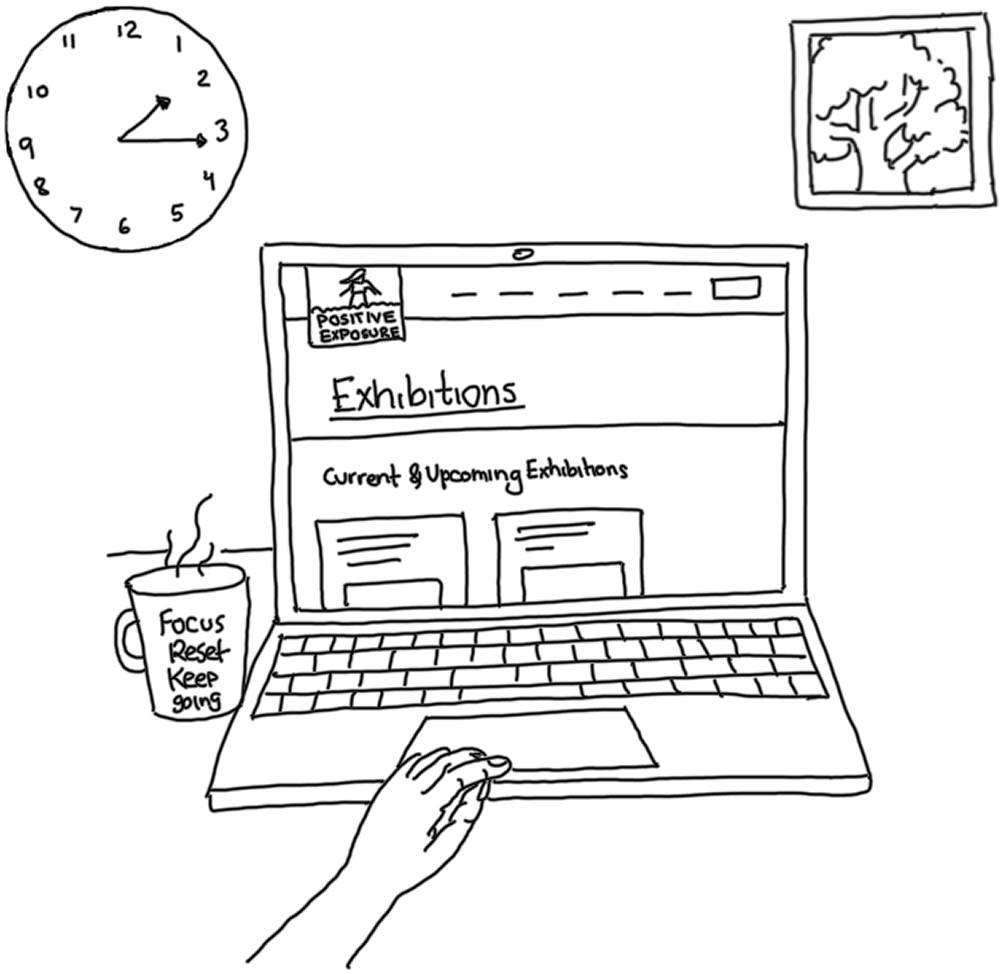
The storyboard follows Jessie across four scenes: she visits the website before her trip and finds no tools to help her prepare(panel 1); she arrives at the gallery excited but quickly feels the crowd building( panel 2); the combination of noise, lighting, and unpredictability becomes unmanageable and she looks for a quiet space she cannot find(panel 3); and finally, she leaves early(panel 4). Every detail in each scene came from the overall research.
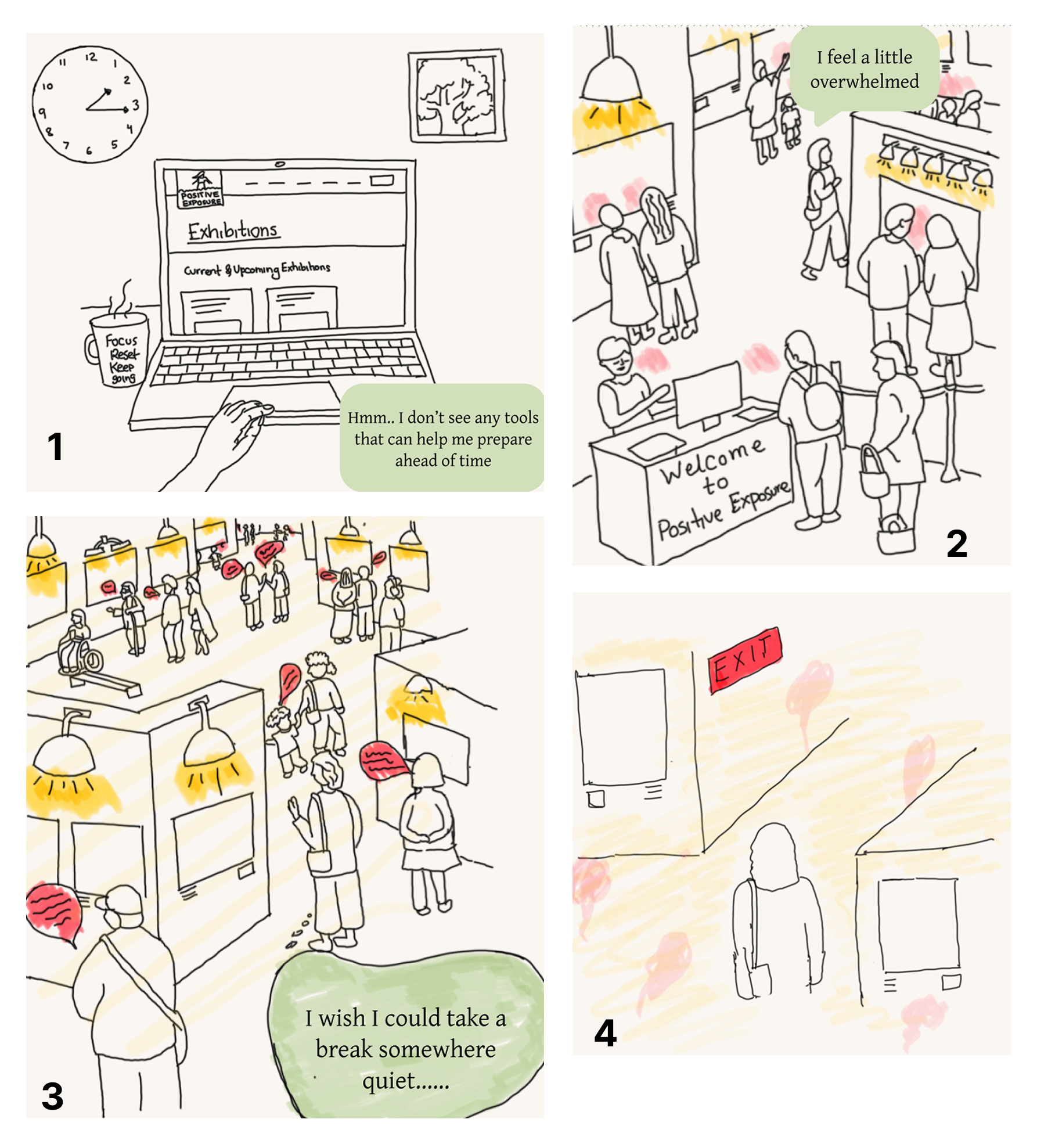
What the act of drawing made clear in a way that reading research alone had not, was how the problems compound. Each barrier might seem manageable in isolation, but Jessie experiences them in sequence, with no chance of recovery in between. By the time she needs a break, she has no resources, no information to guide her, and she is already overwhelmed with sensory overload. The storyboard made the effect of sensory barriers emotionally visible in a way that a list of pain points could not
Storyboard to Journey Map
The storyboard informed our journey map. Having illustrated Jessie’s experience scene by scene, it was straightforward to identify the six key stages of her visit: Anticipation, Arrival, In the Gallery, Overwhelm, Seeking Help, and Exit. Then we populated each with the emotional state, pain points, and missed design opportunities that we had mapped in the research. The journey map became a shared team reference, which led us to ask “what does Jessie need at this stage?” and point to a specific moment in the arc.
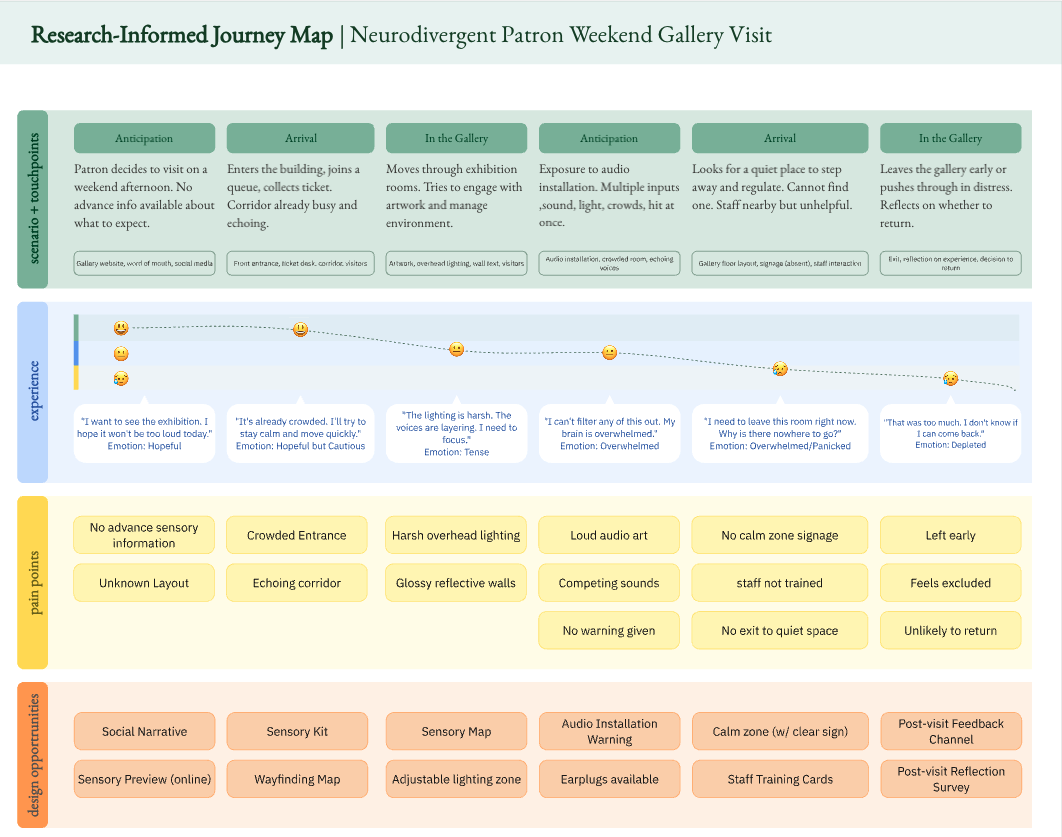
The journey map also made something more clear to us, which the storyboard had hinted at. The barriers begin before the visitor arrives. The absence of pre-visit information on the website and the lack of a social narrative set an anxious tone that led to everything that follows. This confirmed the core insight from our research because unpredictability is a trigger; the most important intervention was giving visitors enough knowledge ahead of their visit to boost confidence rather than uncertainty. This guided the tone and format of everything we built.
The Visit Ready System: four tools and one journey
The journey begins the moment a patron decides to visit. That was the organizing principle behind Visit Ready, a system designed to include the full experience, from pre-arrival preparation to in-gallery navigation to moment-of-distress support. Each of the four tools addresses a different stage of that journey, and all four are designed to be discoverable through a single “Visit Ready” page on the Positive Exposure website.
1: Social Narative
A Social Narrative is a step-by-step illustrated guide that describes a specific environment in plain, first-person language with real photographs and clear expectations. Research shows they reduce anxiety in autistic individuals by making the unknown known; they work by reducing unpredictability (Kelly, 2025).
We built a 13-page Social Narrative for Positive Exposure that walks visitors through every stage of their visit: entering the building at 83 Maiden Lane (where the sign says AHRC NYC, not Positive Exposure, a confusing detail our field visit revealed), checking in with security, taking the elevator to the fourth floor, navigating the gallery, identifying which art can be touched, finding the quiet room, and leaving. Each section uses “I will…” and “We will…” language paired with photographs of the actual space.
2:Sensory Map
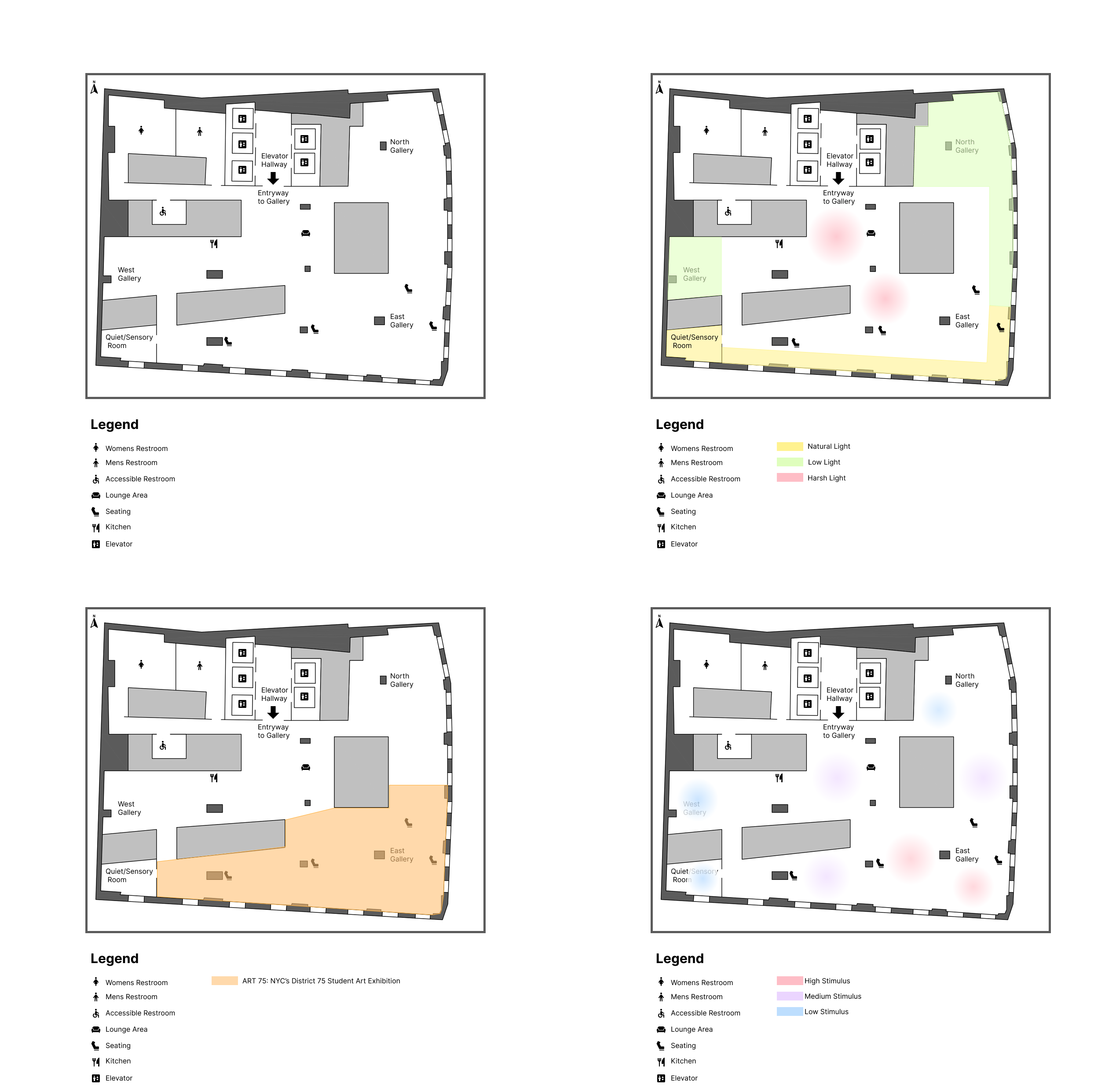
The sensory map gives visitors a visual overview of the gallery floor plan annotated with sensory information: lighting levels (natural, low, harsh), stimulus intensity (low, medium, high), and the precise location of the quiet room. It also shows which areas the current exhibition occupies.
The key design decision was to present three separate map layers rather than one cluttered overlay. Visitors can focus on what is most relevant to their specific sensory profile. So someone sensitive to light can consult the lighting map; someone managing crowd anxiety looks at the stimulus map. This respects the diversity of sensory experience rather than assuming uniform needs, which can cause more overwhelm.
3:Sensory Kit
The sensory kit was an area I took direct ownership of. My role was to research what sensory tools are most effective for neurodivergent visitors in public spaces, and to define the kit’s categories and contents based on that evidence. Research on sensory toolkits in museums and universities confirmed that sensory tools help visitors improve focus, remain calm in overstimulating environments, and support self-regulation before distress escalates (Autism Speaks, n.d.). Based on this, I proposed three functional categories:
Noise Reduction for auditory overload: noise-canceling headphones, foam earplugs, sound-dampening earmuffs.
Visual Comfort for lighting and visual stimulation: tinted sensory glasses, visor or cap, eye mask.
Regulation and Grounding for emotional self-regulation during stress: fidget toys and stress balls.
The kit is designed to be available at the front desk in clearly labeled containers, with signage throughout the gallery so visitors know it exists even if they missed it on arrival.
4:Staff reference cards
The staff card addresses a barrier our field research made clear: the gallery staff needs to be present and trained to help a visitor in distress, so they do not make an already difficult situation worse. The card gives staff a pocket-sized reference for recognizing the signs of sensory overload, a step-by-step response protocol, and phrases to use and to avoid (National Autistic Society, n.d.; Leicestershire Partnership NHS Trust, n.d.). The card also specifies what not to do: don’t touch the visitor unless there is immediate danger, don’t block their exit path, don’t surround them with multiple staff members, don’t force eye contact, don’t rush them to recover (Autism Speaks, n.d.). These boundaries matter as much as the instructions, and the staff must be properly trained and have the staff card handy
Where we think this work needs to go
Visit Ready is just a starting point, not a finished product. Designing for accessibility without testing with the people you are designing for is an incomplete process, and we are aware of that. The next phase should center those voices directly.
- User testing with neurodivergent visitors to evaluate if this is the right direction and if the tools that we included in visit ready are helpful or sufficient
- Integrating Visit Ready into the Positive Exposure website so visitors can access the kit easily. This is critical for pre-visit and planning stage to avoid uncertainty
- Holding staff training workshops to prepare them on how to help neurodivergent visitors without adding to their stress in the moment of sensory overload
- The quiet room already exists, but it needs clear signage and a small set of sensory tools stocked inside.
What I learned
The thing I will carry from this project is the insight about unpredictability. Before we started, I thought accessibility design for sensory needs was primarily about quieter rooms, softer lighting, and fewer stimuli. That is part of it. But the deeper intervention is about agency and knowledge to prepare ahead of time. Giving people enough information about what they will encounter so that the unknown becomes familiar, and the brain has one less thing to brace against.
That insight came from the research, but it was the storyboard that made it real for me. When I had to draw Jessie’s experience panel by panel, I couldn’t skip over the quiet accumulation of small failures. I had to feel the sequence of them and how the absence of website information sets an anxious tone, how the crowd at the entrance adds to it, and how the lack of a findable quiet space removes the last option for recovery. Drawing it made the design problem legible in a way that reading or listening to pain points simply did not.
Positive Exposure celebrates difference. The gap between that mission and the physical experience of a neurodivergent visitor is real, but it is also closeable with very small add-ons. Visit Ready is an attempt to close it, one touchpoint at a time, starting well before the visitor walks through the door. So they can focus on what matters at a gallery, the art.
Sources
References
AMT Lab. (2024). Evaluating neurodiverse accessibility offerings and education support in art museums. https://amt-lab.org/blog/2024/9/evaluating-neurodiverse-accessibility-offerings-and-education-support-in-art-museums
Autism Speaks. (n.d.). Sensory issues. https://www.autismspeaks.org/sensory-issues
BarrierFreeMD. (n.d.). Neurodiversity vs. neurodivergence: Understanding the differences. https://www.barrierfreemd.com/blog/neurodiversity-vs-neurodivergence-understanding-the-differences
Centers for Disease Control and Prevention. (2024). Data and statistics on autism spectrum disorder. https://www.cdc.gov/autism/data-research/index.html
Choi, H. L., Lazerwitz, M. C., Powers, R., et al. (2025). A neural substrate for sensory over-responsivity defined by exogenous and endogenous brain systems. Journal of Neurodevelopmental Disorders, 17, 68.
Dynamics 365 Lady. (2024, September). Navigating sensory overload. https://www.dynamics365lady.com/2024/09/navigating-sensory-overload.html
emhahee [@emhahee]. (2023, May 29). [Video on sensory overload]. TikTok. https://www.tiktok.com/@emhahee/video/7238350544249621802
Healthline. (n.d.). Sensory overload. https://www.healthline.com/health/sensory-overload
Kelly, O. [Orion Kelly — That Autistic Guy]. (2025, August 17). Change is hard! How Social Stories help autistic people [Video]. YouTube. https://www.youtube.com/watch?v=5ZmVALDFM3w
Leicestershire Partnership NHS Trust. (n.d.). Meltdowns and shutdowns. https://www.leicspart.nhs.uk/autism-space/health-and-lifestyle/meltdowns-and-shutdowns/
National Autistic Society. (n.d.). Meltdowns: A guide for all audiences. https://www.autism.org.uk/advice-and-guidance/behaviour/meltdowns/all-audiences
owlibee [@owlibee]. (2025, May 3). [Video on sensory overload]. TikTok. https://www.tiktok.com/@owlibee/video/7499996678871665962
Wada, M., Hayashi, K., Seino, K., Ishii, N., Nawa, T., & Nishimaki, K. (2023). Qualitative and quantitative analysis of self-reported sensory issues in individuals with neurodevelopmental disorders. Frontiers in Psychiatry, 14, 1077542.
YouGov. (2024). Neurodiversity and neurodivergence in the United States. https://yougov.com/en-us/articles/50950