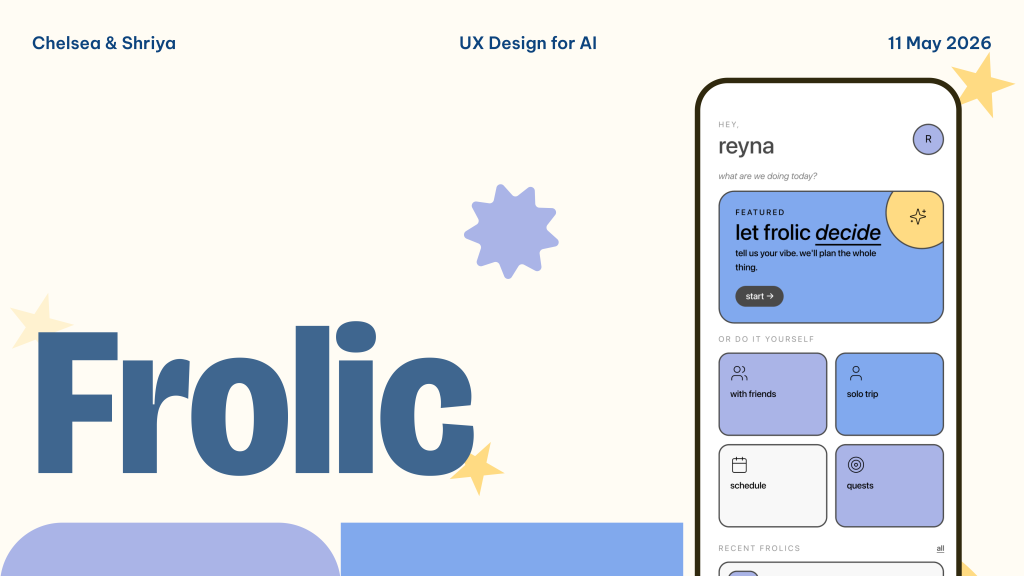
Intro to Frolic
Frolic is a social app designed to help people get out more and stay present when they do. Built around the tagline “Frolic more, flake less!”, the app uses AI to generate personalized outing ideas, sense how you’re feeling, and adapt recommendations to fit your mood and preferences, so planning something fun feels effortless. The goal is simple: less scrolling, more living.
AI’s Role
- Generation
- Emotional Sensing
- Personalization
- Analysis
- Predictions
Frolic AI generates itineraries, for yourself and/or with others, based on sensing your mood, vibe, and other preferences for the outing. It also utilizes personalization by tailoring its suggested plan specifically to the user’s preferences as well as their set constraints such as time and budget. Based on how the user reacts to the generated plan (e.g., they can choose to ‘accept’ the plan or ‘reject’ it), during or after the outing, Frolic’s AI will analyze what worked best for you versus what didn’t, and use that data to make better predictions in the future for the user’s future planning needs.
Core Problem
Users are looking for ways to efficiently plan new and fun outings and help them disconnect from technology more often.
- When making outing plans, users have to juggle a combination of different apps to help them plan.
- Users understand the value of disconnecting from technology, but struggle to do so, especially when they need assistance while on-the-go.
Initial User Research
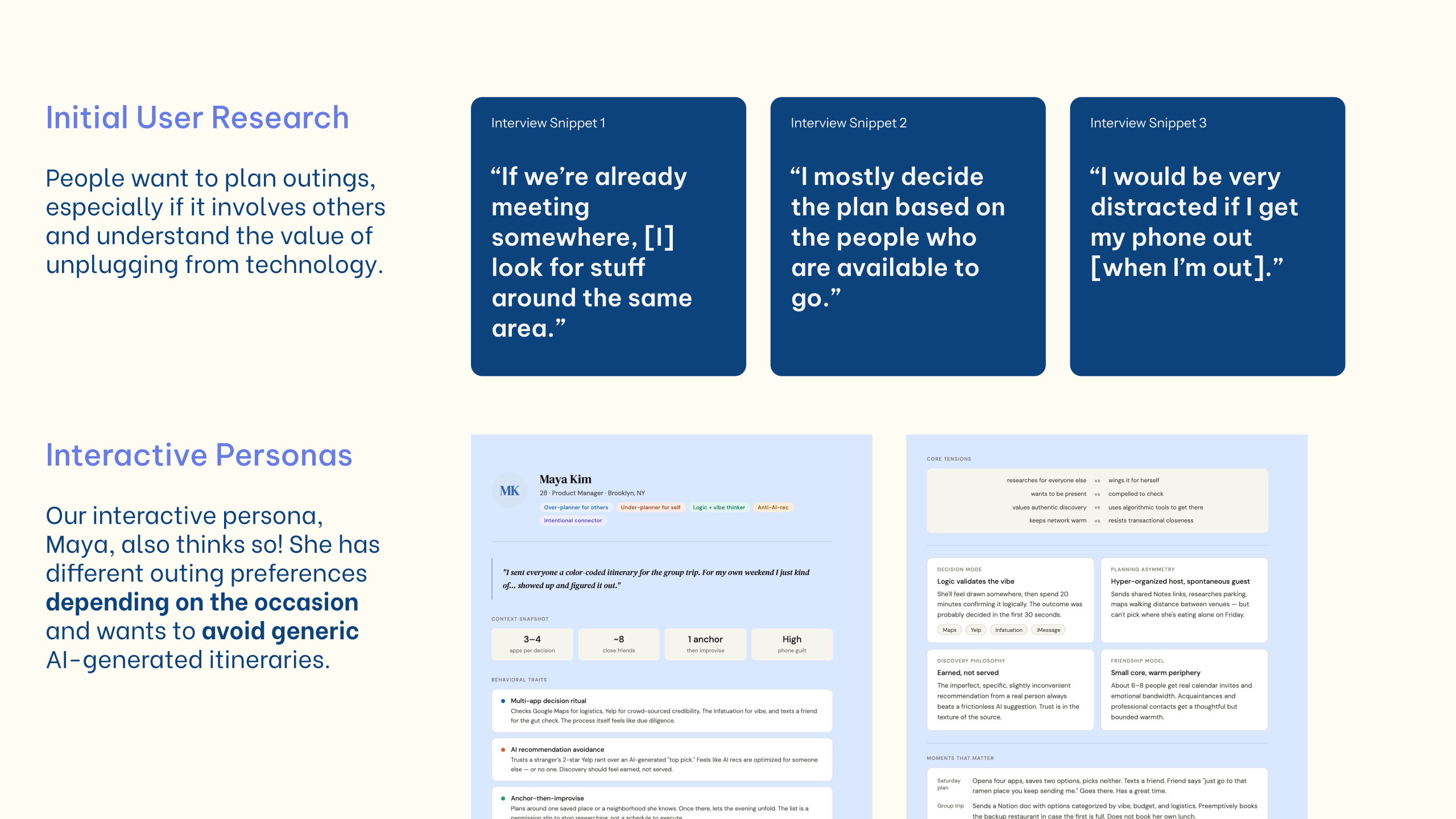
In order to get a better sense of exactly how, when, and why users want to plan outings, both with others or solo, we conducted user interviews and a field observation.
We watched a user try to plan a lunch with their family to take place after their commencement ceremony. While trying to select a restaurant, the user kept switching between Google Maps for budgeting and Beli for more trusted “foodie” reviews. At one point, the user thought they had selected their ideal restaurant only to find it was closed during their needed timeframe. Ultimately, the user abandoned their initial, specific criteria and instead settled for a “good enough” spontaneous choice near the commencement location.
In our user interviews, we asked users questions about their decision-making behind how they choose where to spend their time on an outing, what kinds of tech or tools they use to help them plan, and their thoughts on how they use technology even while on their outing. Generally, we found that people want to plan outings, especially if it involves others and understand the value of unplugging from technology. Major insights we found include:
- People want to plan outings, especially if it involves others. For solo outings, people tend to prefer spontaneity with less structured planning.
- People don’t usually use AI to generate specific plans / itineraries (because AI recommendations tend to be generic).
- People recognize that ‘un-plugging’ from technology when they’re out is important.
- People care most about maintaining relations with their closest friends, but will also value maintaining connections for networking purposes as well.
Interactive Personas
Based on our user research, we created an interactive persona that tied together all our different observations we noted from interviewing real users. When we asked our interactive persona, Maya, a variety of planning-related and lifestyle questions, she was able to give us insights into how a generic user might respond. However, we kept in mind that because “Maya” would generate answers based on the user interview data we gave her, an interactive persona would not be able to give us insights into edge cases or how other relevant user groups would respond. Thus, we put more importance on the insights we gathered from talking with real user interviewees and their experiences.
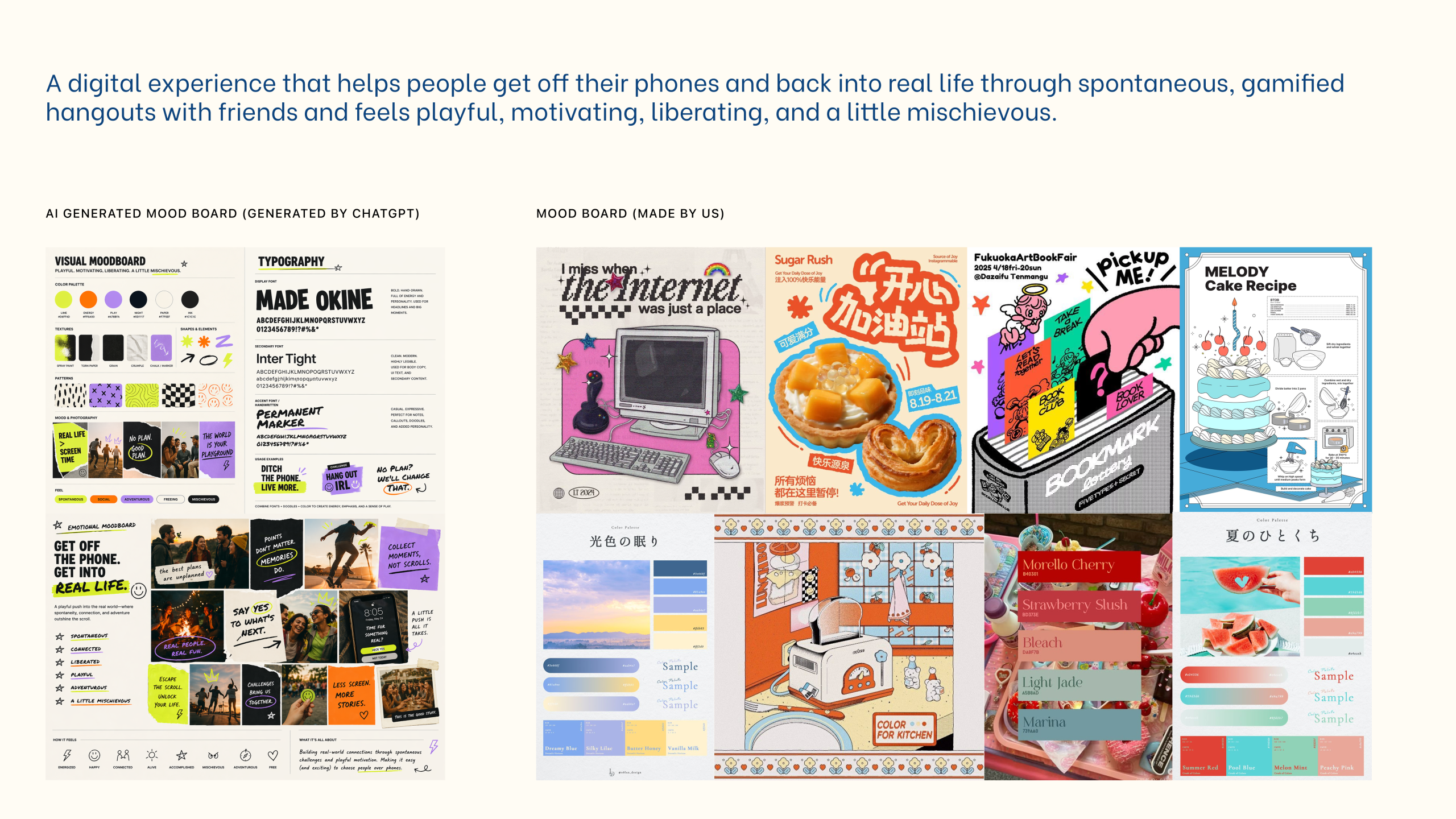
Moodboard & Branding
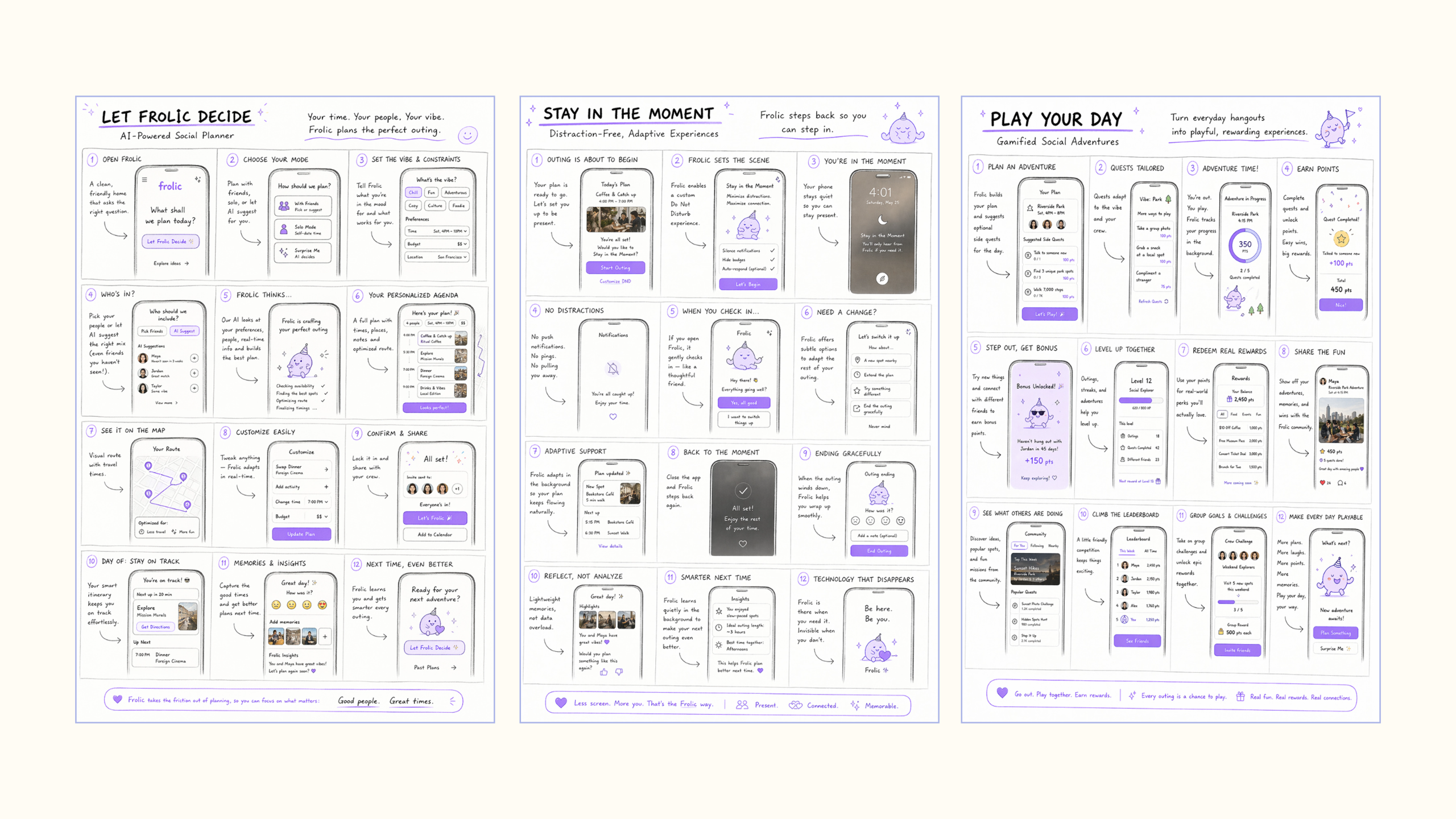
Concept Storyboards
Using ChatGPT, we wanted to see how AI would imagine the user journey flow for each of our 3 proposed features in the form of sketched storyboards. The generative AI made each user journey flow as separate from one another rather than being part of one overall app experience like we originally imagined. We believe that all 3 distinct features work in tandem to solve our user problem of “wanting to efficiently plan new and fun outings and disconnect from technology more often”. So when we switched to prototyping, we intervened and reorganized the user journey flow to naturally incorporate all 3 features as part of 1 interaction flow.
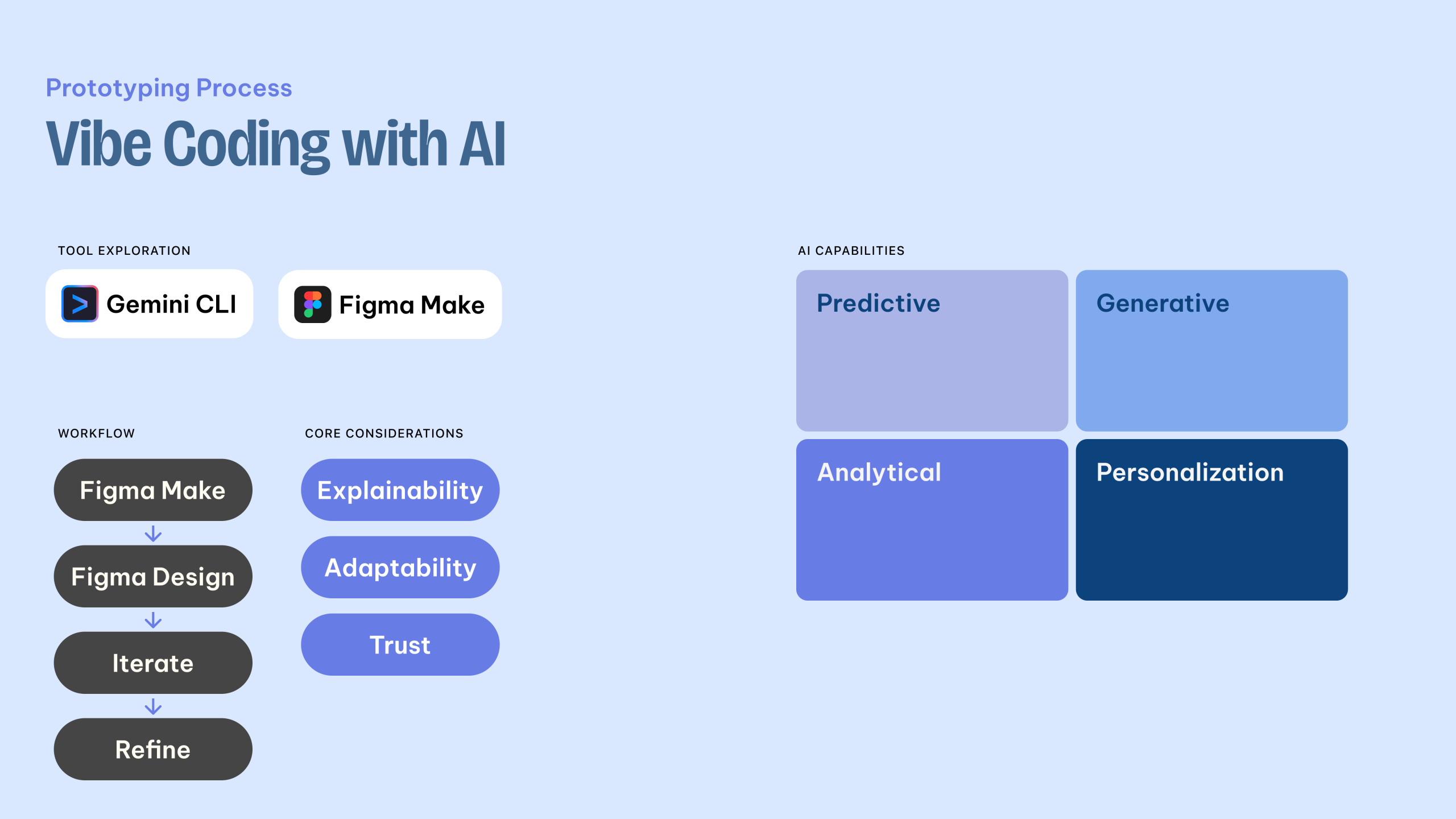
Prototyping Process
Final Design Features
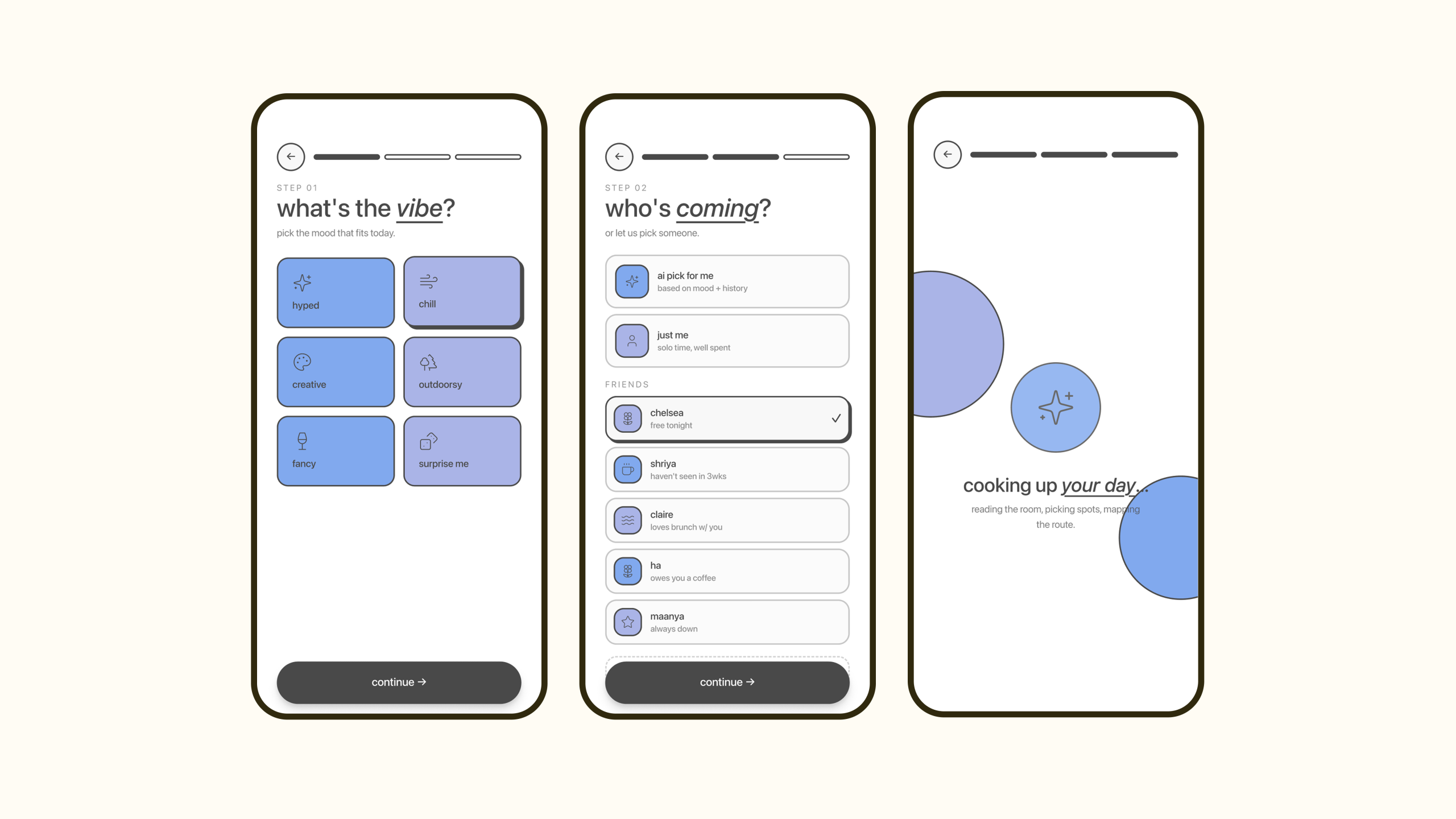
Feature 1: “Let Frolic Decide”: AI-Powered Social Planner
Frolic acts as a smart planner that builds a personalized agenda based on the user’s mood, time, budget, and other social preferences. The AI analyzes the user’s preferences to quickly make full itineraries that are more personalized to each user’s preferences for their type of outing, avoiding simple, generic recommendations.
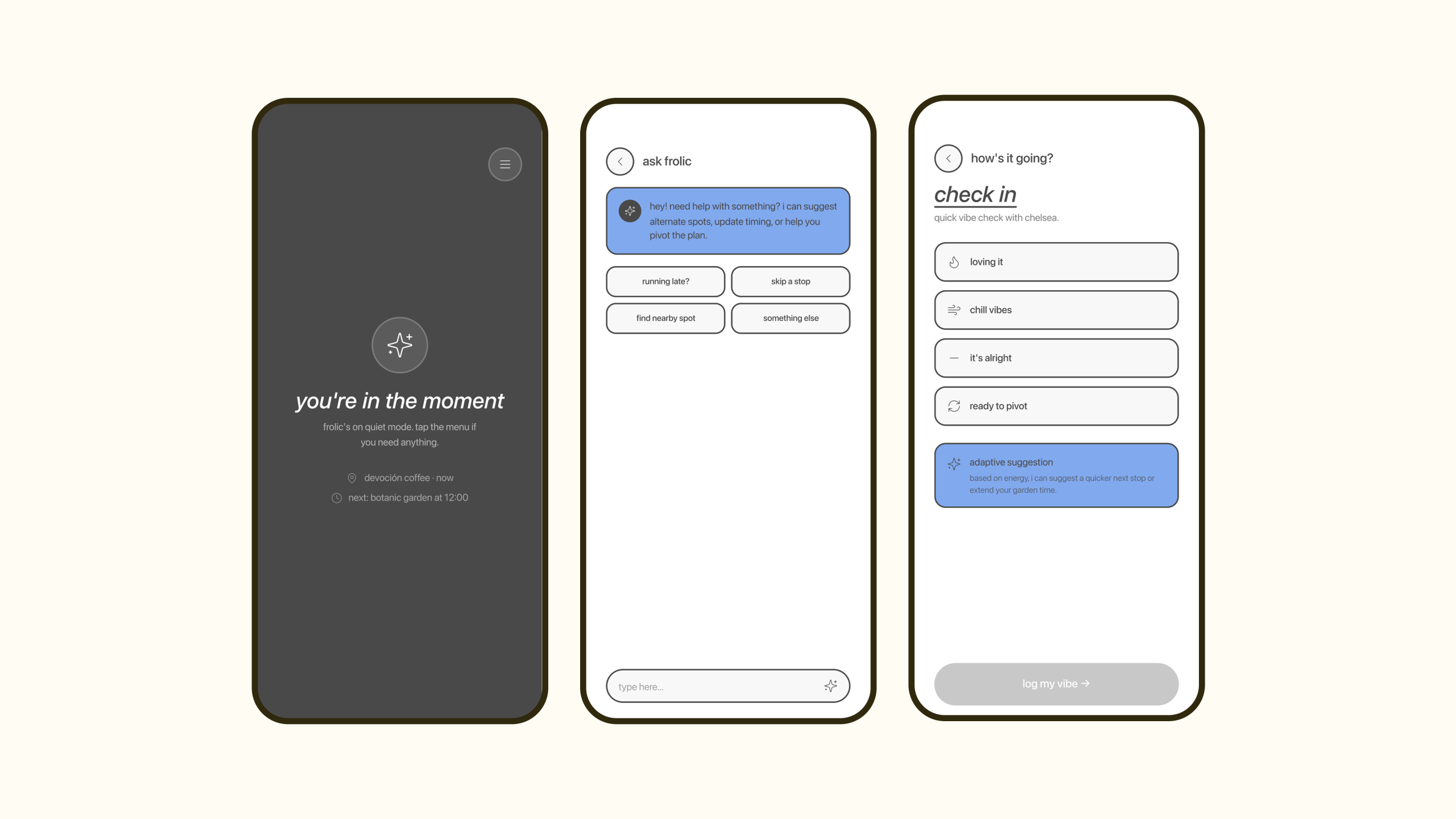
Feature 2: “Stay in the Moment”: Distraction-Free, Adaptive Experiences
Once an outing begins, Frolic shifts into a customizable DND mode to encourage presence and minimize non-essential phone usage. Frolic still offers on-the-go assistance for essential needs, but otherwise, helps users focus on the present and avoid the temptation of scrolling on their mobile phones while out.
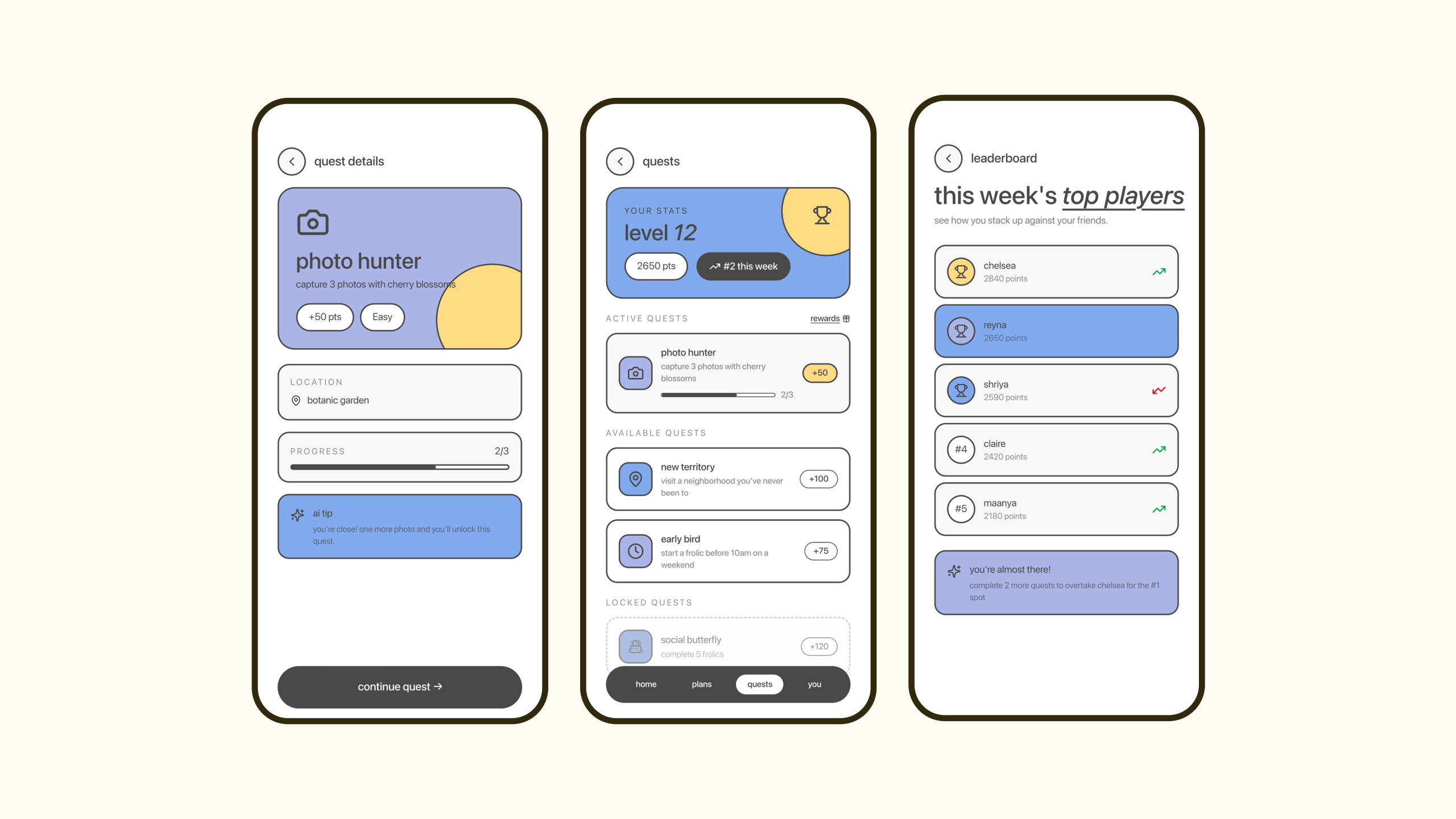
Feature 3: “Today’s Side Quests”: Gamified Social Adventures
Each outing can include generated, optional ‘quests’ tailored to the setting. These points can be redeemed for perks and, optionally, friendly competition with friends! Feeling bored? Run out of things to do? Frolic’s “Side Quests” are gamified ways to encourage users to engage with their surrounding environment and local communities in new & fun ways they might have not originally planned for themselves.
Final Demo
Reflections & Takeaways
The goal of this design project was to design a digital product and user experience that incorporates AI-generation, both as a feature for the product itself, and as an assistive tool for the overall designing process. Although we employed several AI-generative tools such as Gemini AI, Claude Code, Figma Make, ChatGPT, etc., we often found ourselves still feeling unsatisfied by the quality of work that the AI models generated for us. This was especially apparent during the Moodboard & Branding process, where we already had a relatively concrete idea in mind for Frolic’s visual direction, but when we tested AI tools to see what kinds of visual moodboards they would come up with, they were far from what we wanted. It would seem that rather than creativity and idea generation, AI tools are much more suited, and effective, for assisting with tasks such as turning design sketches and wireframes into high-fidelity functional prototypes, stages where the creative-thinking and ideation has already been done.
One of the biggest challenges we navigated throughout this project was figuring out the right balance between what AI could do and what users actually wanted from it. Early on, we talked a lot about how we wanted people to use AI without feeling glued to their phones. We wanted AI to feel less like something that pulls users deeper into technology and more like a tool that helps them connect with people and experiences in the real world.
Our research showed that people are often skeptical of AI-generated recommendations because they can feel generic or impersonal. Because of that, we had to be intentional about designing features that felt genuinely helpful and tailored to the user, not just technically impressive. Working with AI during the prototyping process reinforced this even more. A lot of the UI generated initially felt repetitive and generic, but through iteration and prompting, we were able to shape it into something that felt much more aligned with the experience we wanted to create.
Looking back, one area we would have loved to explore further was the Side Quests feature. We think there’s a lot of potential there, from more dynamic quest generation to deeper social interactions like collaborative challenges or leaderboards with friends. With more iteration, we could see it becoming one of the most engaging and distinctive parts of the Frolic experience.