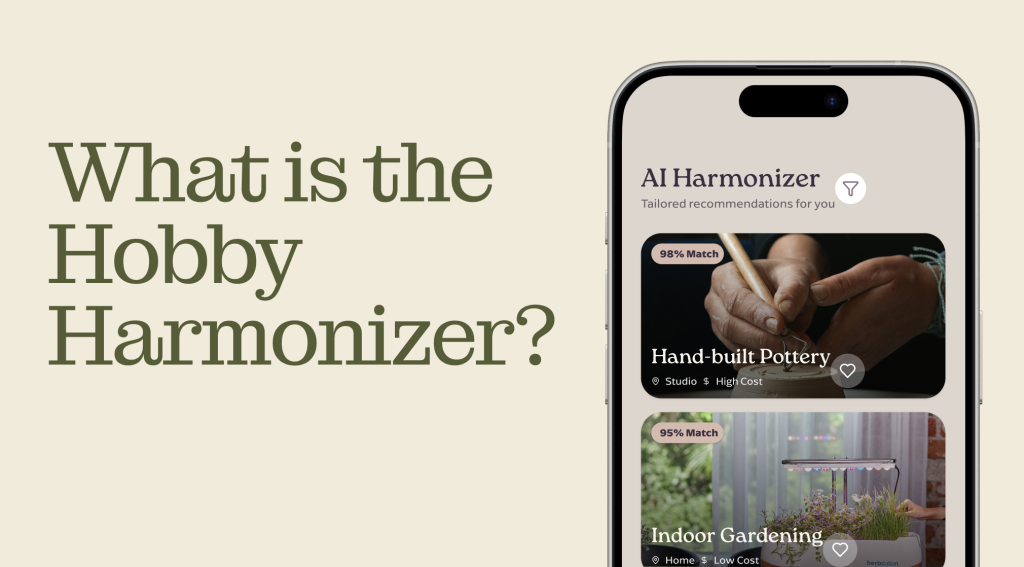
What is the Hobby Harmonizer? : Making Room to Fully Disconnect
The Problem: How might we match users to hobbies that match their daily and digital habits?
Recently, a big trend being shared online is composed of people attempting to disconnect from their phones and live a more intentional and analog life. These people hope that disconnecting from their devices can allow them to live fuller lives and interact with new experiences beyond social media. However, busy schedules, decision paralysis, and creative blocks can cause individuals to have a hard time finding new hobbies or engaging with ones they already enjoy.
Having studied these issues, as part of the project for the UX Design for AI course, the team developed Hobby Harmonizer, a mobile application that utilizes AI to help users disconnect from their phones and explore new hobbies based on their preferences and behaviors. The application includes a hobby-centered AI, Harmony, that analyzes users’ digital patterns to recommend new activities they may enjoy based on their mood, the weather, and their preferences.
Project overview
Project:
Hobby Harmonizer
Timeline:
6 weeks
Goal:
Provide users with a digital product that helps them disconnect from their phones and explore new hobbies based on their preferences and behaviors.
Audience:
Users who enjoy multiple hobbies, indecisive users, retired users
Team:
Shasteny Maclang & Jasmin Rose Guerrera
Role:
UX Designers and Researchers
Tools:
Figma, Figma Make, Perplexity, Replit, Gemini, Claude
The Process
Research
We conducted a mix of desk research, interviews, and observations for the research portion of the product development. Each research area enhanced our understanding of our product direction and our user’s needs.
Desk Research
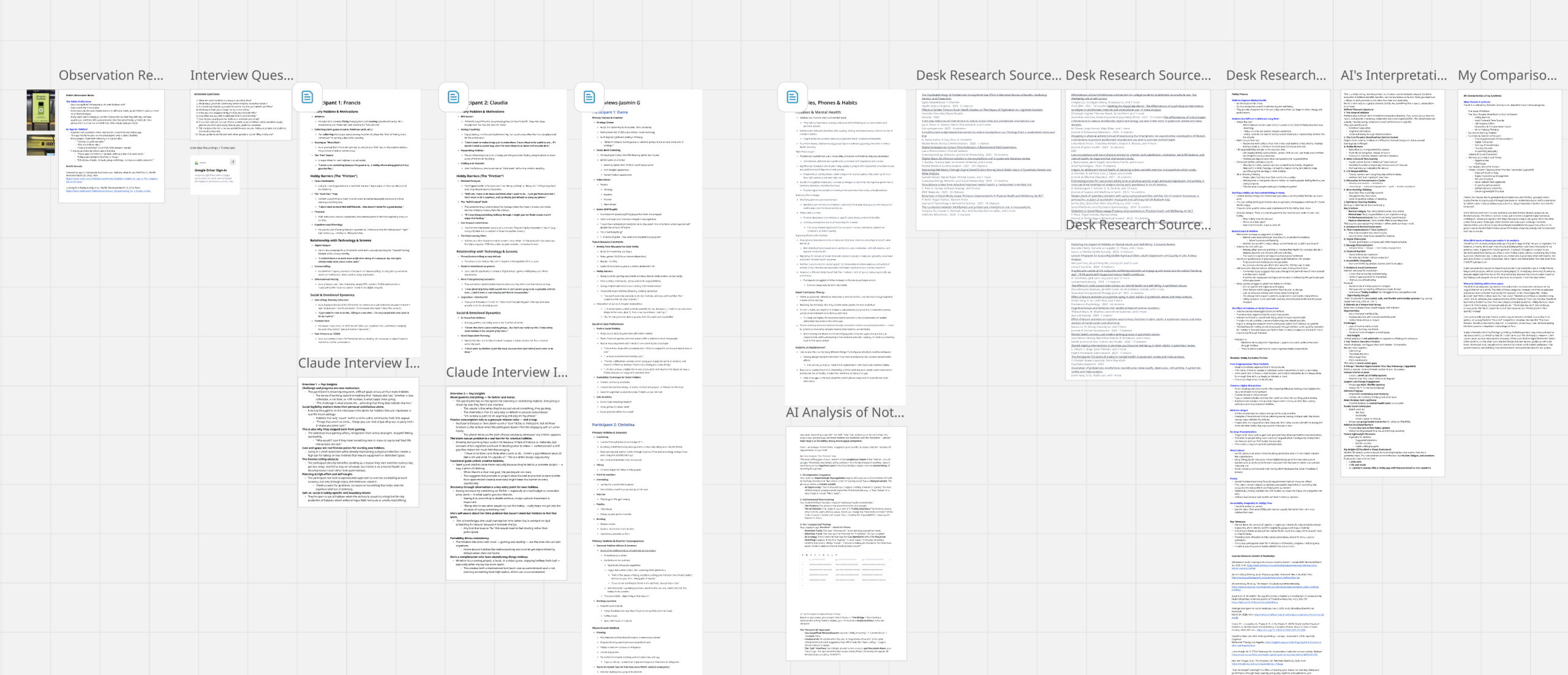
For the desk research, the team consulted various AI research tools (Perplexity and Elicit) to gather academic sources on topics such as the impact of hobbies and phones on our mental health, difficulty starting or maintaining hobbies, and decision fatigue.
The team found that:
- Hobbies reduce depression, anxiety, and stress while fostering social connections and personal growth.
- Cognitive leisure activities were associated with lower incidence of dementia.
- Smartphone addiction was significantly associated with depression and anxiety.
- Periodic abstinence from devices or specific apps shows consistent benefits.
Observations
To ground our research in real user sentiment, the team explored Reddit threads within hobby communities to understand how people genuinely talk about their relationship with hobbies: their frustrations, their wishes, and what they’re already trying to do about it.
The Hobby Buddy Problem
One recurring theme across threads was that people don’t just want hobbies; they want people to do them with. A thread titled “Looking for a hobby buddy” revealed just how common this feeling is:
- Users struggle to find people to do their hobbies with, even when they know others who share the same interest
- Shared hobbies don’t always mean shared compatibility, one person draws folk art while another does portraits, and the gap can feel too wide
- Schedules, skill levels, and pace mismatches make it hard to maintain a hobby partnership even when one forms
- Many users expressed a desire for motivation and accountability, not just discovery
An App for Hobbies? People Are Already Asking for It
In a separate thread, a Reddit user shared that he had built his own app (Buddee) to help people meet others who share their hobbies. The response was largely enthusiastic, with commenters saying things like “Concept sounds fantastic” and “I was just wishing I could find niche weavers nearby.”
However, critics raised real concerns worth noting: the app’s reliance on user growth to function, its similarity to dating apps like Bumble or Hinge, and the need for group matching features to address safety.
These responses confirmed both the demand for a hobby-focused product and the design challenges that come with it.
Brands Are Already Responding to Analog Living
It wasn’t just individuals online expressing this shift; companies are actively marketing toward it.
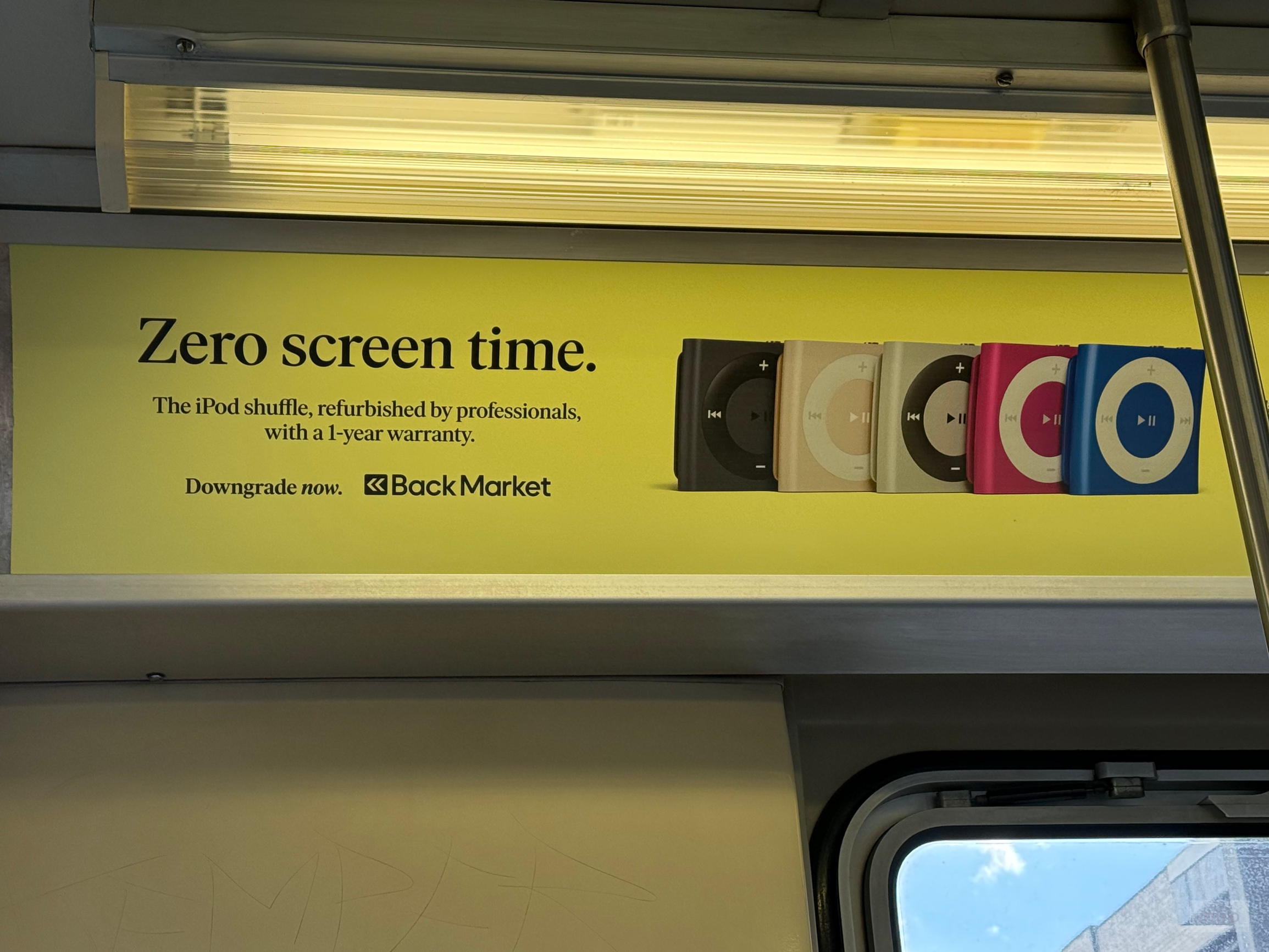
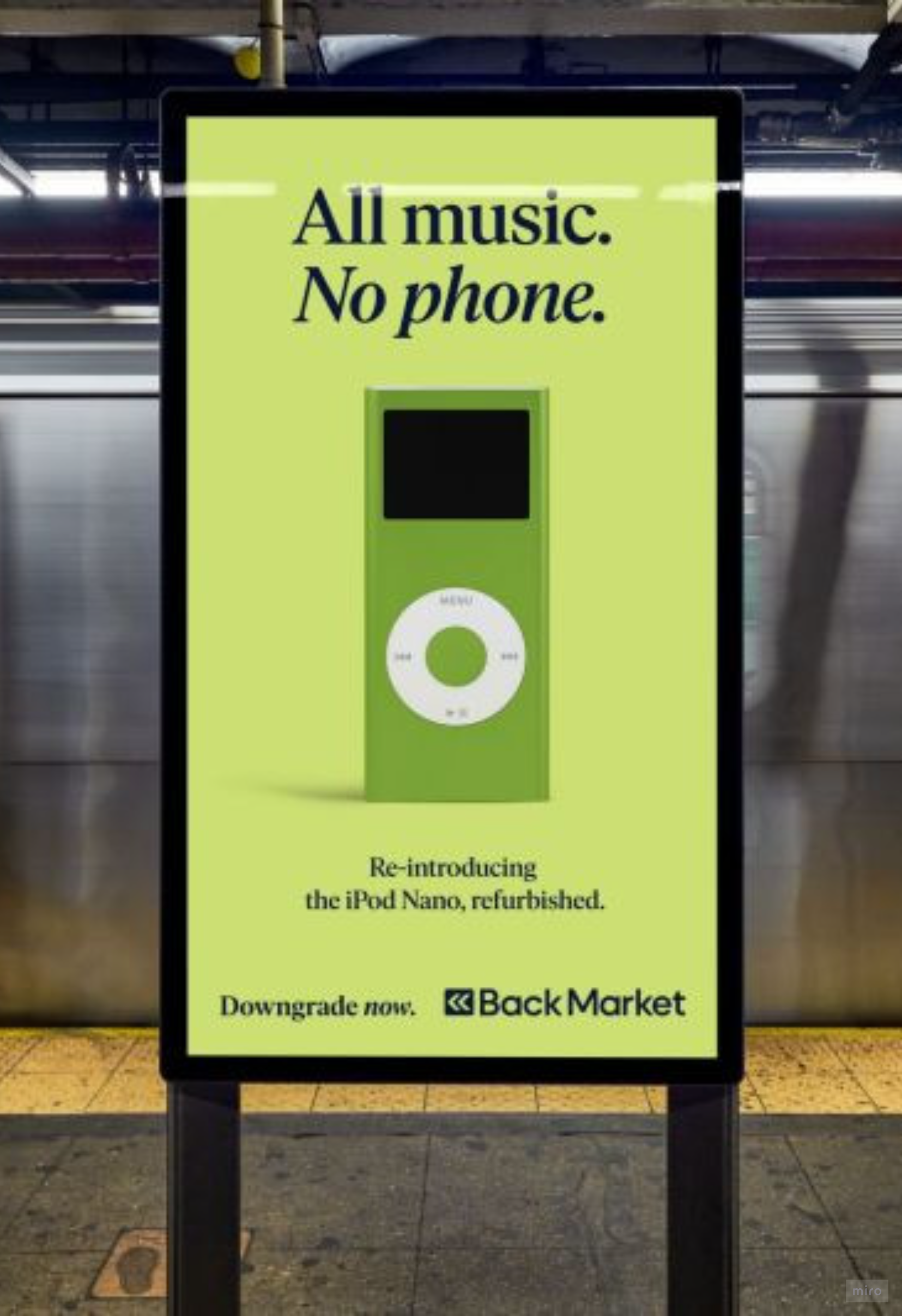
Back Market, a refurbished electronics retailer, recently ran a subway ad campaign in New York City re-introducing the iPod Nano and iPod Shuffle with messaging like “All music. No phone.” and “Zero screen time.” The campaign, branded as “Downgrade now,” signals that the desire to disconnect is mainstream enough for brands to build entire campaigns around it, validating the cultural moment that Hobby Harmonizer is designed to meet.
Interviews
To complement our desk research, we conducted four semi-structured interviews with individuals who maintain active hobbies alongside busy personal and professional lives. Our participants varied in age, lifestyle, and hobby type, but revealed a striking set of shared patterns that directly shaped the direction of Hobby Harmonizer.
The Phone Is the Path of Least Resistance
Across all four interviews, the smartphone emerged as the default activity.
Not because participants wanted to be on it, but because it required the least effort to start. One participant described decision paralysis as her biggest barrier: when a hobby prompt wasn’t clear, she’d default back to her phone. Another identified doomscrolling on the couch as the reason he consistently started his hobbies later than intended, often at the cost of sleep. This pattern aligned with our desk research findings on habit formation; the phone wins not because it’s more enjoyable, but because it has the lowest activation cost.


Starting Is the Hardest Part
None of our participants lacked interest in their hobbies; they lacked the bridge between wanting to do something and actually beginning.
One interviewee only picks up his guitar when he feels inspired or encouraged, and openly acknowledged that self-motivation alone isn’t enough. Another avoids starting creative projects unless she has a large, uninterrupted time block, because stopping midway feels worse than not starting at all. One other, despite having a rich roster of hobbies, found that caregiving responsibilities had pushed them entirely out of reach. Not for lack of desire, but lack of an easy entry point back in.
Real-World Constraints Shape Hobby Choices
Practical barriers (cost, space, time, and availability) came up consistently across all four participants. One interviewee won’t pursue music or archery due to equipment costs and apartment size. Another’s ability to attend Magic events depends entirely on ticket availability and friends’ schedules. Another participant’s hobbies are deeply seasonal, tied to weather and her outdoor environment.
These constraints reinforced the importance of the filtering features and AI in Hobby Match: presenting hobbies that are realistic for a user’s actual life, not just their idealized one.

Key Takeaways for Design
Our interviews confirmed that users don’t need to be told hobbies are good for them,they already know!
What they need is a lower barrier to starting, context-aware suggestions that account for their mood, schedule, and environment, and just enough encouragement to take the first step without feeling managed. These insights became the foundation for Harmony’s three core interactions: transparent matching, explainable recommendations, and adaptive, user-controlled personalization.
Interactive Personas
We had two interactive personas. They reflected users who were retired and loved the outdoors, as well as users who were currently trying to find time to do their hobbies while in the workforce. We input their hobbies, goals, struggles, and values to see how Claude would process the information.
Solo Retired Wanda


Hobbies
- Crochet
- Snowshoeing
- Reading
Goals & Frustrations
- To stay active in her retirement
- To visit the bookstores, she enjoys
- Daily chores eating up her free time
Wanda’s interactive persona comes out very stereotypical, with her defaulting to Facebook even though her persona description mentions her YouTube usage. She was also quite theatrical with her mannerisms, especially when she picked up an imaginary crochet hook. This persona revealed that even though we still wanted to help users like Wanda, her interactive persona was too stereotyped when used it in combination with AI.
Social Gym Brad

Hobbies
- Gym
- Magic The Gathering
- Videogames
- Music
Goals & Frustrations
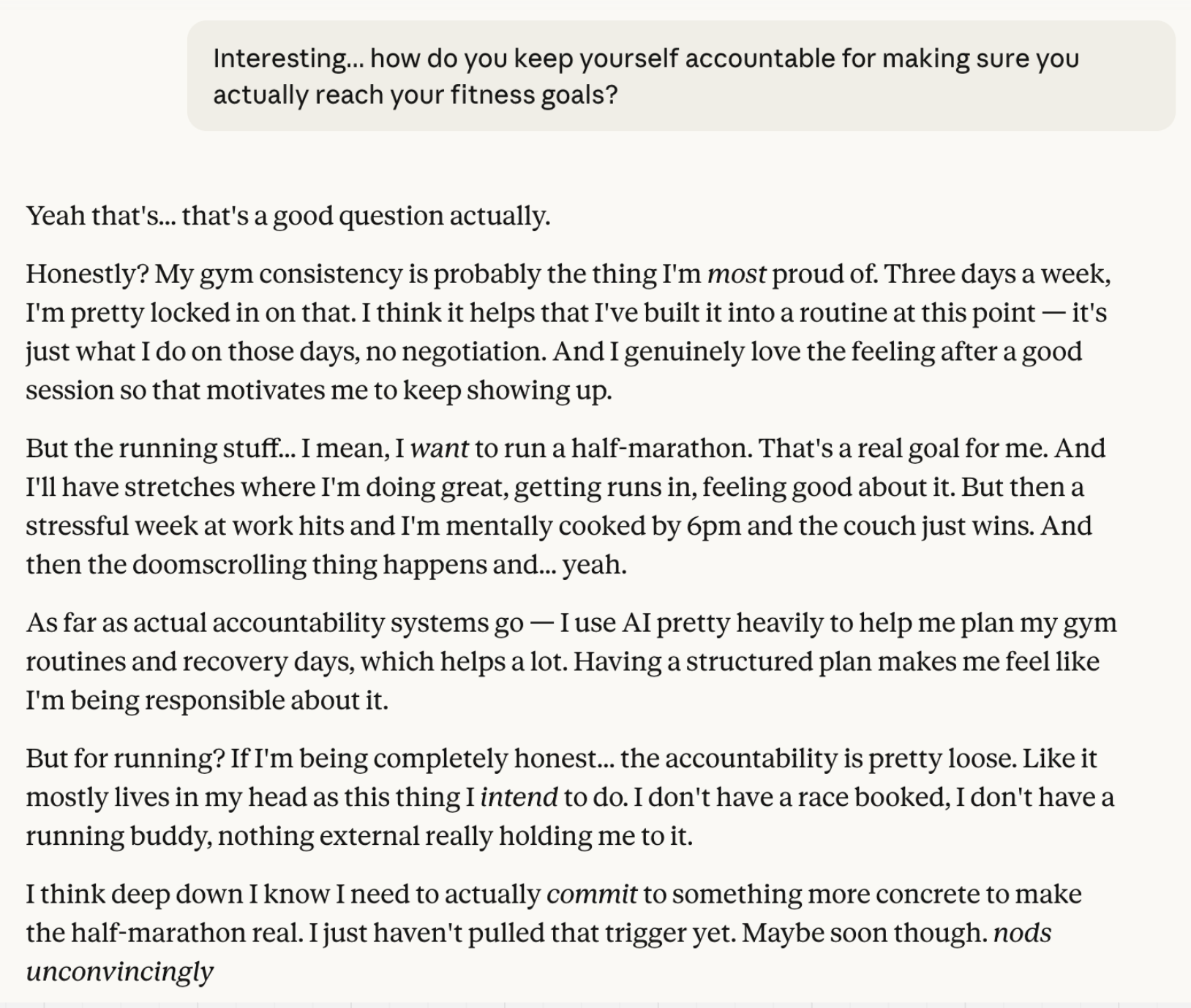
- Wants to run a half marathon
- Wants to learn to play guitar
- Work is mentally taxing
- Doomscrolling drains his free time
Brad’s interactive persona was much more defensive and felt more realistic than Wanda’s due to this behavior. For instance, Brad dislikes and is often mistrustful of apps that are too pushy. This allowed us to understand that nudging users through notifications may not be the best way to get users to interact with new hobbies or our application.
Idea Exploration: Exploring in Order to Settle on a Main Idea
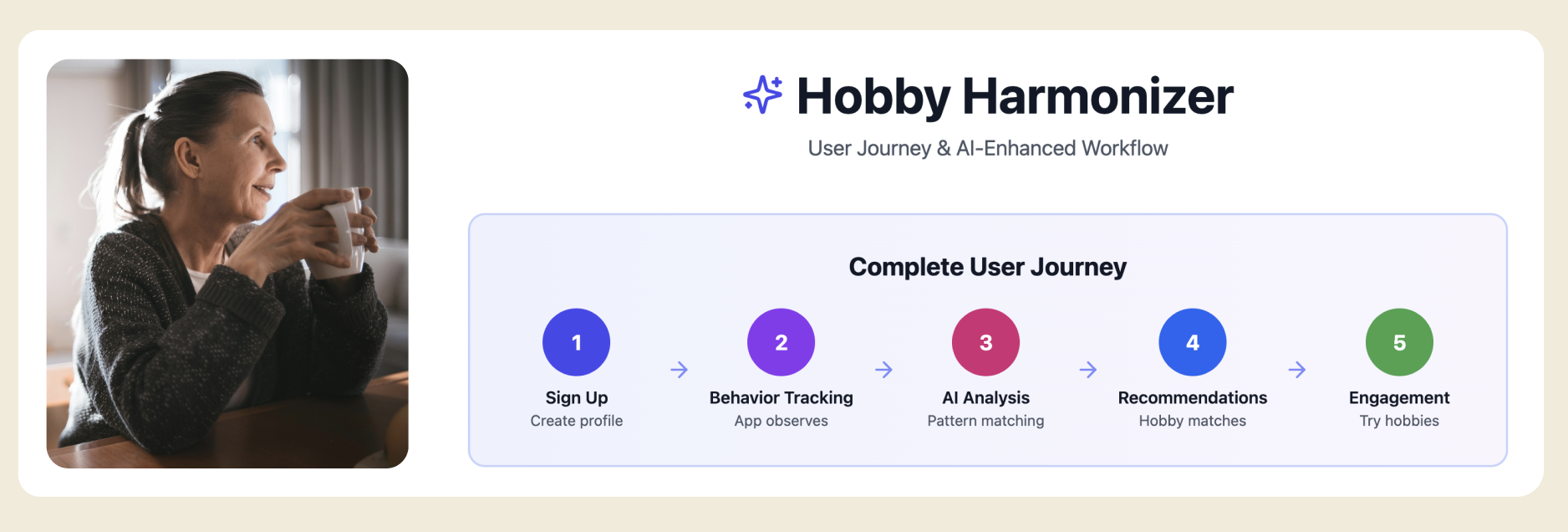
User Journey: How would a user find hobbies that match their daily habits?
We reflected on how Wanda would go through a Hobby-matching type of application. The user journey helped us to see where the AI would play a part in the process and how behavior tracking may make certain users feel concerned about their privacy. We realized, thanks to the user journey, that we had to focus on creating trust with the user as well as give them more control over what the AI gets access to within their mobile device.
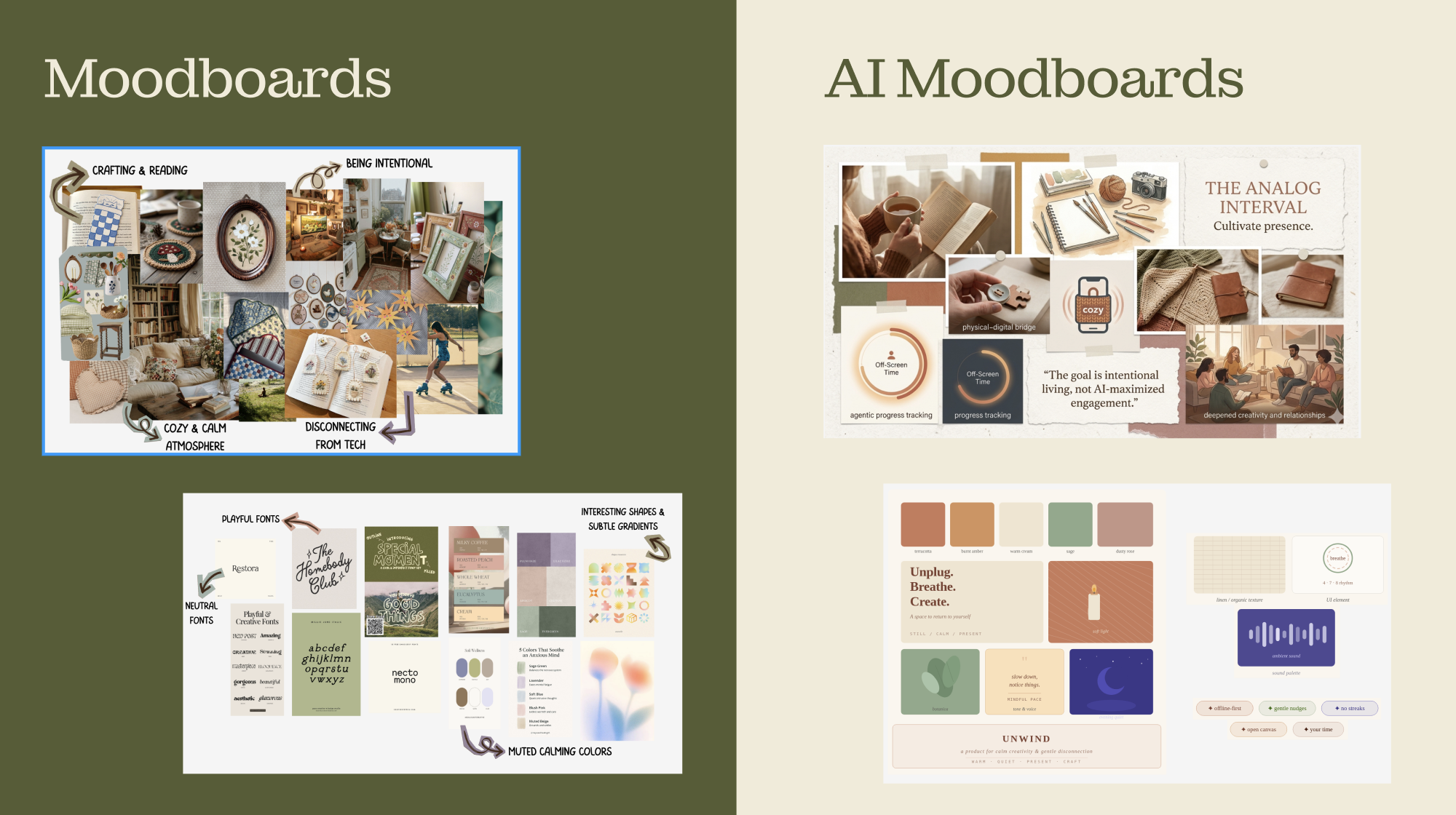
Moodboards: To define our product’s visual identity, the team created hand-curated and AI-generated mood boards.
To set the visual direction for Hobby Harmonizer, we built a moodboard around a cozy, vintage, and analog aesthetic. We wanted the app to feel like a breath of fresh air from the overstimulating, high-contrast world of most social media platforms.
Our references leaned into warm textures, handmade crafts, worn paperbacks, and quiet outdoor moments. The kinds of images that make you want to put your phone down and actually do something. This mood guided our color and typography decisions and helped us make sure the app’s look reinforced its core message: slowing down is a good thing.
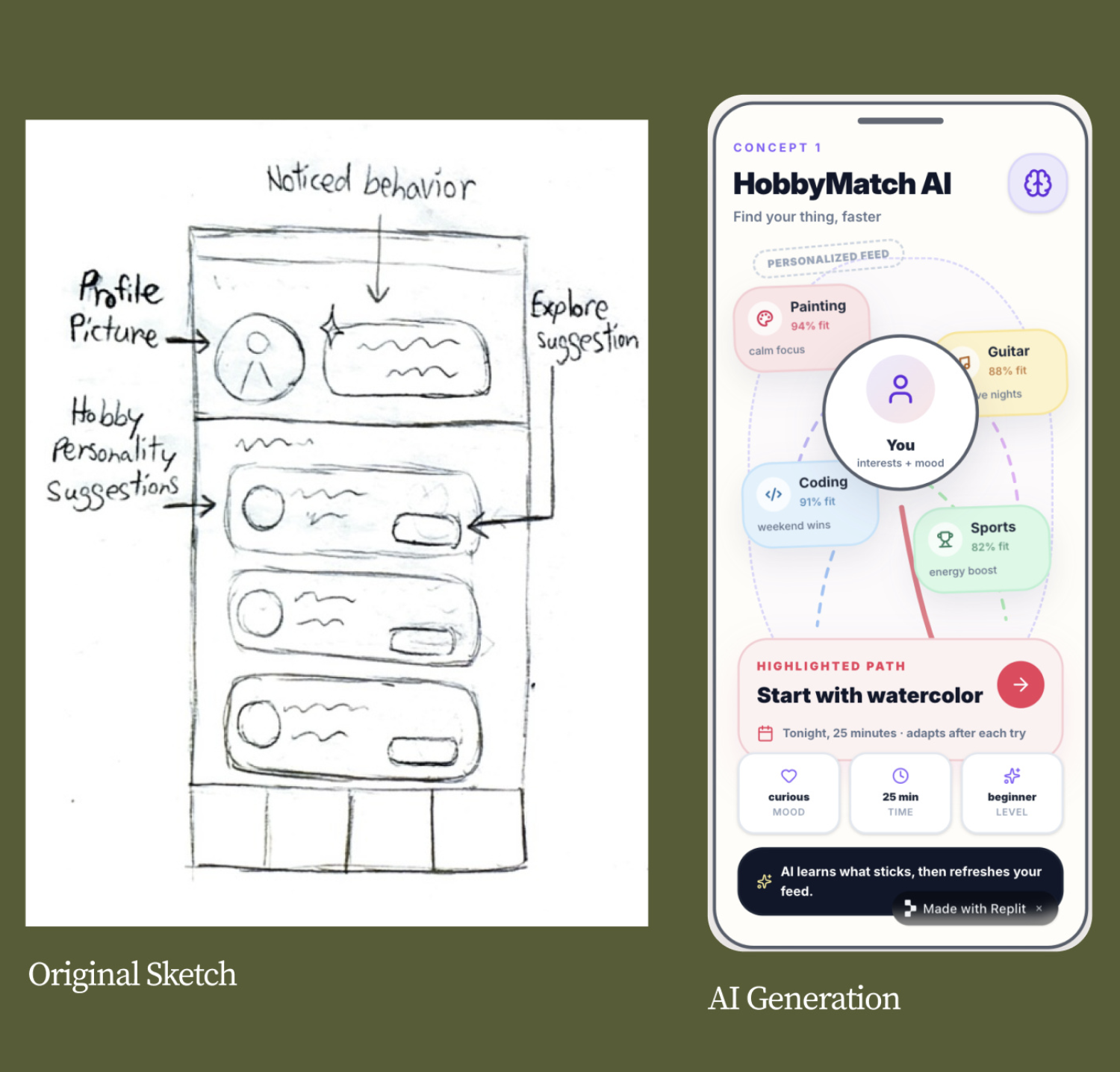
Concept Sketches: Harmonizing, Encouragement and Neighbourhood Engagement
We reflected on three potential modes of getting users to interact and to delve into the hobby lifestyle more.
- Hobby Harmonizer: Our first concept iteration revolves around analyzing the users’ past behavior to then match users with hobbies that most fit their personality. The Hobby app harmonizes with the user’s hobby abilities.
- Personalization
- Prediction
- Recommendation
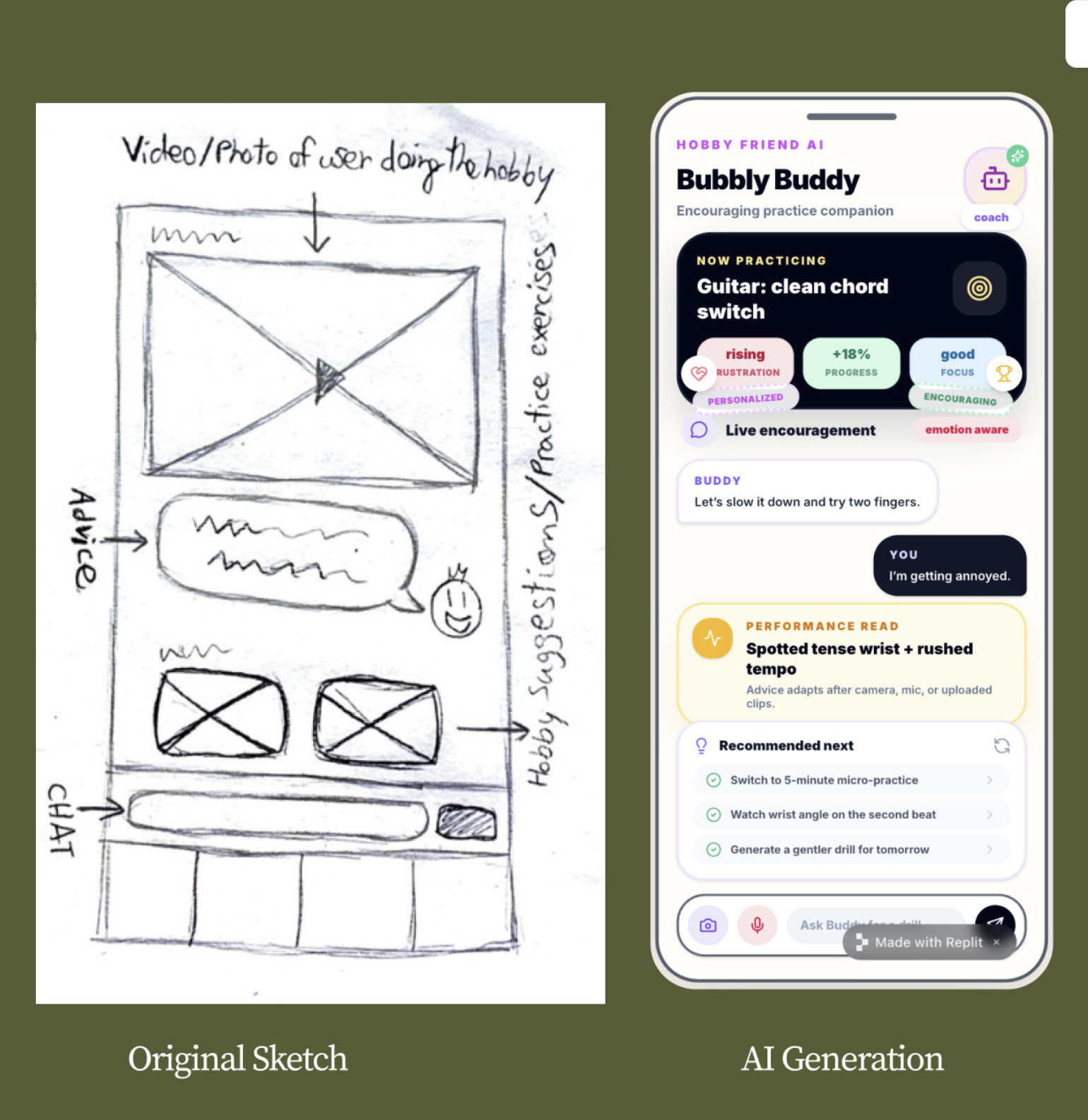
- Hobby Bubbly Buddy: A friend who chats with the user and encourages the user as they learn a new hobby or skill. The chat can also recommend advice after seeing and analyzing their hobby performance. It can sense the user’s frustration with certain tasks and respond accordingly.
- Conversational
- Recommendation
- Generative
- Personalization
- Emotional Sensing
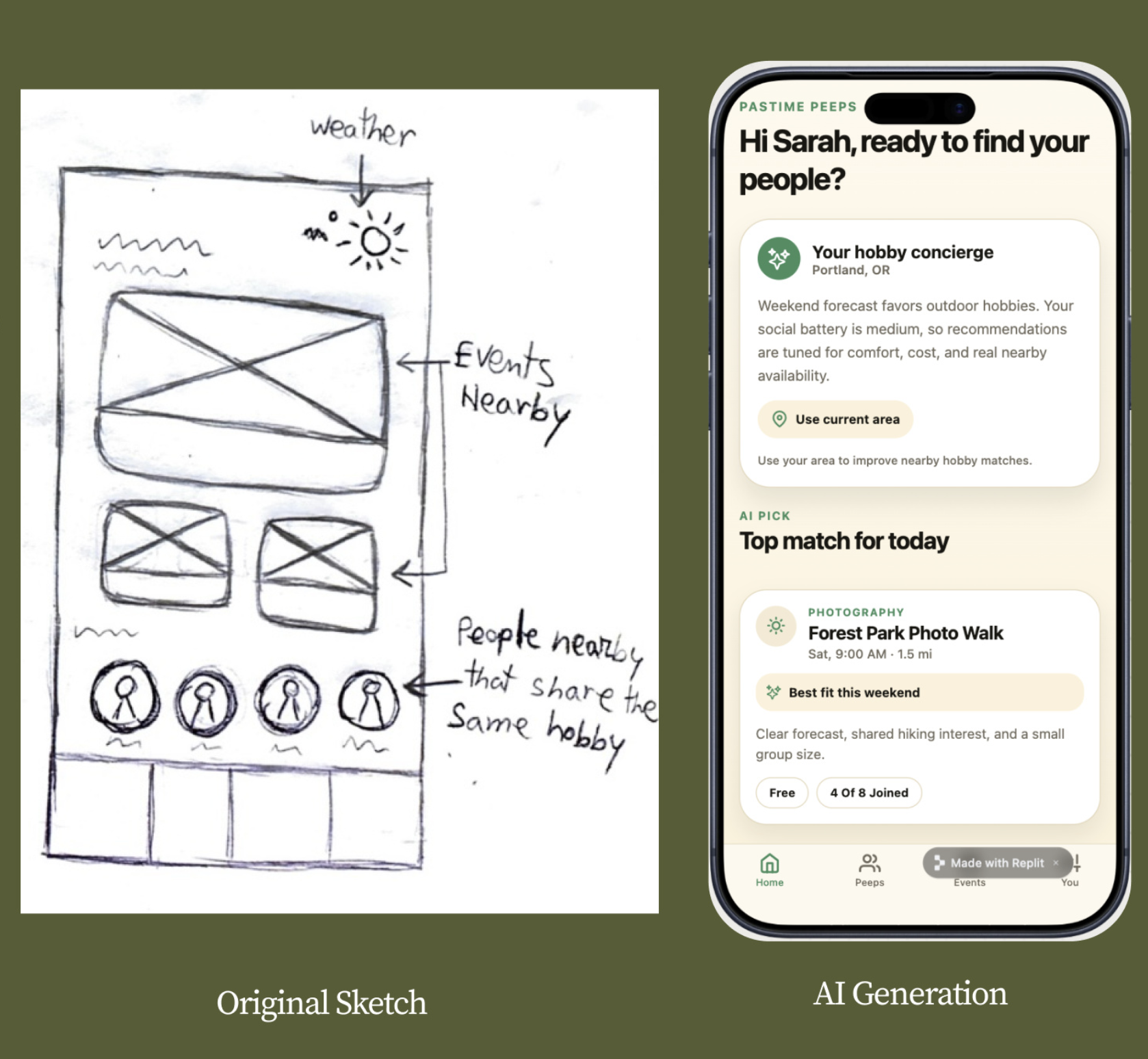
- Pastime Peeps: It matches and links users up with people who have similar hobbies and hobby events that best suit their geographical location, weather, and financial needs.
- Personalization
- Recommendation
- Prediction
- Constraint-Based
Final Designs Decisions: Defining our Concept, Colors and Font
The Chosen Concept: Getting Users in Tune to Hobbies that Most Suit Them
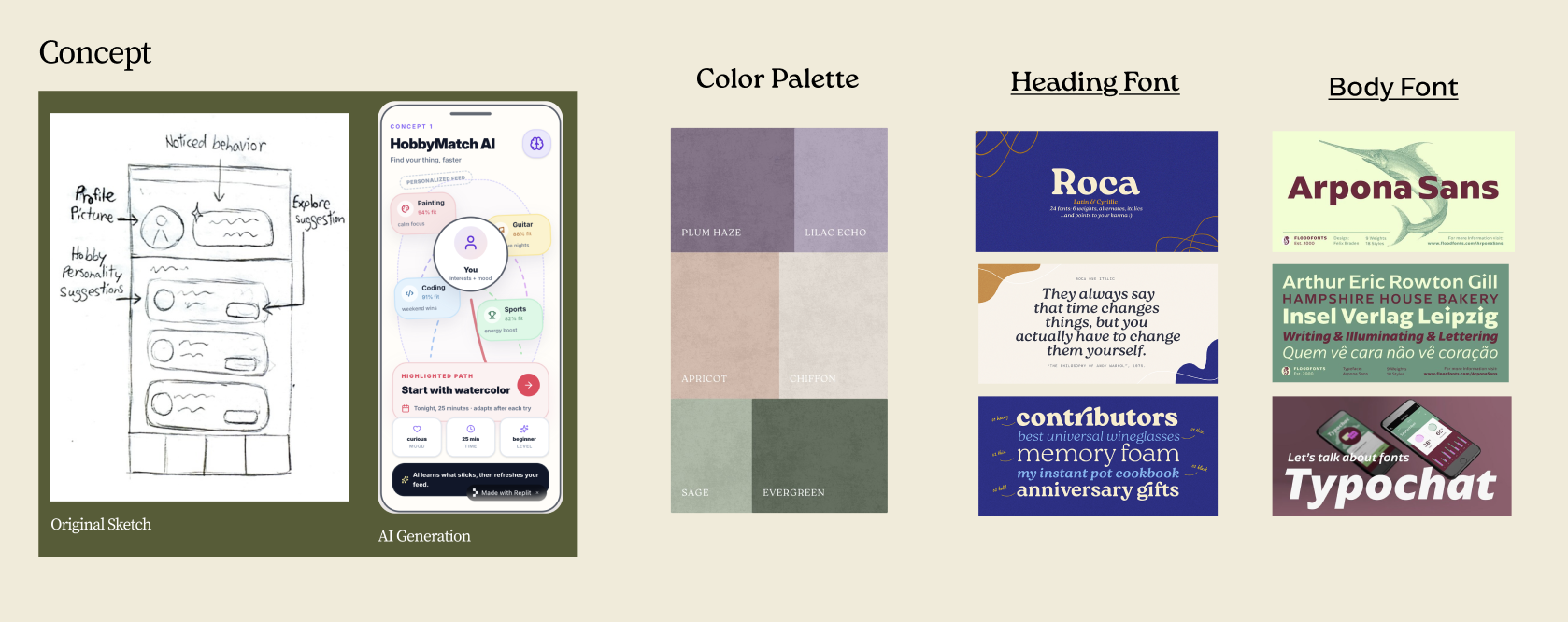
The application analyzes the users’ behavior through their mobile phone habits to then match users to hobbies that fit their personality. The Hobby Harmonizer application harmonizes and syncs to the user’s past hobby abilities, user habits, and any information about their interests that it can find through their phone, search, or social media use.
Personalization
- The application will use AI to match users to hobbies that match their personalities. This includes finding the users’ likes, dislikes, and interests through their social media and phone activity.
Prediction
- It will predict hobbies that the user may be interested in or is already interested in according to their phone habits or geographical location.
Recommendation
- It will recommend hobbies based on the user’s preferences.
The Chosen Styles: From Calm Purples and Greens to Roca and Arpona Sans Typography
After careful consideration, the team decided that the feel of the product should strive for a balance between calming and playful.
Our color palette was chosen to reflect the calm, grounded feeling we wanted users to associate with stepping away from their screens.
We anchored the palette in muted, nature-inspired tones.
- Plum Haze (#837086) and Lilac Echo (#B2A3BA) bring a soft, introspective quality
- Sage (#A8B5A1) and Evergreen (#61705E) nod to the outdoors and the idea of getting off your phone and into the world
- Apricot (#D8BBAD) and Chiffon (#DFD6CD) add warmth and approachability, keeping the palette from feeling too cool or clinical
For typography, we struck a balance between playfulness and utility.
We chose Roca as our display and header font for its rounded, friendly personality; it feels inviting without being childish. Arpona Sans handles body text with clean readability and a slightly calming warmth that pairs well with Roca’s character.
The combination gives Hobby Harmonizer a voice that is both trustworthy and approachable, which felt essential for an app asking users to share their habits and digital behaviors.
AI Principles & Adaptability: Transparency, Explainability, and Adaptive
We asked AI what the best way was to gain trust with users when AI was involved in an application, because who better to ask about AI than AI itself?
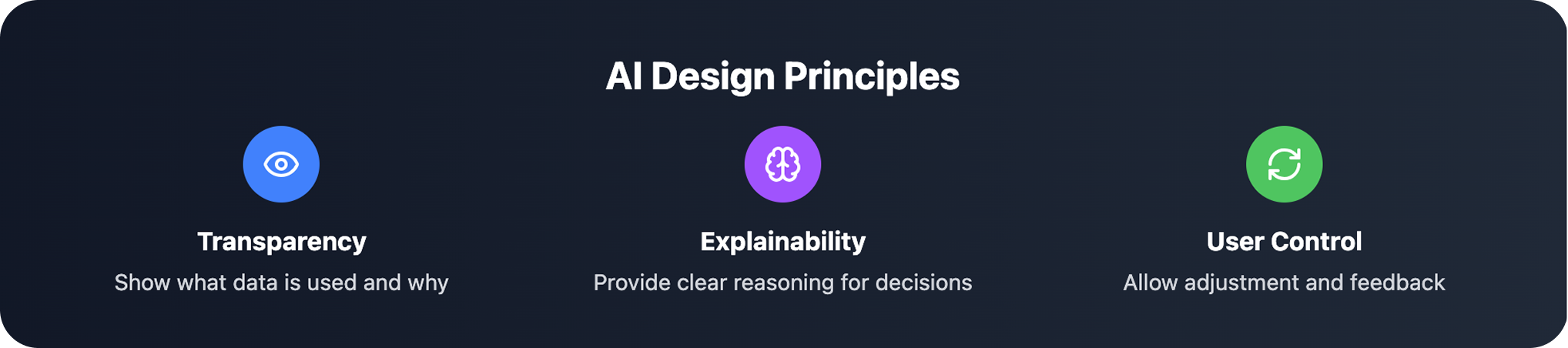
This led us to focusing on three main principles:
- Transparency
- Always show where the data comes from.
- Explainability
- Always explain why and how these hobbies match the user
- User Control
- Always give the user control over what the AI can access within their mobile device and allow them to be able to adjust those features.
Then we focused on how we could combine our principles into the Hobby Harmonizer and how the AI would adapt within our application constraints.
This led to three key AI moments and journeys within the harmonizer.
- Transparent Behavior Analysis
- Show users where these matches are coming from based on their behavior.
- What behaviors led to these recommendations?
- The app does not hide this information from the user and displays it right there in the application.
- Explainable Recommendations
- Compatibility scores further inform the user about how much their behaviors match the hobbies chosen
- Explains to users their stress levels & why they got certain matches right there in the application
- Adaptive Learning Feedback Loops
- Letting them control the setting of the app to decide what AI gets access to.
- Calendar Events
- Screen Time
- Location
- Letting them control the setting of the app to decide what AI gets access to.

Final Prototype & Demo
3 Main AI Interactions: Chat, Match, and Inspire
The Hobby Harmonizer prototype brings AI to life through three key features, each designed to feel helpful rather than intrusive.
Chat with Harmony: Have More Control Over Your Suggestions
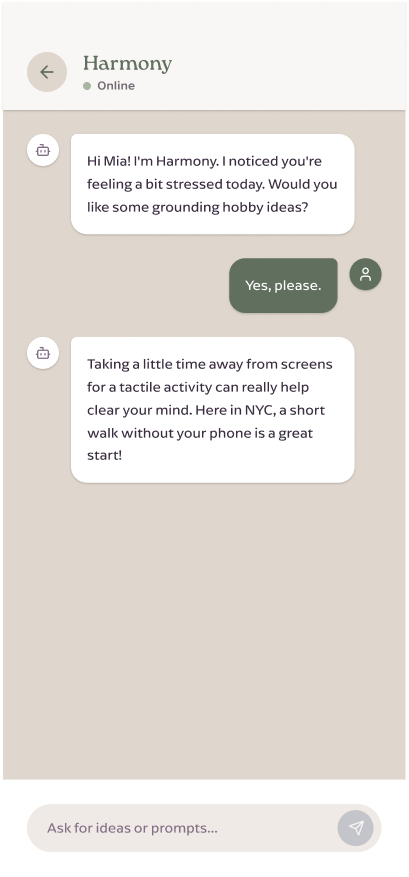
Harmony is a conversational AI companion users can turn to at any point in their experience. Rather than being purely reactive, Harmony checks in with users and surfaces context-aware suggestions. For example, if Harmony detects that a user is feeling stressed, it will proactively offer grounding hobby ideas tailored to their current mood and location.
- Chat directly with Harmony to get hobby ideas beyond your match list
- Personalize your experience by letting Harmony learn your preferences through conversation
- Ask Harmony to explain its reasoning; why was a specific hobby suggested for you?
Hobby Match: Weaponize Your Phone Usage for Good
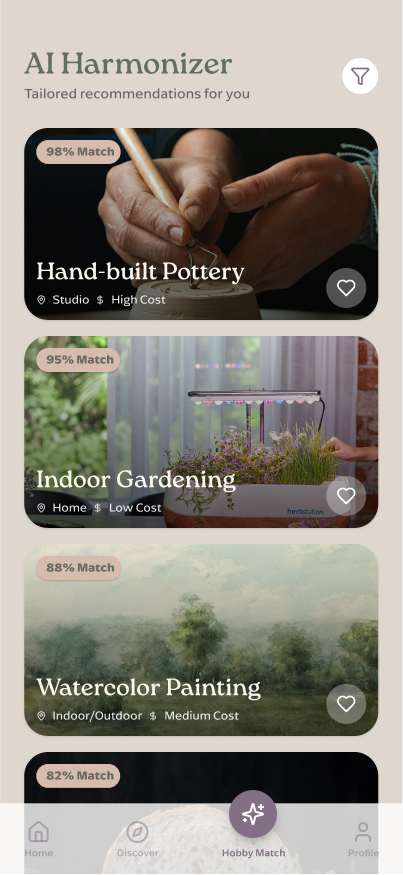
The Hobby Match screen is where the AI’s analysis becomes visible. Using the user’s digital habits, Harmony generates a ranked list of hobby recommendations. Each with a compatibility percentage that shows how closely the hobby aligns with the user’s behaviors and interests.
The screen also presents data-driven context, like noting that a user has been saving a lot of abstract art to their Pinterest boards, to make the reasoning feel transparent and personal.
- Browse hobby matches ranked by compatibility percentage
- See location tags and cost indicators at a glance (Home, Studio, Low/Medium/High)
- Filter matches by location, cost, and other preferences to further tailor results
- Save hobbies you’re interested in to revisit later
InspirAItion — Don’t Know How to Start? Don’t Stress!
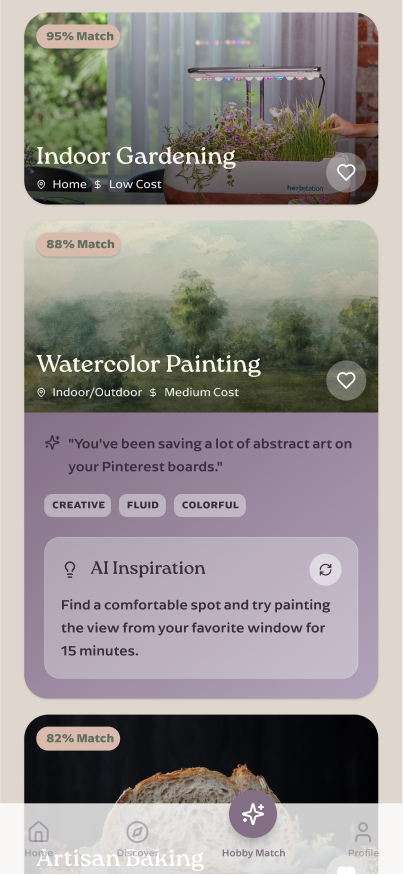
Sometimes knowing you’re interested in a hobby isn’t enough. Getting started is often the hardest part. That’s where the AI Inspiration feature comes in. Embedded directly within each hobby card, this feature generates a short, actionable prompt to help the user take their very first step. Users can refresh the prompt as many times as they need until something clicks.
- Receive a bite-sized, personalized starting point for any hobby (e.g., “Find a comfortable spot and try painting the view from your favorite window for 15 minutes”)
- Regenerate the prompt until you find one that feels right
- Prompts are tailored to the user’s context, including time of day, mood, and location
Next Steps: Explanations, Expanding and Scheduling
The Hobby Harmonizer has a strong foundation, but there’s plenty of room to grow. Our next steps focus on deepening the AI’s intelligence, expanding how users interact with it, and making hobby planning feel more seamless in everyday life.
Defining Matches and Energy Levels More
The home screen already surfaces a mood and energy reading. For example, flagging that a user seems stressed based on their rapid scrolling and short interactions that morning. However, we want to explore making this system more nuanced and trustworthy. Next steps include:
- Training the AI to more accurately distinguish between energy states (e.g., low energy vs. focused calm vs. mentally drained)
- Giving users the option to manually input or override their mood if the AI’s read doesn’t feel right; putting control back in their hands
- Refining what behavioral signals (scrolling speed, app-switching, time of day) feed into the energy model so recommendations feel more earned and less arbitrary
Expanding AI Capabilities
Right now, Harmony is great at getting users started. The next phase is helping them go deeper. This means growing Harmony from a discovery tool into a long-term hobby companion:
- Suggesting new hobbies over time as the AI learns more about the user’s evolving interests and completed activities
- Introducing a hobby progression feature. For example, if a user is learning guitar, Harmony could suggest specific skills to work on next, beginner-friendly songs to try, or practice routines tailored to how much time they have
- Expanding the ways users can interact with the AI beyond chat and match cards, such as voice input or quick check-ins
Hobby Calendar and Scheduling
One of the biggest barriers to actually doing a hobby is finding the time. Integrating with users’ calendars would allow Harmony to suggest hobbies that genuinely fit into their day, not just hobbies they’d like to do in theory:
- Connecting the app to calendar events so Harmony can identify open windows and recommend hobbies that fit the available time
- Allowing users to schedule hobby sessions directly within the app and set gentle reminders
- Using calendar context to make smarter suggestions (e.g., recommending a short solo activity before a busy afternoon, or a social hobby on a free weekend)