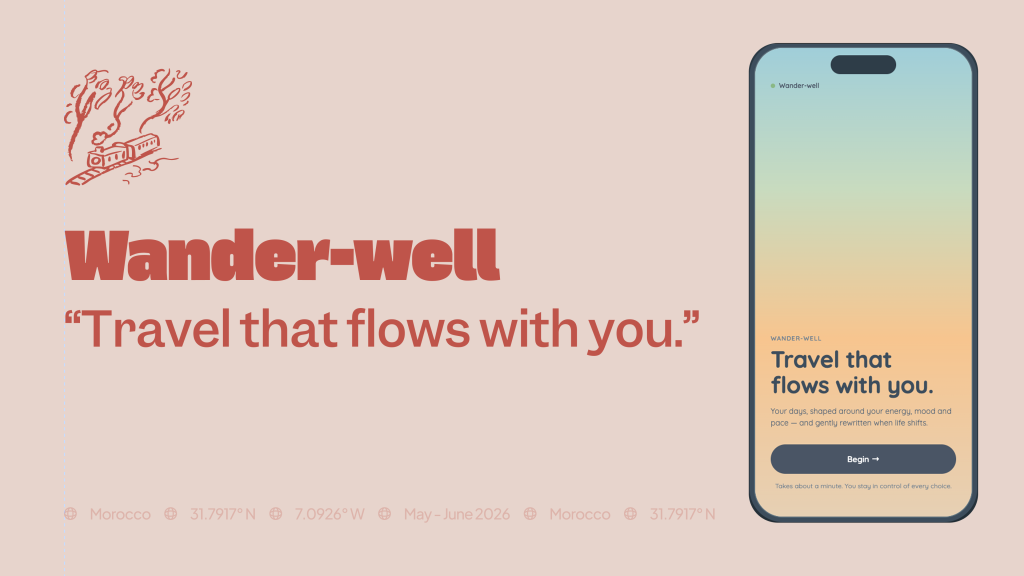
Designing emotionally adaptive travel experiences, with AI and using AI.
An AI-powered travel companion that co-creates emotionally adaptive itineraries based on energy, mood, pace, and real-time context.
Overview
Travel planning today is optimized for logistics.
But through our research, we found that people don’t want perfectly optimized travel. They want travel that adapts with them.
People slow down when they’re tired. Plans shift because of the weather. Group dynamics change throughout the day. Sometimes the best moments happen completely unplanned.
Yet most travel tools still treat people like static schedules instead of emotional, evolving humans.
Wander-well began as an exploration into what emotionally adaptive AI planning could look like if travel experiences were designed around energy, mood, flexibility, and real-time context instead of rigid optimization.
This project was created as part of a UX Design for AI Products course.

What made this project unique was that AI became embedded not only within the product experience, but throughout the entire design process itself.

Using tools like ChatGPT, Claude, Gemini, Figma Make, FigJam AI, and Replit, we experimented with AI-assisted research synthesis, adaptive journey mapping, interactive personas, visual exploration, and rapid prototyping workflows.
Exploratory Research
Travel planning is fragmented, exhausting, and often disconnected from how people actually feel while traveling.
Through 4 interviews and exploratory research, 4 key insights emerged:
- Structured Flexibility: Users wanted enough structure to feel secure while still leaving room for spontaneity and in-the-moment decisions.
- Emotional & Contextual Adaptation: Travel choices were heavily influenced by mood, energy, weather, crowds, and changing real-time conditions.
- Reduced Cognitive Overload: Fragmented planning across multiple tools and managing multiple preferences created decision fatigue, especially during collaborative or group travel.
- Trust Through Transparency: Users were skeptical of generic AI recommendations and wanted systems that could explain suggestions in a contextual and human-aware way.
This revealed an opportunity to rethink travel planning not as rigid optimization, but as emotionally adaptive decision-making.
AI for Research Synthesis
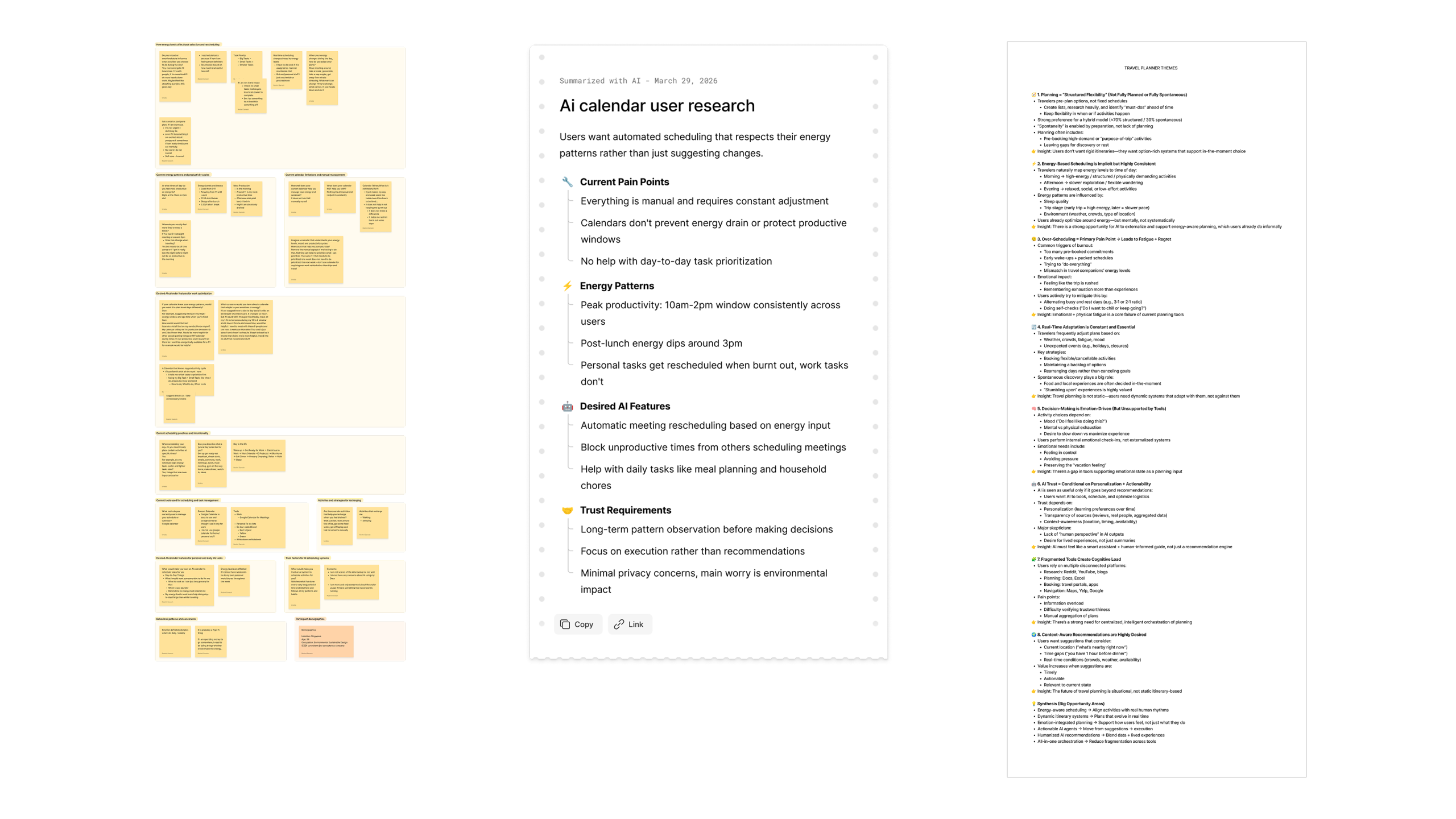
- We used FigJam AI to cluster interview notes by topics and
- ChatGPT + FigJam AI to identify recurring themes, patterns, and key insights from our research.

AI worked surprisingly well during this stage, helping us move much faster through large volumes of qualitative data while still grounding decisions in real human interviews and observations.
Interactive Personas
AI for Interactive Personas
One of the most experimental parts of the project was turning personas into interactive conversational systems.
Using all the research insights, instead of just creating static personas, we experimented with AI-generated interactive personas using ChatGPT's Custom GPT feature.
A productivity-focused professional looking for an intelligent system that adapts to his energy patterns and reduces scheduling overwhelm.
A flexible, experience-driven traveler seeking emotionally adaptive and context-aware travel planning without losing spontaneity or autonomy.
To push this exploration further, we made the personas interact with each other conversationally to simulate what planning and decision-making might look like if they traveled together.
This helped us explore:
- Group negotiation dynamics
- Conflicting travel preferences
- Emotional pacing differences
- Real-time adaptation between travelers
Rather than treating personas as static artifacts, we used AI to turn them into dynamic participants within the design process itself.
You can explore the conversation here
From Research to Exploration
After building a foundation through interviews and interactive personas, we began translating those insights into design explorations through three lenses:
Feel
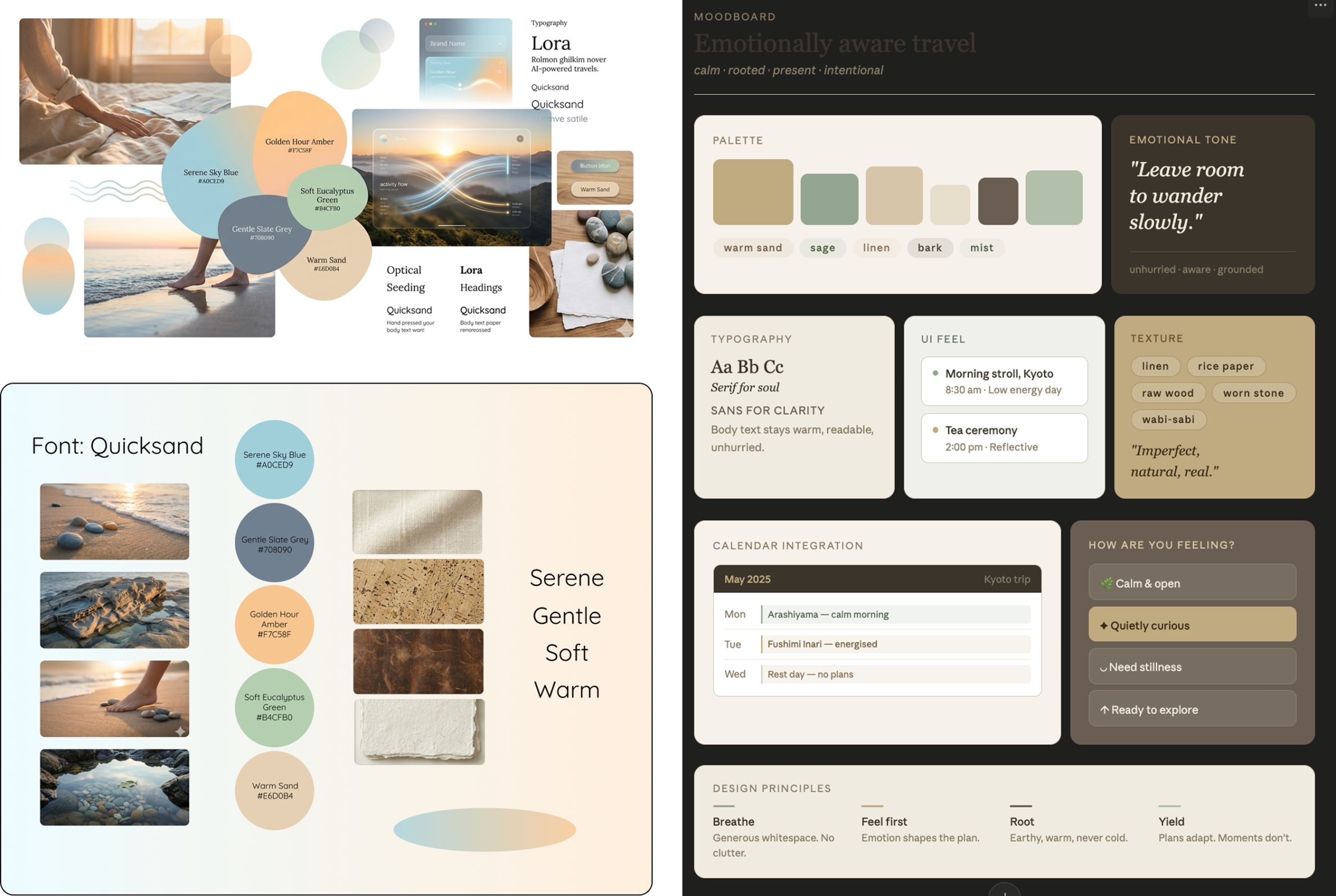
What should emotionally adaptive travel planning feel like?
Using Gemini and Calude, we generated moodboards and visual explorations.
We explored Claude Artifacts and Figma Make, we rapidly explored adaptive journey flows and real-time itinerary logic.
Flow
How should an adaptive AI system evolve over time?
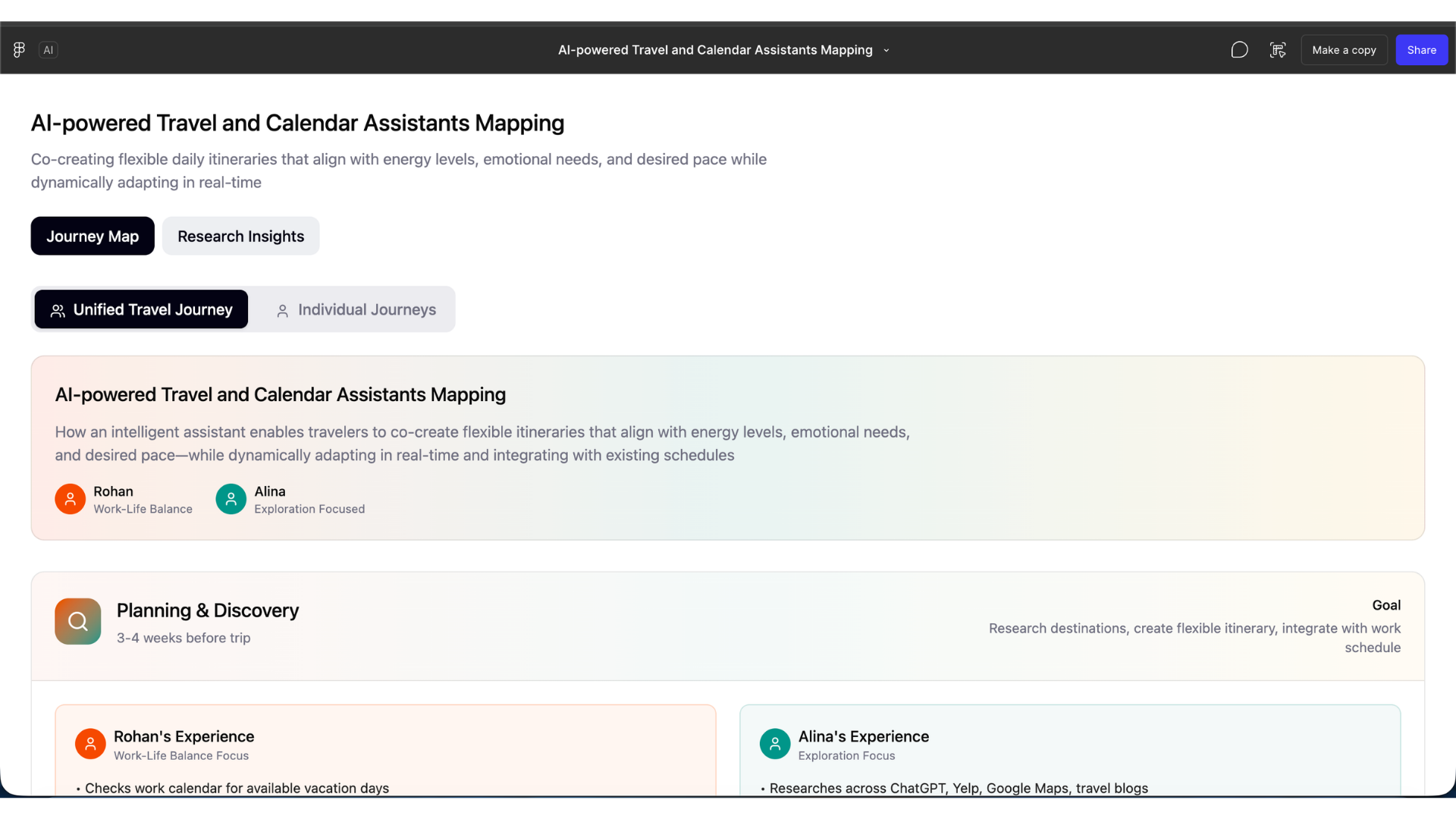
Using Claude Artifacts, FigJam AI Bot, and Figma Make, we mapped adaptive journey flows.
They explored:
- Cold starts
- Learning behaviors
- Real-time itinerary adaptation
- Emotional shifts
- Group negotiation dynamics
Rather than designing one fixed flow, we explored how the relationship between traveler and system could continuously evolve.
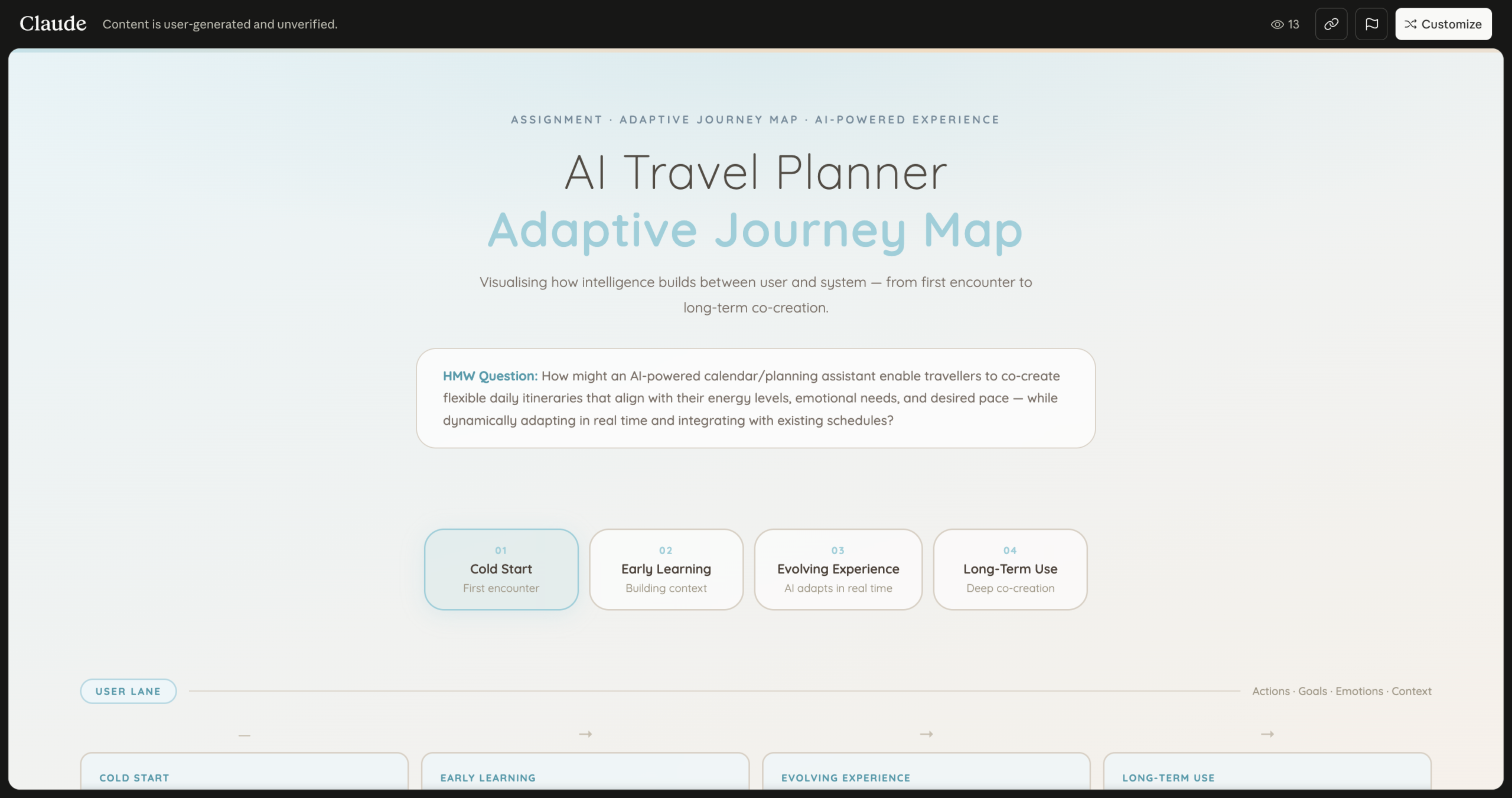
https://claude.ai/public/artifacts/d479de7d-da71-40cd-9345-9bd405e2f5af
Form
What could the onboarding flow of emotionally adaptive AI planning actually look like?
We explored AI-assisted rapid prototyping, and interaction experiments using Replit.
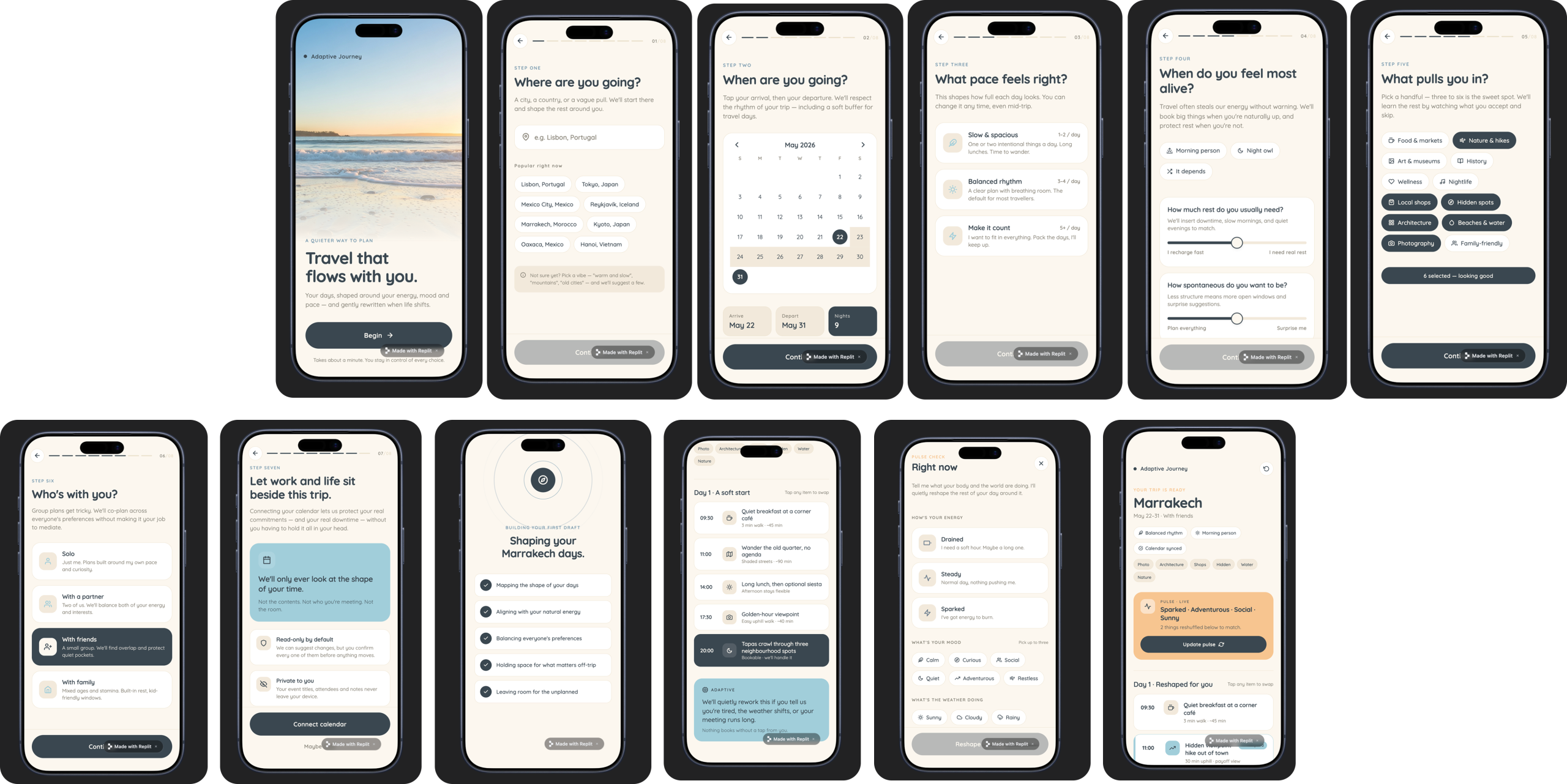
This eventually evolved into Wander-well.
From Exploration to Functional Prototype
Cold Start → Early Learning
We first explored how AI could gradually learn about travelers beyond basic logistics through onboarding and preference customization. Instead of only asking where users wanted to go, Wander-well captured travel style, pacing, interests, and energy preferences to reduce cold-start friction and build more emotionally aware recommendations over time.
AI-Generated Flexible Itinerary
The next exploration focused on adaptive itinerary generation. Rather than creating rigid schedules, the system dynamically reshaped recommendations based on mood, energy, weather, contextual signals, and changing plans.
We also experimented with explainability by helping users understand why activities were being suggested and how recommendations aligned with their emotional pace and preferences.
Emotion & Context-Aware Group Planning
Finally, we explored how AI could support emotionally adaptive group travel. The system continuously negotiated between multiple travelers’ pacing styles, interests, moods, and contextual conditions in real time, enabling more collaborative and flexible decision-making instead of forcing a single optimized itinerary.
Reflection
Wander-well started with a question about travel and ended up teaching us something unexpected about AI.
Throughout this project, AI was everywhere — in our research synthesis, our personas, our prototyping, our visual exploration. And in many of those moments, it genuinely accelerated our work. Moving through qualitative data faster, generating adaptive flows we might not have sketched by hand, turning static personas into conversational participants — these felt like real creative leaps.
But the further we pushed AI as a creative partner, the more clearly we saw its edges.
AI was excellent at pattern recognition and fast generation. It was much weaker at sitting with ambiguity, holding emotional nuance, or knowing when not to suggest something. In early research especially, we noticed ourselves reaching for AI synthesis when we probably needed to slow down and stay closer to the raw human observations. The insights were still grounded in real interviews — but in retrospect, more time with the unmediated data might have surfaced things the clustering missed.
The strongest moments in Wander-well did not come from accepting AI-generated outputs at face value. They came from resisting them — from recognizing when something felt emotionally off, overly optimized, or disconnected from real human behavior, and choosing to redirect the work ourselves. In that sense, the project reshaped how we think about AI in the design process. Its greatest value was not replacing human creativity or intuition, but provoking stronger critical thinking about when human judgment matters most.