Overview
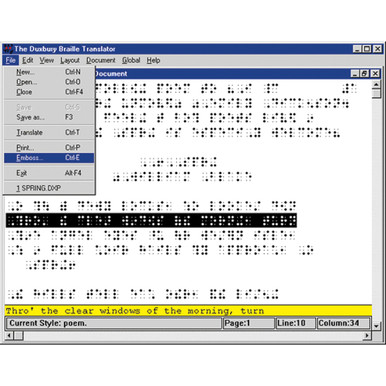
Duxbury’s Braille Translating Software (DBT) allows for users to convert text to braille, making it useful for both braille users and non-braille users trying to make their content more accessible. The software is designed to be easy to use and supports translation for 180 languages.
Dating back to 1975, DBT has been a leading force in braille translation. It is the favored software for many of the world’s leading braille publishers. The software works by having the user input a text file (which the software accepts most types) and then providing the translation line by line. The software prioritizes being user-friendly and has the ability to produce contracted (shorthand) and uncontracted braille, mathematics, and technical braille. Some use cases for the software are braille for school books, teaching materials, office memos, bus schedules, personal letters, and signs compliant with the Americans with Disabilities Act (ADA).
For context, braille is a tactile writing system used by people who are blind or have low vision. It features six raised dots that users read with their fingertips. Many people are aware of the basics of braille but may be unaware that the substitutions of cells for characters are not usually an exact one-for-one. In languages such as English and French, where “grade 2” braille is employed, the procedure is particularly challenging since it involves “contractions” that are partially based on pronunciation. Beyond the problems with print, formatting braille pages presents additional challenges. DBT has word processing capabilities for working directly in both print and braille, as well as translation and formatting capabilities to automate conversion from standard text to braille (and vice versa).
Though the software is highly refined, even the developers will admit for the most accurate results, a fluent Braille user should proofread the output.
Here are some accessibility features of note:
Interline Printing
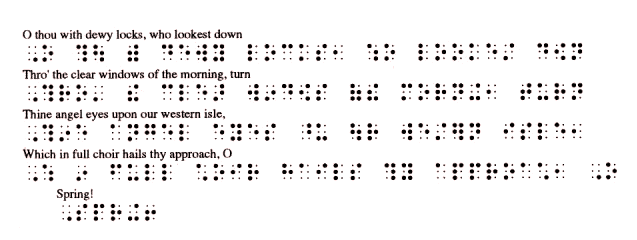
DBT features an interline printing function, where the text and braille translation are shown side by side. This feature is useful for braille teachers, proofreaders, and promotes inclusivity for all types of users. It makes it easy for users to follow along with the information regardless of whether they can read standard text or braille. The social model comes into play here as this allows the environment to be shifted to accommodate for vision impairment, connecting braille and non-braille users.
Mathematics
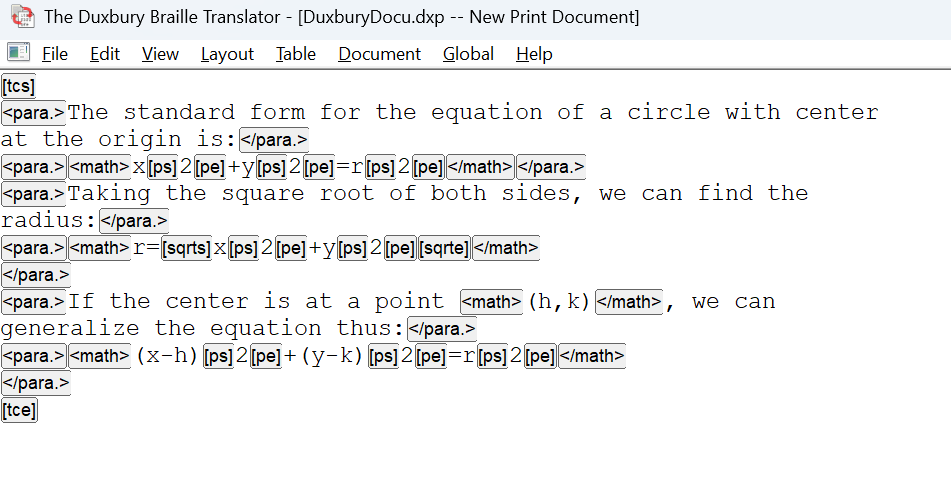
DBT can format and translate mathematical notation into braille using specialized templates and the designated “math” style. This is particularly useful for professors and students, offering an accessible translator for the subject. Here is a list of the braille math systems it supports, taken from DBT’s website:
- Unified English Braille (UEB) – is used in English speaking countries. It has also been adopted by some non-English speaking countries. UEB includes its own braille math code.
- Nemeth Code – Nemeth Code has a shared role in the United States and is widely used in Asia. If a DBT template name contains the word “Nemeth”, that template supports Nemeth code.
- Braille Mathematics Notation (2005) – was used in the United Kingdom until it was replaced by UEB. It is used in many places in Africa.
- Unified French (2006) – is used in France and many French-speaking territories.
- Greek Mathematics (2003) – The Greek system is a slightly modified version of Nemeth Code.
- German (Marburg 6-dot Mathematics 2013) – is used in Germany and other German speaking countries.
- Russian Braille Mathematics (1970) – is used in Russia and in countries historically influenced by Russia politically or economically.
- Arabic Braille Mathematics (2002) – is used in many Arabic speaking countries, and in regions that use Arabic script.
- Spanish Unified Mathematics Code (1988) – is widely used in Spanish speaking countries.
As we can see, there are many different mathematics languages supported by DBT. Depending on how you decide to go about translating math equations with DBT, you may require third-party software. This feature falls under the functional model of disability, as it creates a solution for people who are visually impaired to access the subject more easily.
Pricing
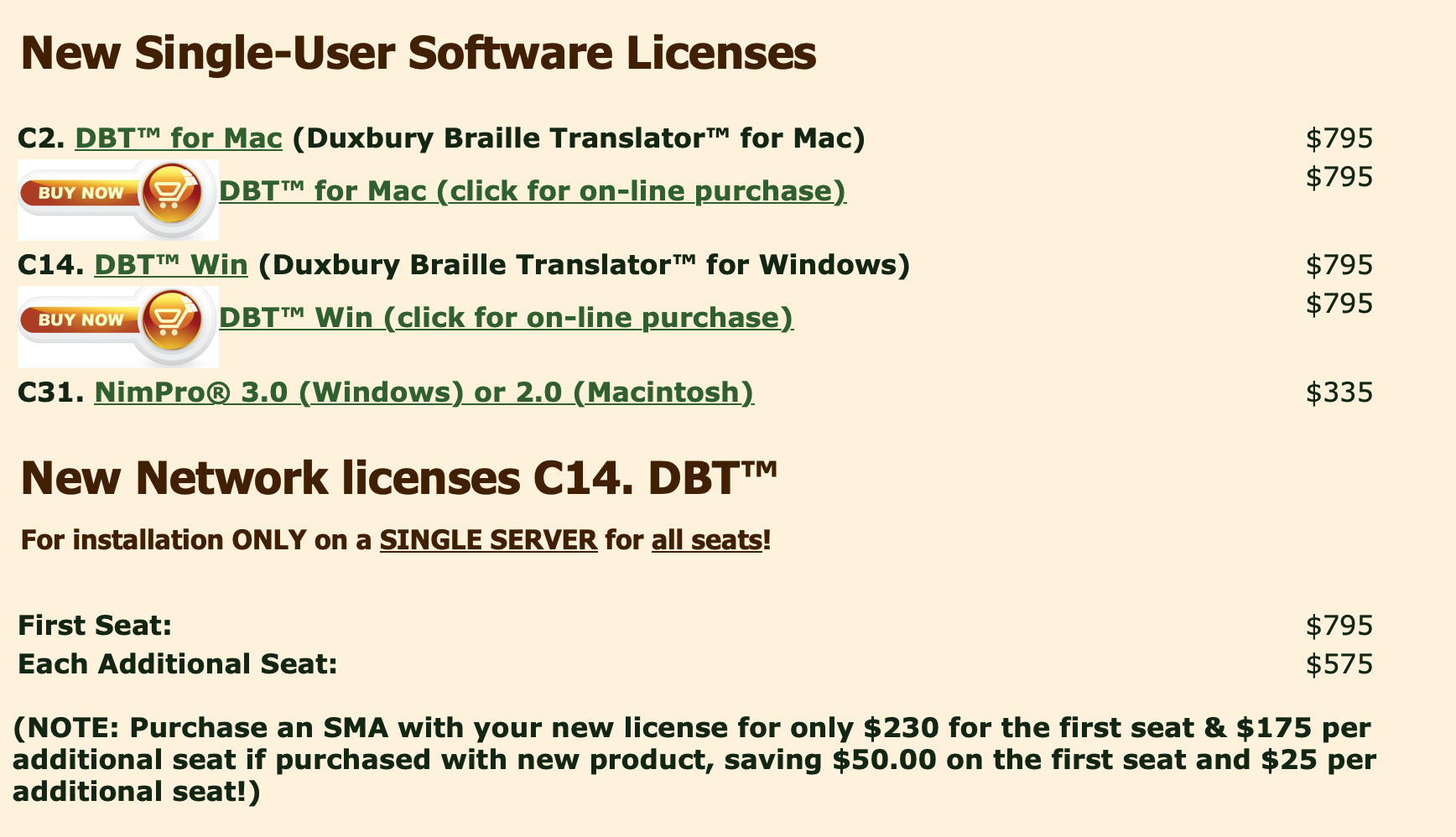
The price point for this software is a little steep at an average of $800 for most users, which dings its accessibility when it comes to affordability. It is an incredibly highly priced software but it could be argued that over time this initial cost is cheaper than if the software employed a subscription model. This also demonstrates the functional solutions model, as it is a product advertised to fulfill a specialized need, so it can be charged higher since there is little competition in the market.
Conclusion
DBT is a transformative software that connects both braille and non-braille users to make content accessible and inclusive. It has been updated heavily throughout the years and continues to be a leading software in the braille community.
Sources:
https://www.duxburysystems.com/default.asp
https://afb.org/blindness-and-low-vision/braille/what-braille