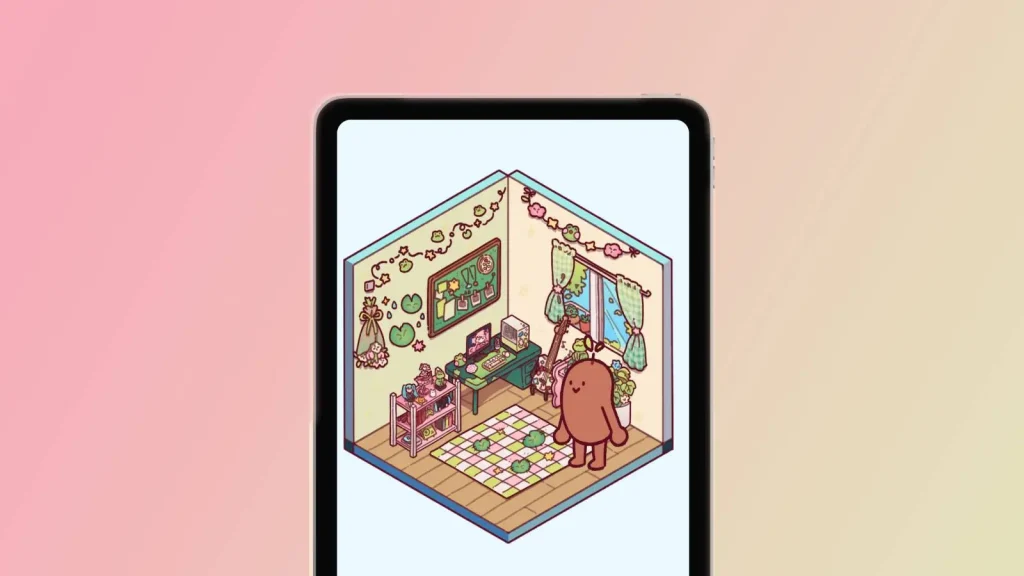
Focus Friend is an app created by online educator Hank Green in collaboration with Honey B Games. It is a cute focus timer app that allows users to restrict all or selected app usage for a period of time so they can “focus” on a needed task. The app’s main functions are its focus timer and the rewarded socks/cards that users can collect to decorate their Bean’s digital home.
The main user goal for Focus Friend is to focus on an analog task without being distracted by their phone. Other goals include being less distracted for a consecutive period of time, earning socks to decorate their room, or using the break timer to remember when it is time to focus again. Utilizing theories from Don Norman’s Design of Everything, I analyzed the main functions and weakness in Focus Friend.
Focus Timer
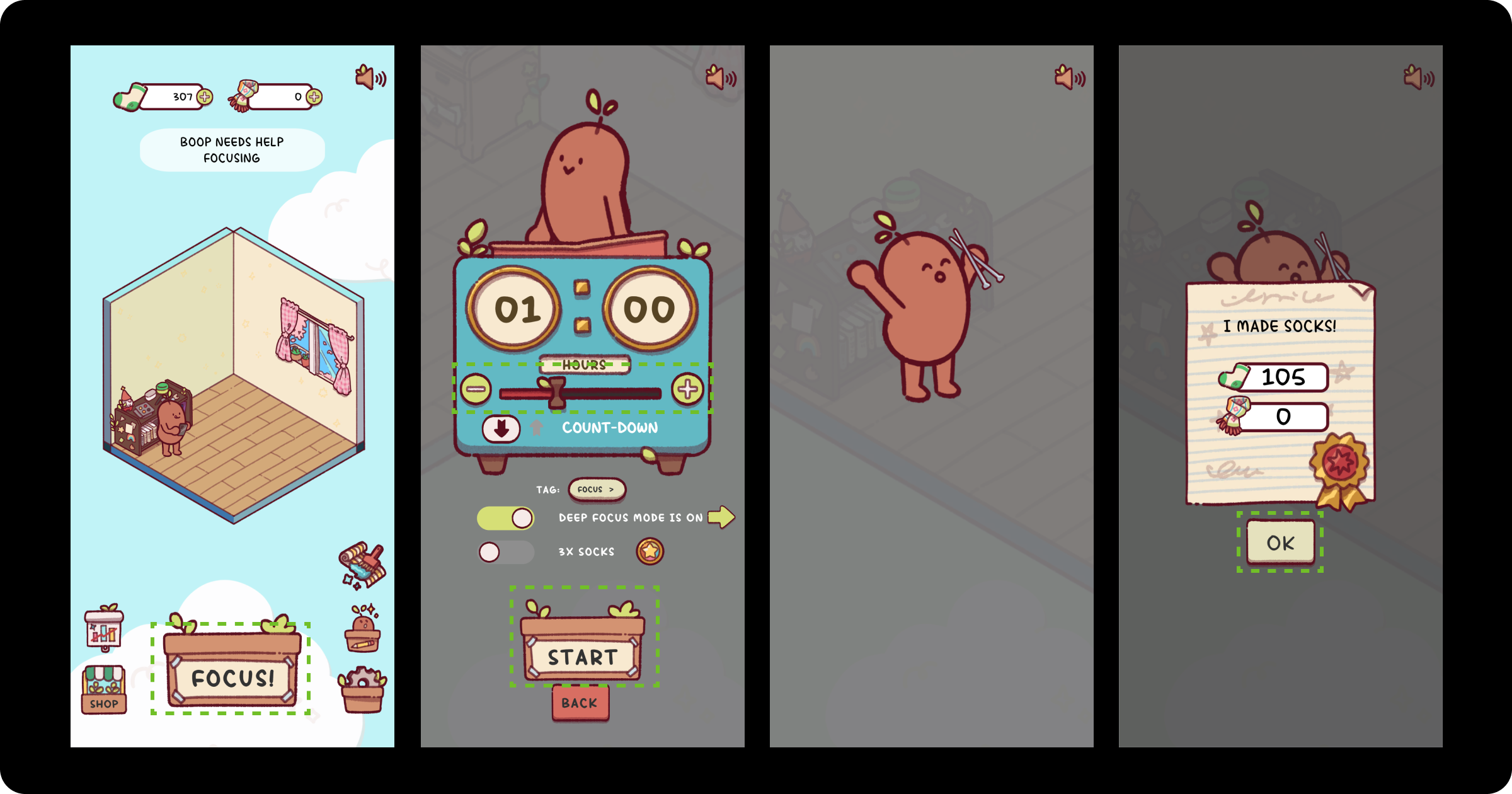
The main feature, the focus timer, allows users to set either a count-up or countdown timer for the period their phone apps will be locked. After setting the time, several clear signifiers communicate that the timer is active. The app zooms into the user’s Bean knitting, the background is grayed out, the timer is displayed prominently, and the only available action is to stop the activity.
The focus timer also uses multiple constraints to guide the user toward the same goal of reducing phone usage. First, all or selected apps are blocked for the entirety of the timer. Second, the user’s Bean remains on screen knitting instead of providing other distracting interactions. Finally, the Focus Friend timer can only be ended early through a deliberate action. These constraints reduce the number of available actions and make it harder for the user to accidentally or casually leave the focus state.
The app also has good discoverability because the visual state makes it immediately apparent what is happening. The user does not need to remember whether the timer is still running because the interface communicates its current state.
Bean and Emotional Design
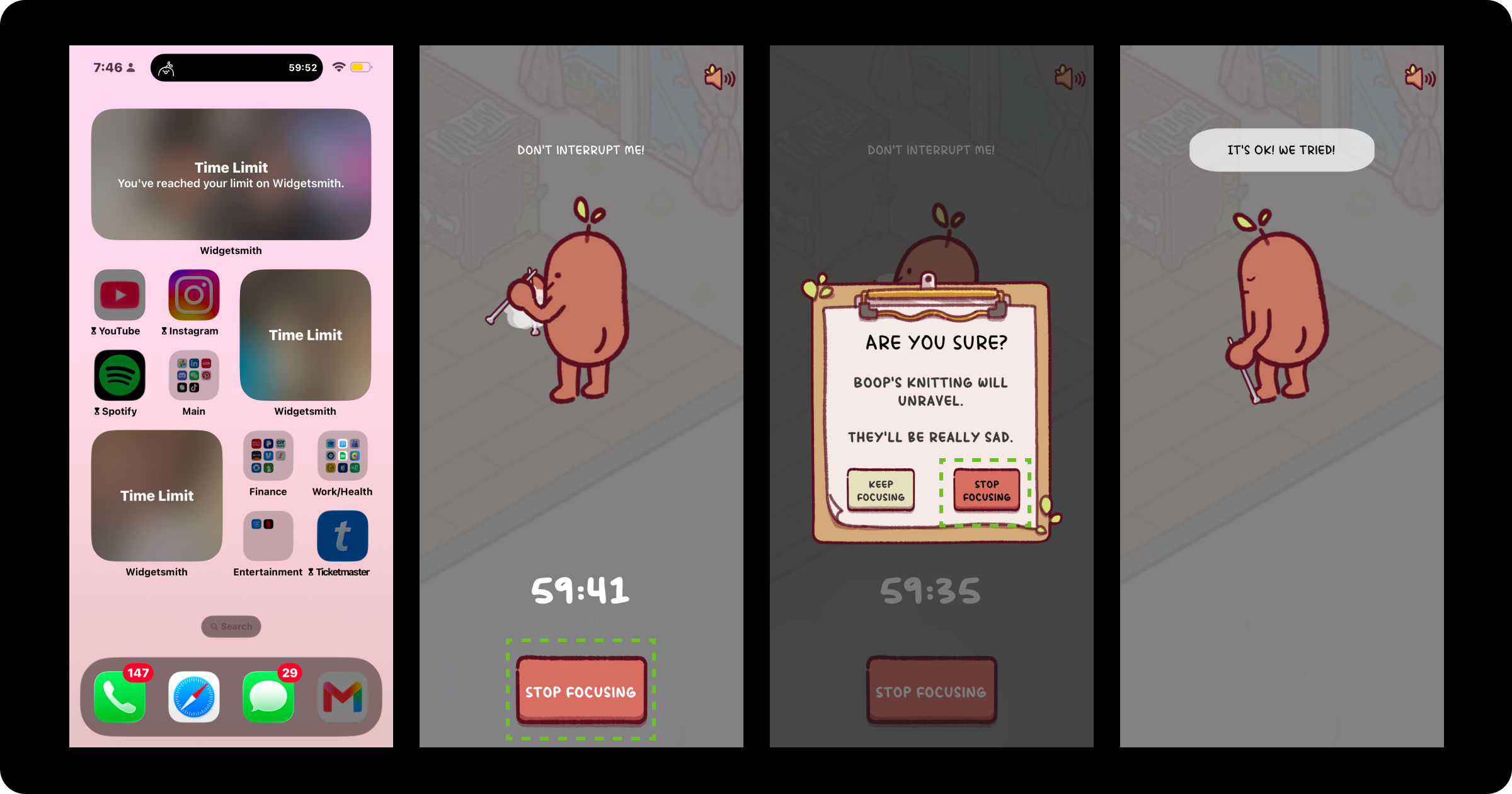
The user’s Bean is an excellent example of emotional design. During a focus session, Bean’s emotions toward successfully completing or ending a timer early mimic the user’s own emotions. This becomes particularly effective when a user wants to leave the focus timer early.
The process can be understood through Norman’s three levels of emotional design:
- Visceral: The user experiences the immediate urge to leave the focus state and open social media, maps, or another app.
- Behavioral: The user follows the instructions required to cancel the timer.
- Reflective: After cancelling, the user may feel guilty or disappointed because Bean looks sad and the knitting progress is lost.
Bean’s expressions and the “Are you sure?” messages act as strong signifiers that appeal to the user emotionally. A person downloading Focus Friend already intends to focus, so abandoning the focus state can naturally feel like failing to accomplish their original goal. Rather than simply telling the user that they should continue focusing, the interface uses Bean as an emotional reminder of that goal.
Home Page and Navigation
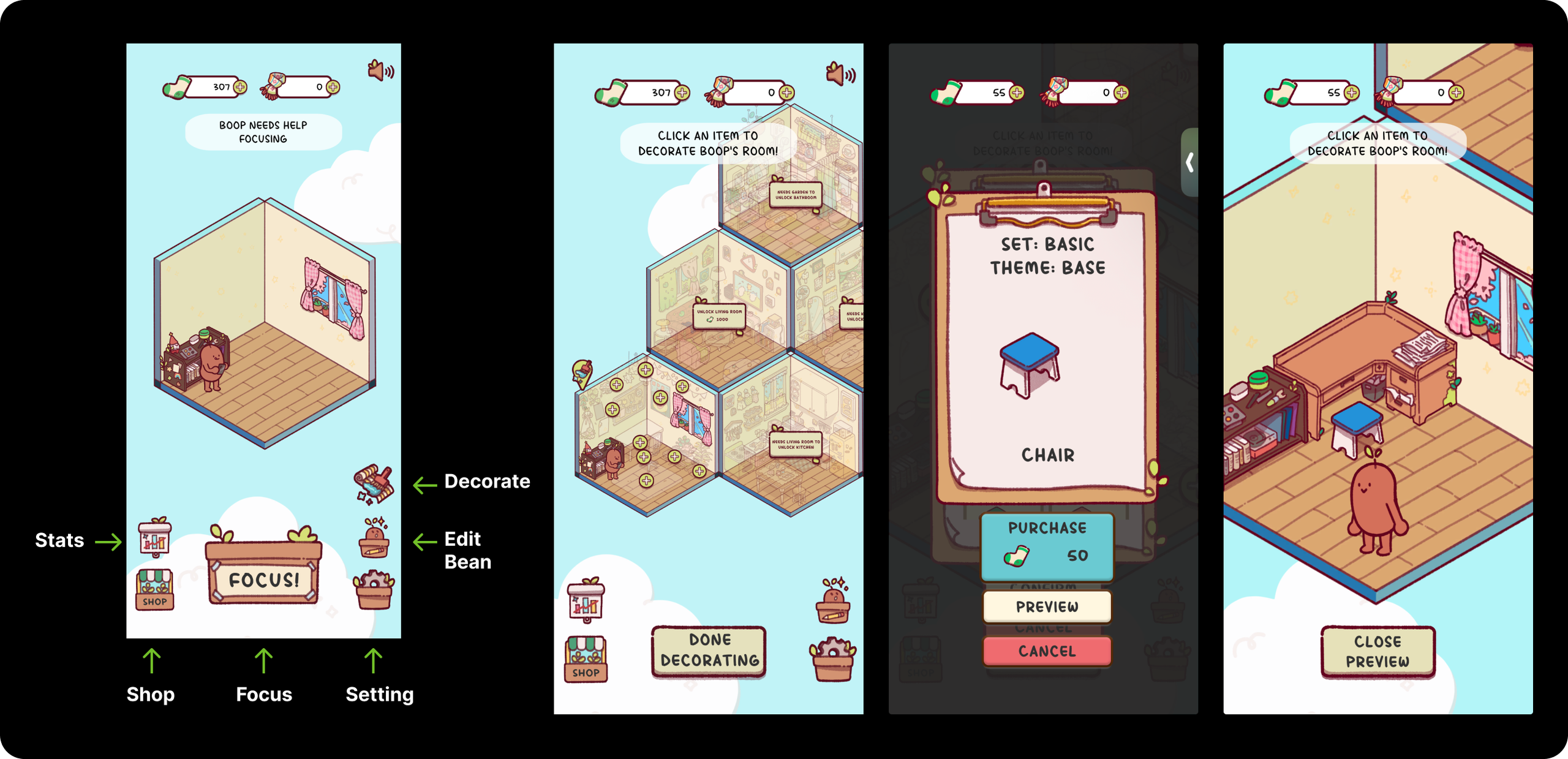
The main screen has a strong conceptual model because it uses familiar signifiers to communicate what each icon does. A paint brush represents decorating, while a gear represents settings. These icons also correspond with conventions used in many other digital interfaces, allowing users to understand their functions without needing a manual.
The decorating feature also uses natural mapping effectively. When users earn socks from their focus sessions, they can preview furniture and decorations directly in Bean’s room before purchasing them. Seeing an item physically placed in the space helps users understand what the reward will look like and reinforces the relationship between the reward and the environment.
Problem: Lack of Urgency
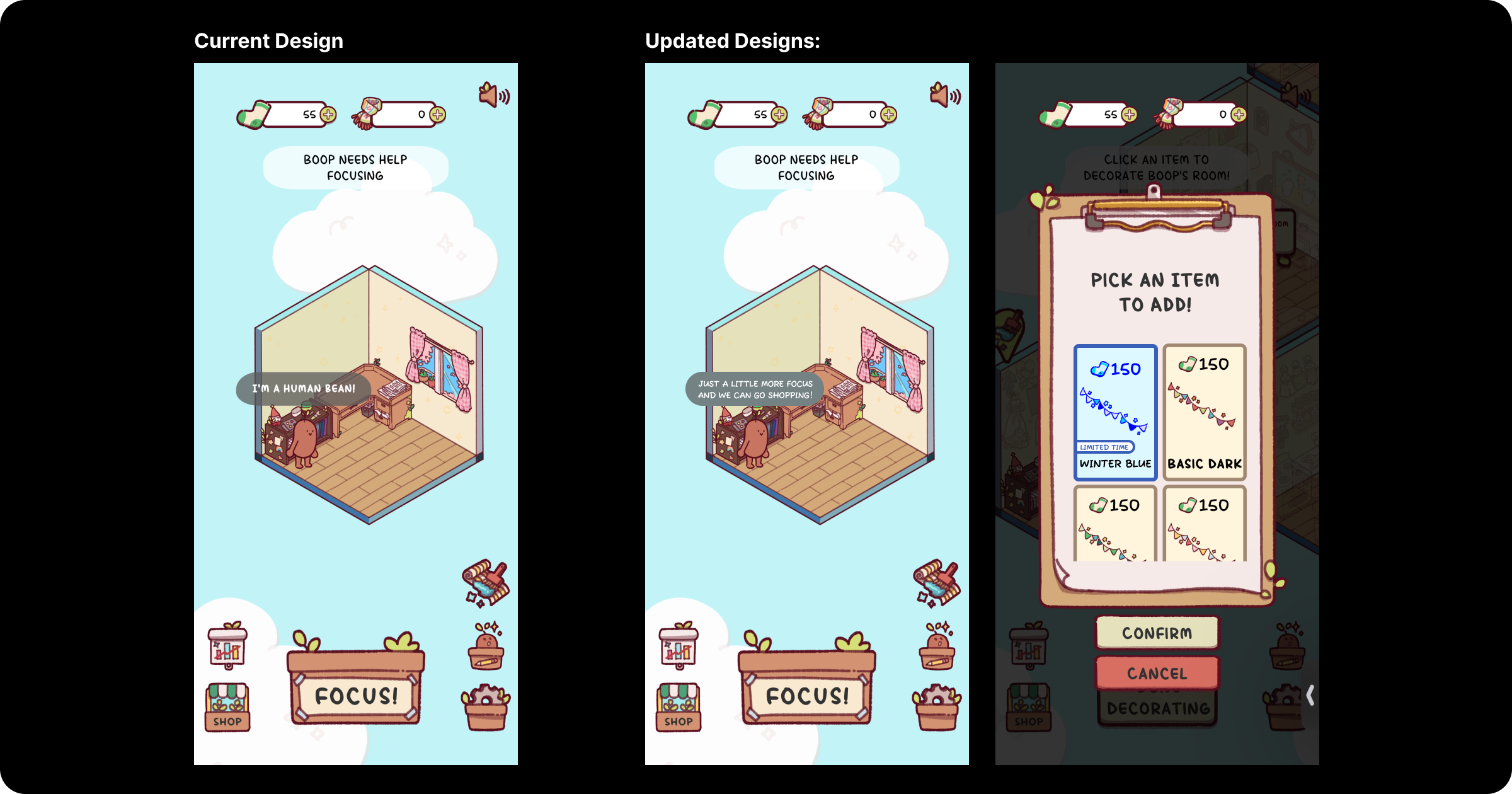
My main problem with Focus Friend is its lack of urgency compared to other cozy games. Bean does not strongly encourage the user to focus, and the statement that Bean needs to focus does not stand out enough to create a strong reason to start or complete a session.
This could be improved by creating more meaningful feedback and incentives. For example, limited-time interior items could give users a stronger reason to complete more focus sessions because they would have a specific goal to work toward. Bean’s dialogue could also provide more motivating feedback, such as encouraging the user at the beginning of a new day or celebrating consistent focus sessions. These changes would not need to make the app stressful; they could maintain the cozy tone while creating a clearer relationship between the user’s actions and their rewards.
Conclusion: Gamification and Rewards
Overall, Focus Friend has a strong combination of constraints, signifiers, discoverability, emotional design, and gamification. Its cozy visual style makes focusing feel more approachable, while the Bean and room decorations give users something tangible to work toward. The absence of photo ads and other distracting content also helps maintain the focus-oriented experience.
The strongest part of the design is that the app does not rely entirely on willpower. It uses constraints to physically limit distractions while using Bean and the reward system to make the experience emotionally and visually engaging. The main opportunity is to make the connection between focusing and earning rewards more motivating. With stronger feedback and a clearer sense of progression, Focus Friend could encourage users to return and focus without losing the cozy experience that makes the app appealing.