Letterboxd is a popular social media platform that allows users to discover, rate, and review movies. Using Don Norman’s The Design of Everyday Things, Letterboxd can be evaluated through its signifiers, feedback, discoverability, and the gulf of execution.
Homepage
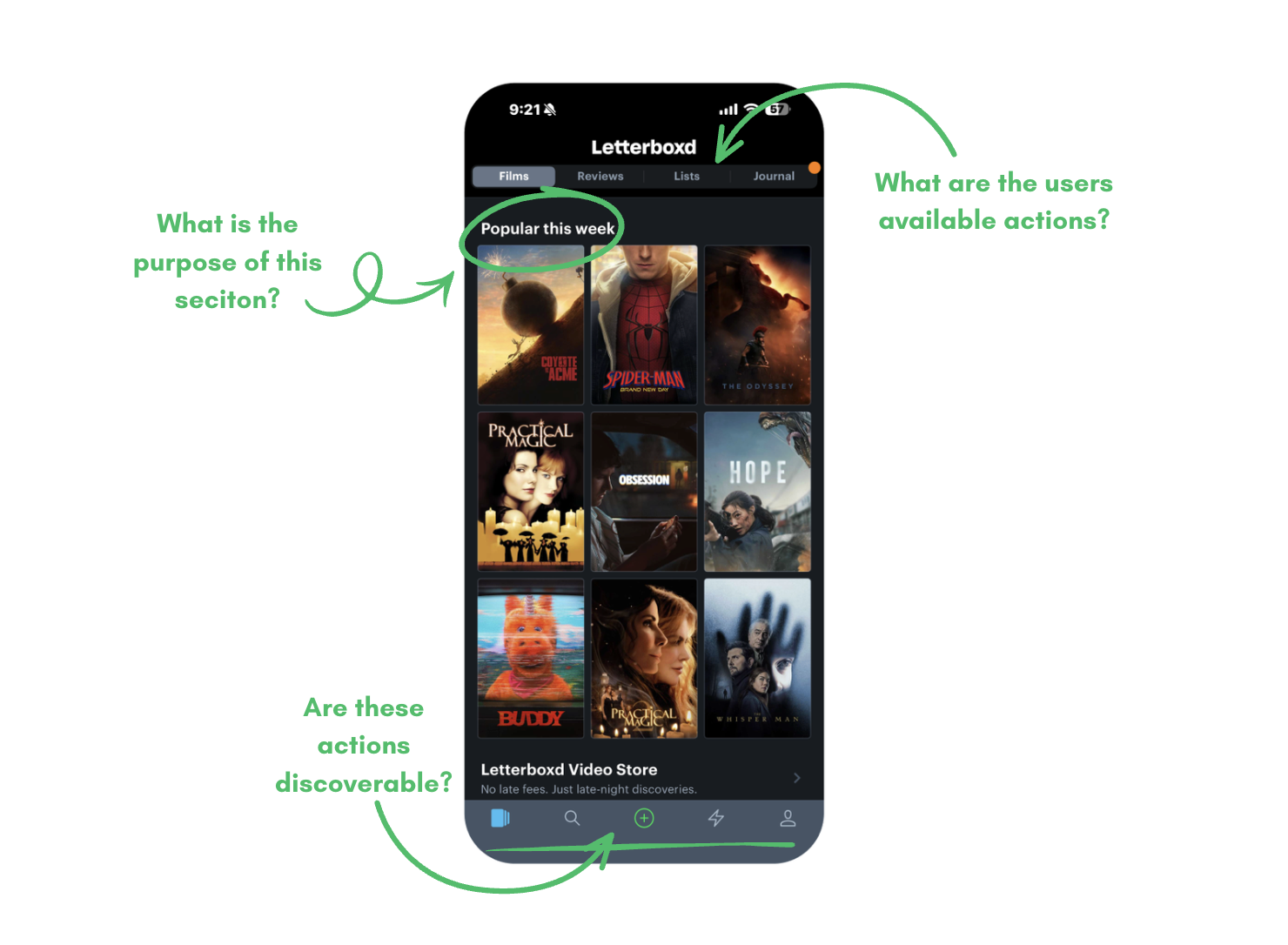
The homepage is the user’s first impression of Letterboxd, and marks the beginning of the gulf of execution where a user must translate their goal into the actions made possible by this interface. Immediately, users are presented with the large “Popular This Week” section. The purpose of this section is to signify that the films can be selected/discovered. This helps users whose goal is to find something to watch.
Additionally, the homepage features a top and bottom navigation bar. Starting with the top navigation bar, the available actions are to select “Films”, “Reviews”, “Lists”, and “Journals”. The highlighted nature of the “Films” category signifies which action the user is currently using. This section reduces the gulf of execution by clearly displaying the categorical actions on Letterboxd. Navigation of this section requires that the user already knows what each signifier means, “Films” and “Reviews” are clear, however sections like “Lists” and “Journals” may require further exploration or explanation to fully understand the actions affordances. The top navigation bar makes action discoverable, however effectiveness relies on the users ability to interpret each label. A suggestion here could be to relabel confusing actions. For example; the signifier “Journal” could be interpreted more successfully as “News” or “Articles” to signify that this section houses written content.
Moving downward to the bottom navigation bar, Letterboxd’s interface switches to visual signifiers in the form of icons. The bottom navigation bar further reduces the gulf of execution by displaying access to more of Letterboxd’s core functions. The “Search”, “Add”, and “Profile” icons are relatively recognizable. However, the “Home” and “Activity” icons are less clear. While all icons are equally discoverable, the signifiers are less intuitive. A suggestion here would be to use the Letterboxd logo as the home button on the bottom navigation bar. This would provide a more recognizable signifier, making it easier for users to navigate back to Letterboxd’s main user interface.
Search
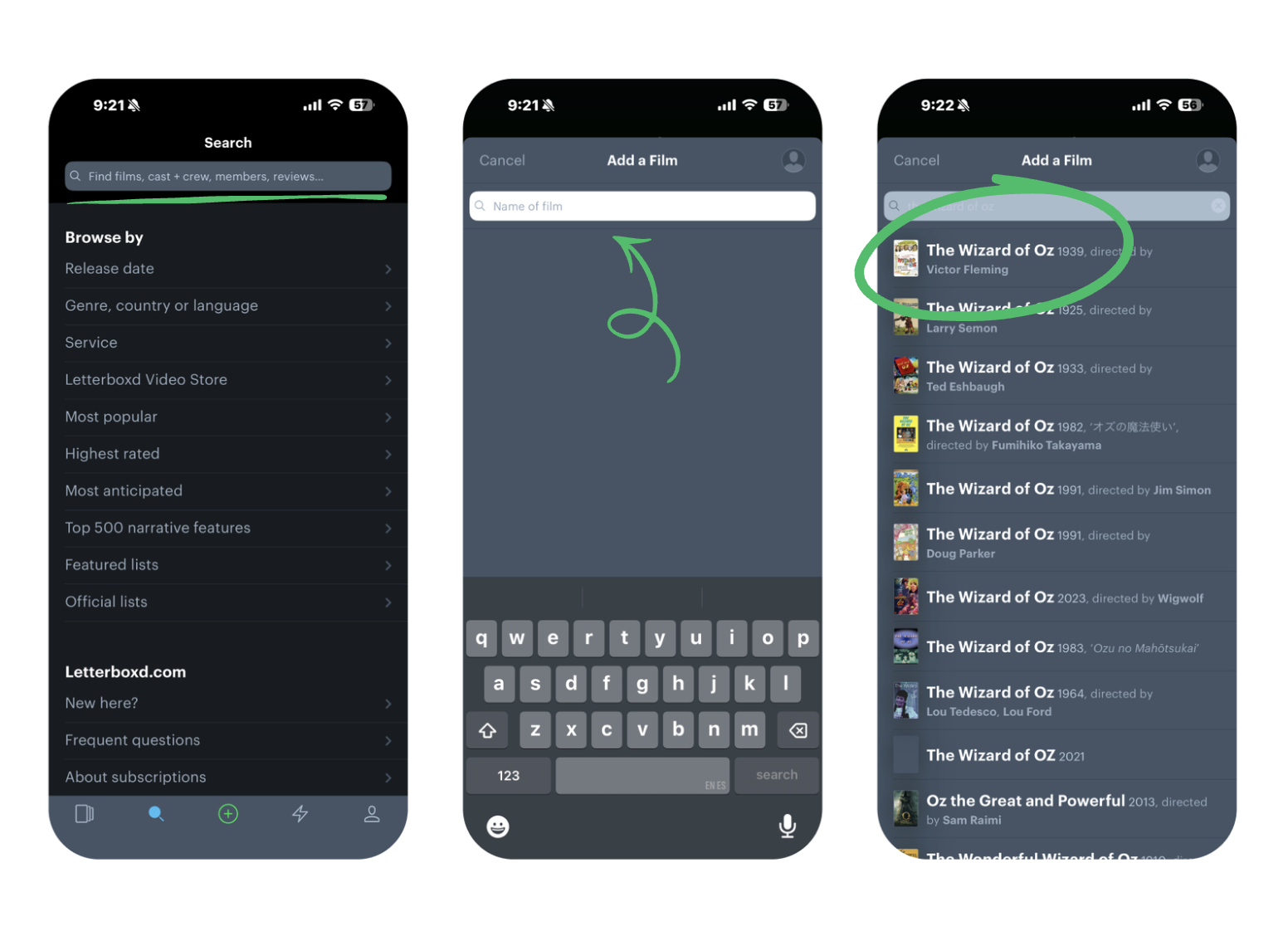
The search bar additionally reduces the gulf of execution, if the user is looking to find a specific film the next step would be to select the search bar icon in the bottom navigation bar. When selecting the search icon, searching for a specific movie, and clicking enter, Letterboxd provides consistent feedback to the user. When selecting the search bar, the keyboard appears indicating the next action is to type the movie name. Upon clicking enter, users are prompted with the results for their search, which is direct feedback to the action previously completed. From this page users can select their desired movie, learn more about it, and rate and review. Overall, the search function is incredibly discoverable and efficient, making both the required action and result very clear.
Review
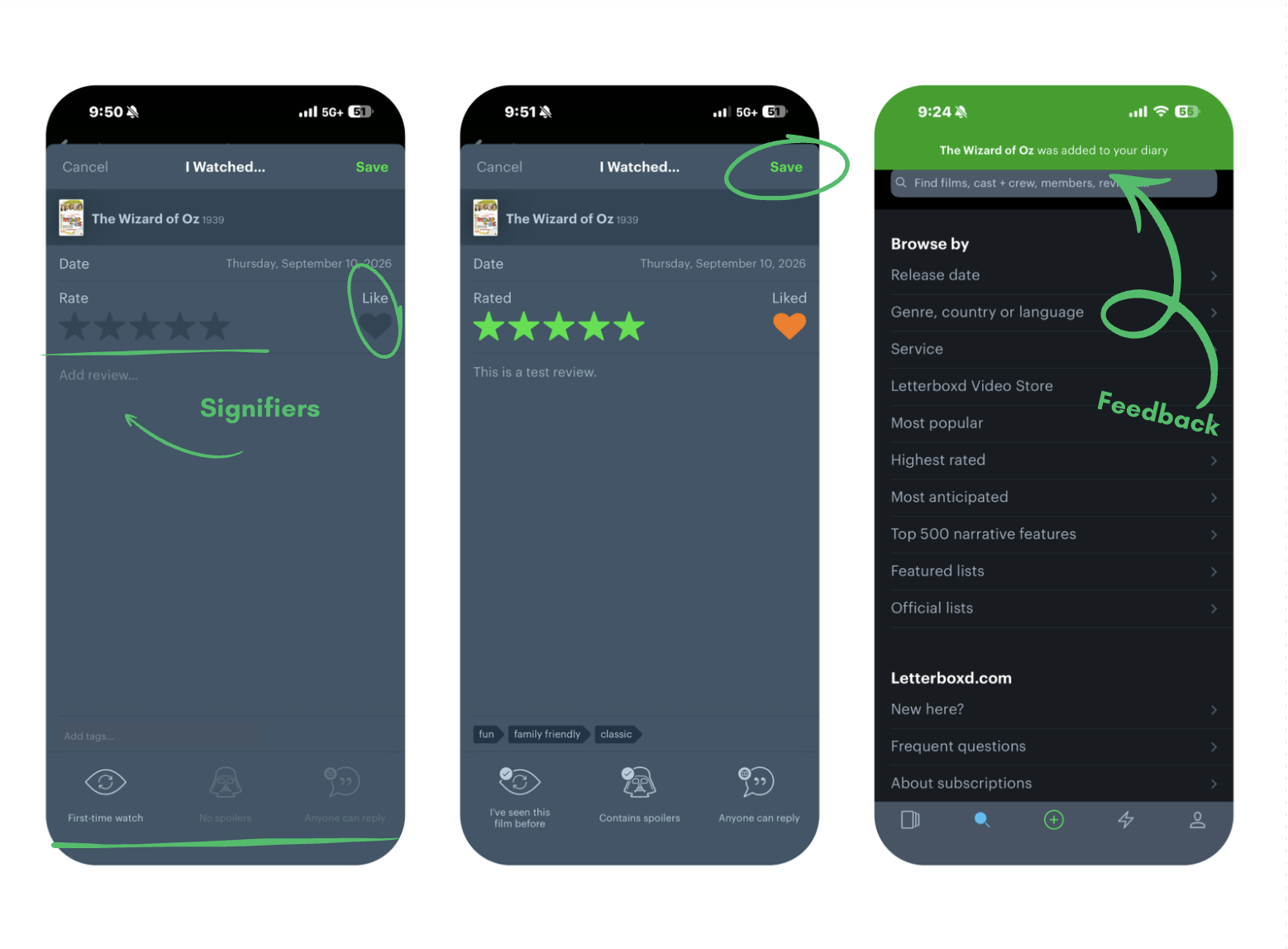
Furthermore, the review function is one of the most popular functions on Letterboxd. This can be reached either through selecting the desired movie or using the “Add” button on the bottom navigation bar. The review page is relatively discoverable for first time users, however users are overloaded with so many signifiers it can be difficult to understand where to begin. The most apparent signifiers are the “Add a review…”, “Like”, and “Rated”. Additional signifiers include the “Add a tag” and other buttons on the bottom of the page, though their actions are not as discoverable as the more apparent signifiers. To engage with these actions the user must know that when they are selected, the option changes. One suggestion to eliminate confusion and increase discoverability is to change the “First time watch”, “Contains spoilers”, and “Anyone can reply” to “Watched this before?”, “Review contains spoilers?”, and “Who can reply?” with functions to select yes, no, and the desired groups who can reply. This would increase discoverability and clear any confusion regarding these signifiers. Lastly, upon selecting save, users are prompted with clear feedback that their review has been saved and that it can be found in their diary.
Conclusion
Overall, Letterboxd is a well designed app that demonstrates Don Norman’s principles outlined in The Design of Everyday Things. Letterboxd’s user interface minimizes the gulf of execution between its users goals and the actions required to execute them. The homepage, search function, and review pages are very discoverable and well mapped, and while many signifiers are clear and intuitive others may need additional detail to provide clarity. Letterboxd is a user-friendly social forum for movie lovers to discover, search for, and rate and review films.