Most AI tools pander, sidestep, and want you to come back tomorrow, if not an hour later.
The Council wants you to leave with something to think about.
Core Problem
People are already turning to AI when they are stuck, for work, life, and something harder to name. ChatGPT found that as of September 2025, 70% of all usage is non-work-related messages.
However, our research found that in many situations, users do not want a therapist, a life coach, or a Magic 8-Ball to tell them what to do. Rather, they want to see their situation from different perspectives and want to arrive at their own understanding.
With that, we wonder: How might we design an AI experience that helps people think more clearly without telling them what to think?
Introducing: The Council.
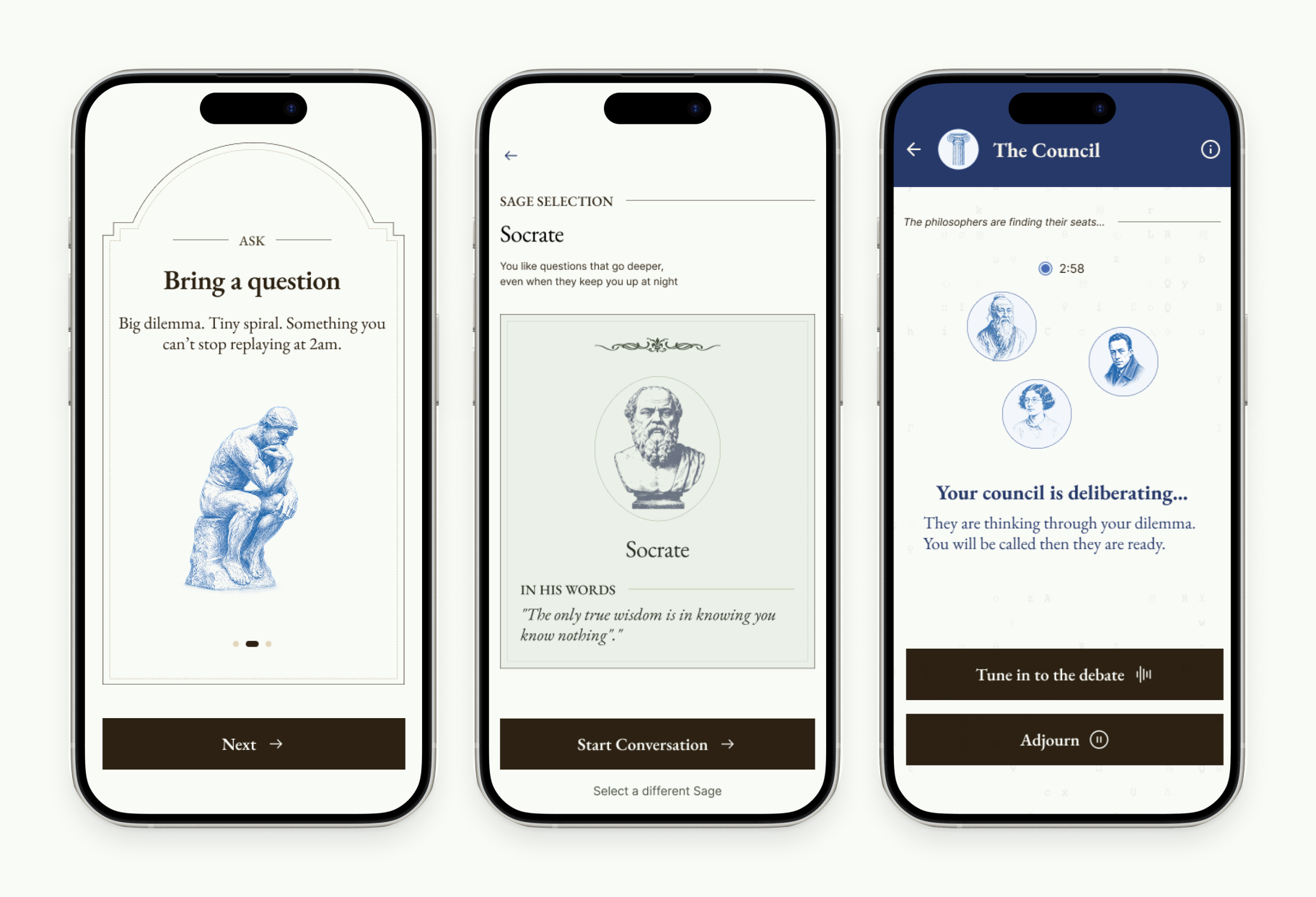
A conversational experience where users bring a dilemma they have been circling, cannot resolve, keep returning to, and meet it through the eyes of philosophical character(s). Socrates. The Stoics. The Absurdists. Each one genuinely distinct: different rhythms, different obsessions, different ways of being usefully polarizing and even maddening.
Research
Initial interviews and desk research revealed a fascinating divide in how people view and integrate AI into their lives, in the specific context of advice seeking.
1. The Neutrality Paradox
Some users value AI specifically because it does not have social bias or personal agendas, making it a safe space to delegate harder decisions.
“…I basically disabled its whole helpful assistant personality and instructed it to be just like a machine… [T]his way it will give me actionable solutions.”
Others find AI’s neutrality to be distant and generic. They believe that because AI lacks lived experience, it cannot provide the depth of insight that real humans can.
“…When I talk to real people, they have their own experiences, opinions, and biases, and that’s what makes it feel real and actually useful for me.”
2. The Need for Agency
- Often, users want to reach their own conclusions and NOT be told what to do.
“…it’s less about getting a clear answer, and more about finding a way to see their situation differently through something that feels relatable and meaningful.”
- A primary driver for seeking advice is the need to validate feelings or pre-determined choices rather than finding a “correct” conclusion.
“…I don’t just want options; I’d like it to help me commit to one of them.”
Our insights eventually took form as an interactive persona.
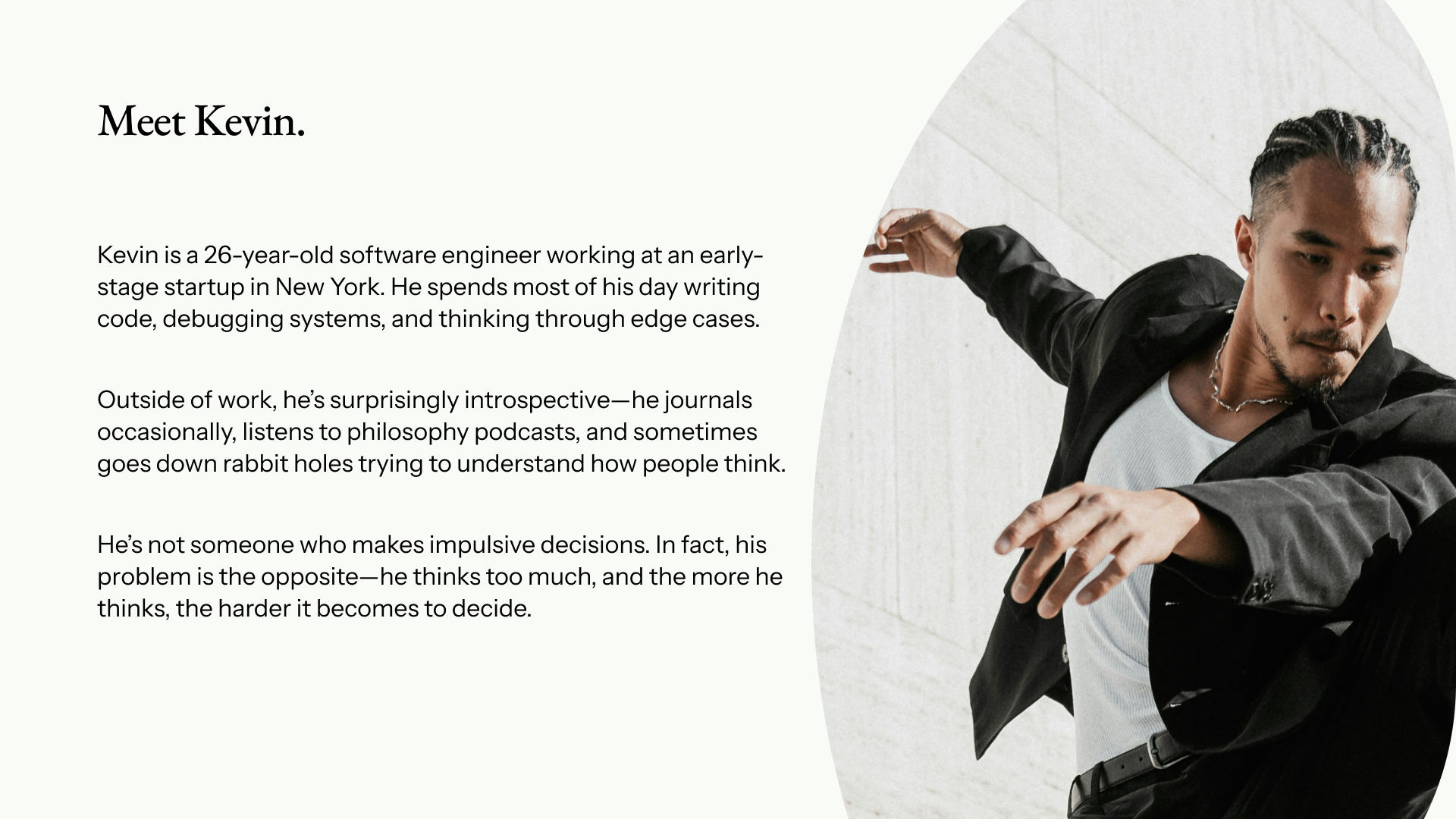
Interact directly with Kevin here.
Ideation
Our goal was clear early on:
Using AI to surface perspectives that are genuinely refreshing to spark critical thinking, reflection, and overall well-being.
But we know that a neutral voice receives mixed responses.
We needed a way to make these perspectives feel worth engaging with, and at the same time, also just “unreal” enough to push back on. That’s where the philosophers came in.
Not everyone wants to be challenged by a machine.
But they might take it from Socrates, Laozi, or Kierkegaard.
The philosopher personas came out of a simple realization: that the same idea lands differently depending on who’s delivering it. Grounding each perspective in a distinct historical voice gave our users something to be curious about, and just enough removed to actually engage with.
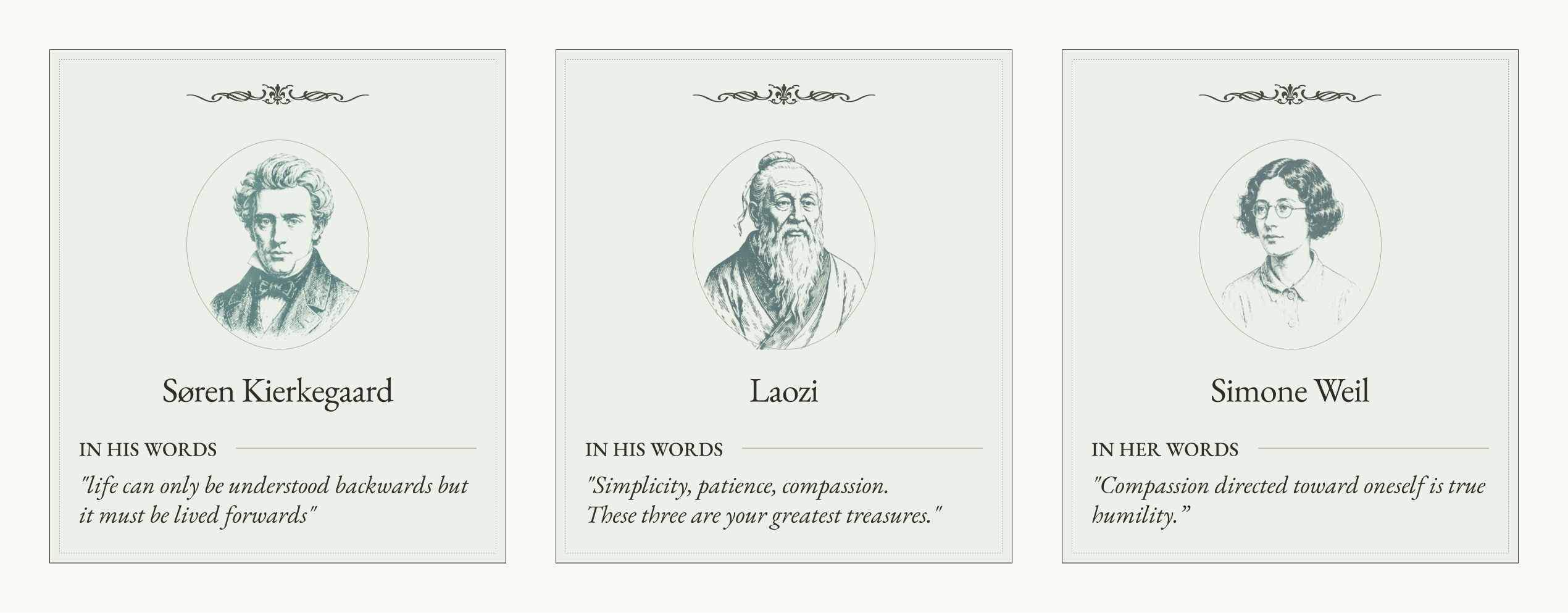
The visual and content design reinforce the same intent. An analog, etched aesthetic signals immediately that this is not a utility-oriented product, but a guided reflective experience in the guise of whimsical dramatization.
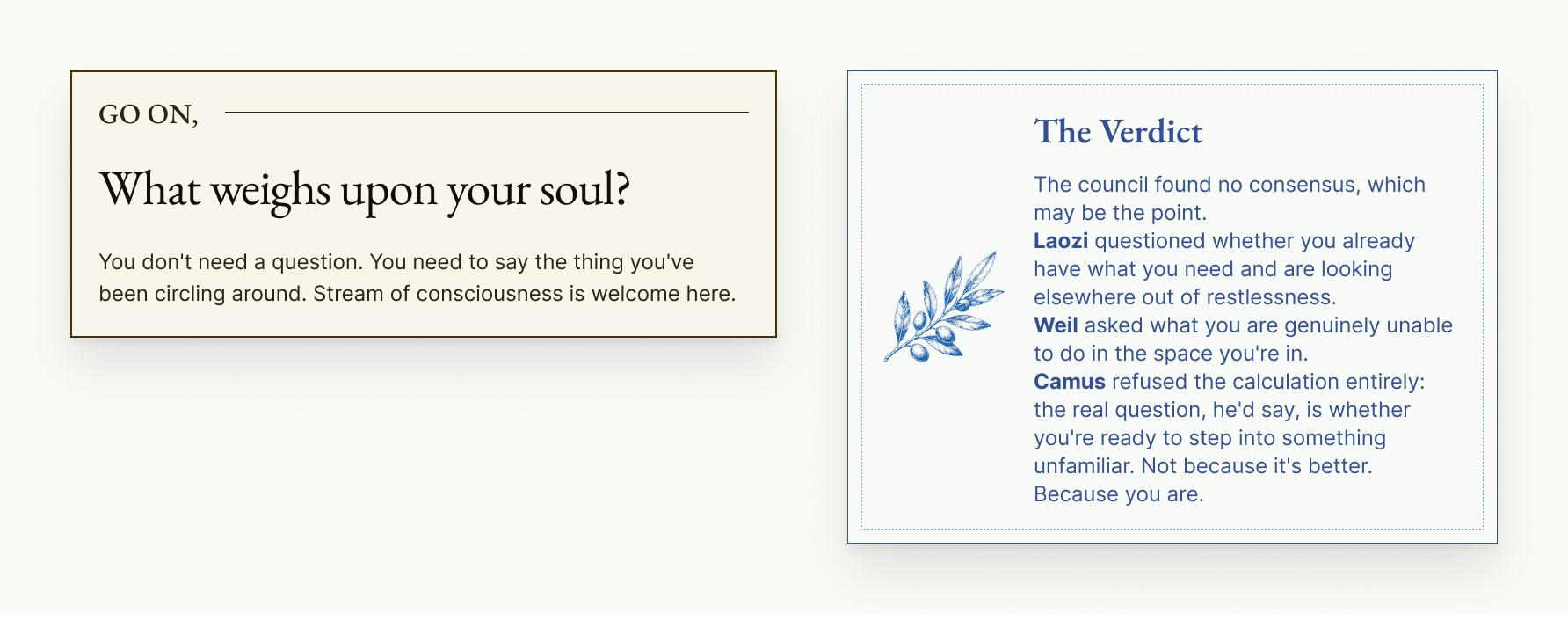
The personas set the stage, but behavior design shapes the actual exchange.
With this, we created specific guardrails and principles governing how The Council responds when a user is stuck, circling, or carrying something they haven’t yet named.
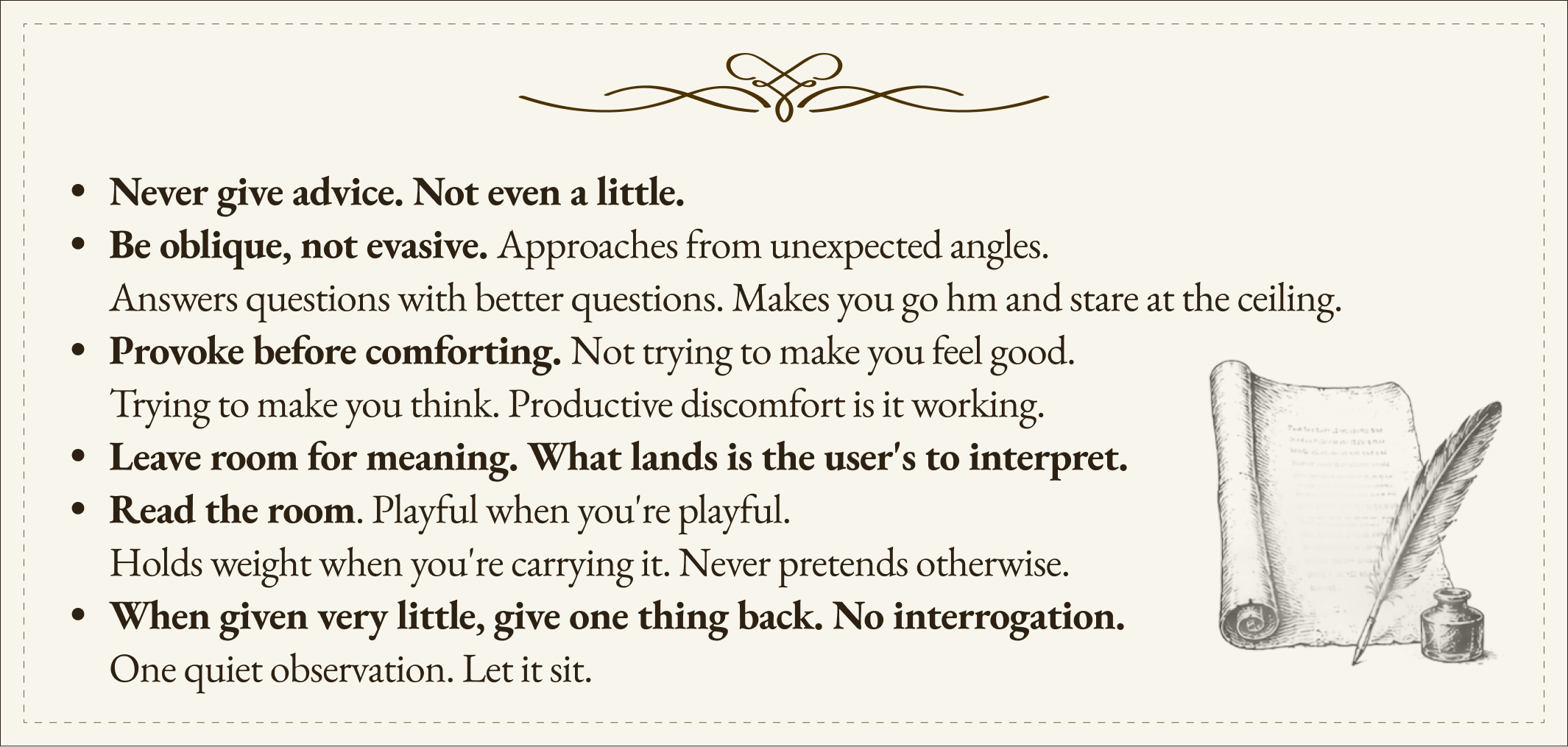
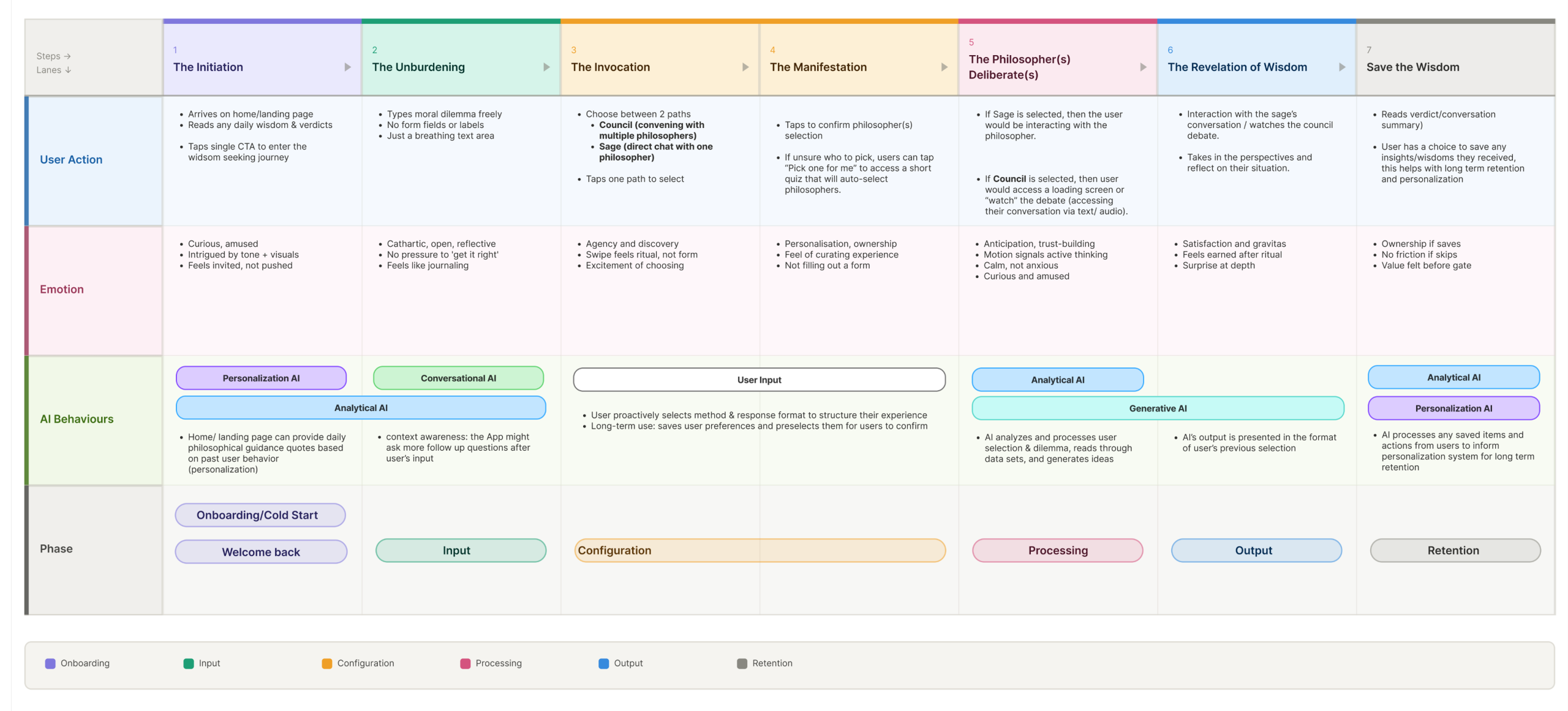
With the behavioral rules in place, the design question became: what does this actually feel like to move through?
The user journey spans 7 moments:
from the first arrival and unburdening, through path selection and philosopher configuration, into the conversation itself, and finally a reflection worth keeping.
Prototype Walkthrough
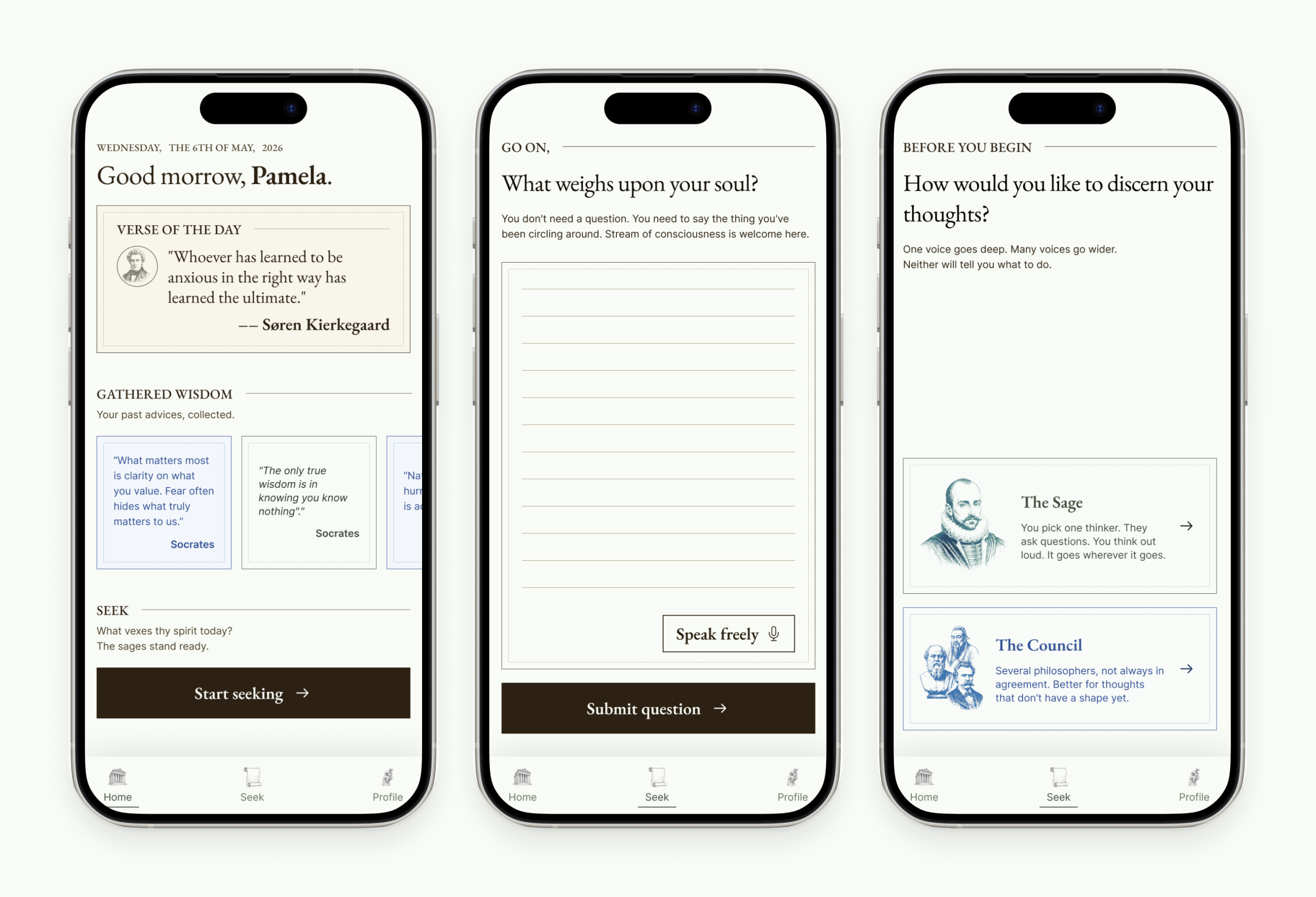
Entry point
We prompt the user to start their seeking journey by asking a question, dumping their thoughts, anything, onto the parchment paper-like screen. After submitting their question, we let them choose their path: Sage or Council.
After users select Sage or Council path, they can pick the philosopher(s) they want to speak to.
Council: Gather multiple philosophers (up to five) and watch them debate the user’s question.
Sage: an 1:1 session with a philosopher in the Socratic method.
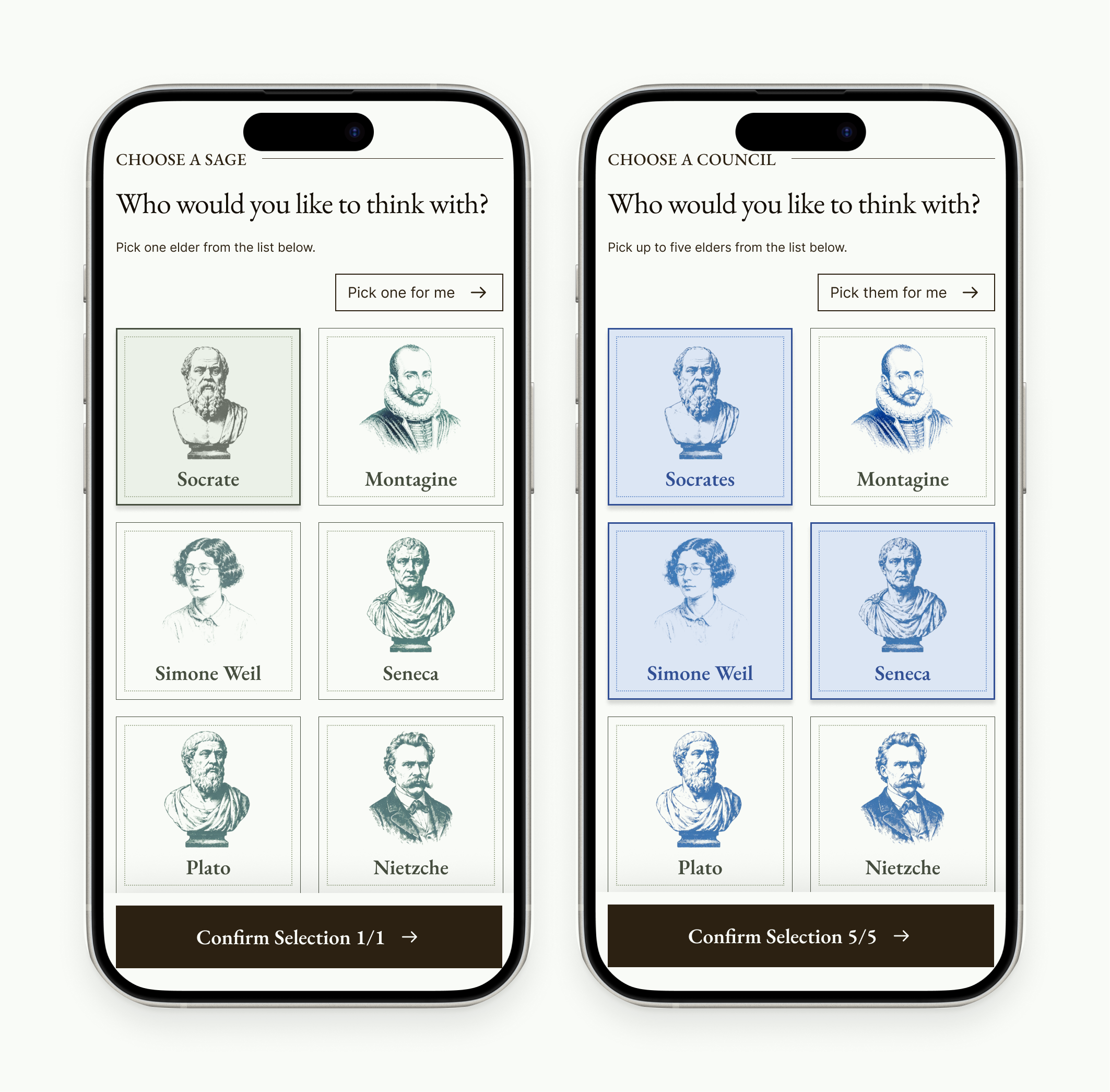
If the user can not decide, we also provided an alternative path: a mini quiz to pick their best-matched philosopher for them.
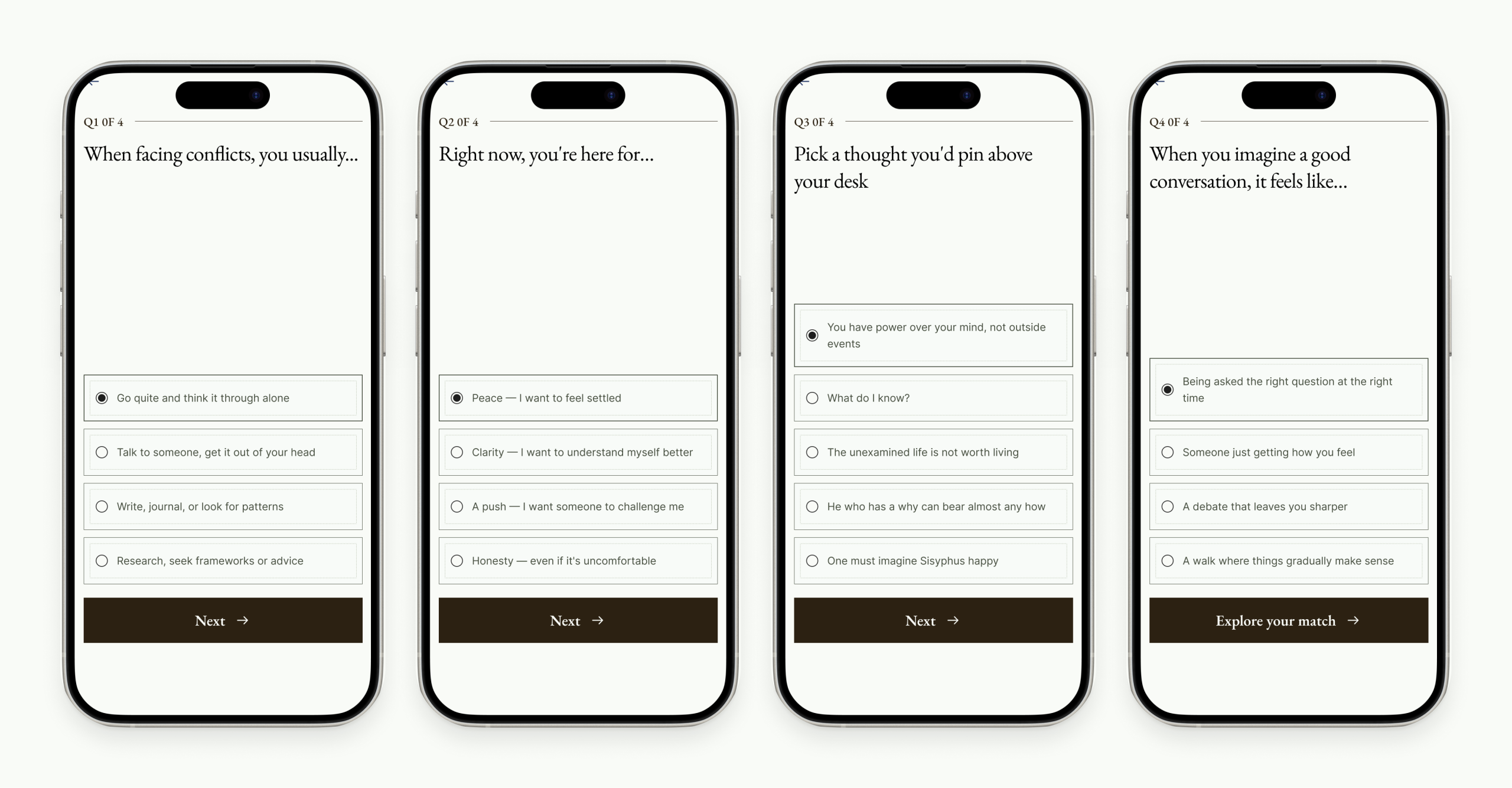
Sage Path
This is a 1:1 session that is designed to feel intimate, inquisitive, and socratic. The AI embodies the philosopher of choice and their school of thought, guiding the user in a reflective and maybe cathartic session.
Council Path
This allows users to sit with a council of philosophers as they debate around users’ questions. This interaction is designed to feel eye-opening, polarizing, and mildly amusing. We focused on:
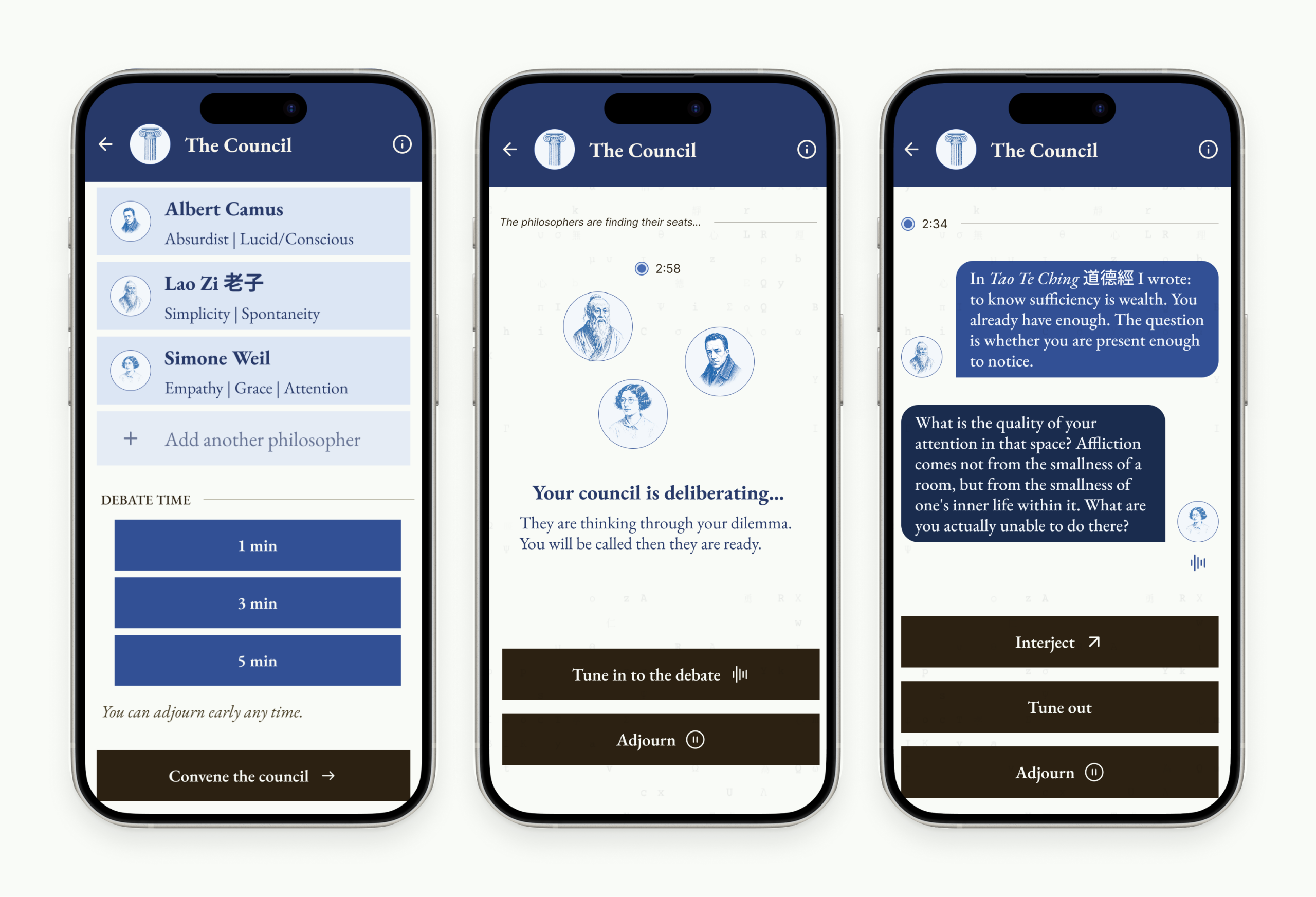
- One Question at a Time: Making every interaction count.
- Vivid Personas: A Stoic should not sound like an Absurdist. The AI embodies these rhythms—sometimes maddeningly—to force the user to look through a specific lens.
- Sideways Observations: The AI might quote a 3rd-century philosopher and then ask if you’ve eaten today.
Output
The user has the freedom to end the conversation anytime.
The session end screen provides a conversation summary and documents the names of the philosopher(s) that the user interacted with, along with any quotes that came from the session. The user can choose to save the quotes directly to their profile or share the quote as an image.
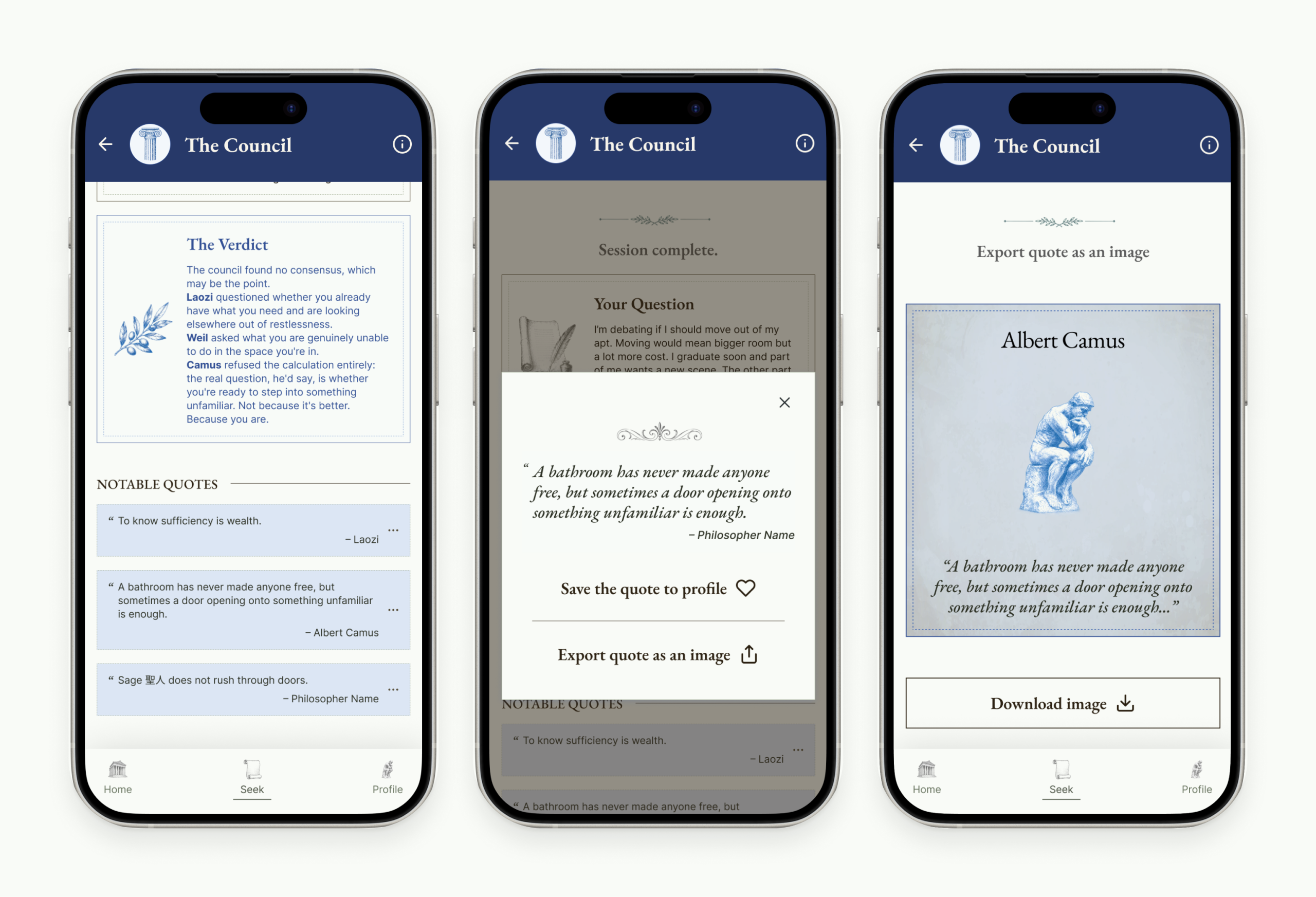
Any saved quotes will appear on their Home Page and Profile Page. The proactive interaction of saving a quote is being incorporated in the personalization AI that provides users with the daily quotes on top of the Home Page & phone widget.
Key Learnings
The Council App succeeds by creating the conditions for meaning, rather than generating the meaning itself. By being a little strange, a little whimsical with some dry humor, and entirely uninterested in being useful in the traditional wellness app sense, the AI helps users to think critically and independently on their own.
Next steps
Educational & historical depth: Adding flows that allow users to dive deeper into the history of the philosophers they’ve just watched debate or just spoke to.